

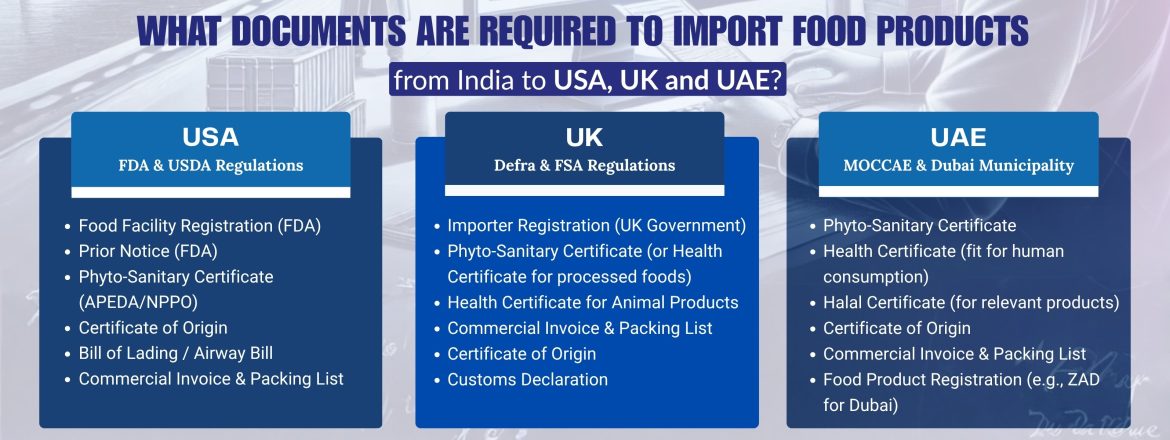
What Documents Are Required to Import Food Products from India to USA, UK and UAE?
Over the last ten years, international demand for Indian food exports has grown tremendously due to the increasing number of people from India living abroad (the Indian diaspora), changing preferences/consumption habits of consumers, and increasing interest in ethnic foods.
However, in importing food products from India to regulated markets like the United States, the United Kingdom and the United Arab Emirates; multiple regulatory systems exist which follow varying compliance frameworks and require extensive documentation to monitor compliance.
Despite their differences, all three countries require compliance with their respective regulations, and all three countries require safe, verifiable and documented products that are compliant with all applicable regulations regarding safety, product traceability, and transparency. As such, it is critical for importers to understand the documentation requirements necessary to facilitate a smooth customs clearance process and to avoid paying high costs due to delays with the customs clearance process.
Core Documentation for Exporting Food Products from India
It is imperative to comprehend the baseline documentation needed for the exportation of food products being exported to other countries prior to exploring individual countries’ specific requirements.
Essential Documents Needed For Exporting Food Products
- Commercial Invoice: This document provides information about transaction value, description of what is being sold, and who the buyer is, as well as the seller’s contact information.
- Packing List: This document will provide details on the total number of items, the total weight of items, and any other packing information.
- Bill of Lading / Airway Bill: This document can be used to confirm that shipment has occurred.
- Certificate of Origin: This document will serve as verification that the goods exported were actually produced in India.
- FSSAI Certificate: A document which confirms compliance with Indian Food Safety Regulations.
- Phytosanitary Certificate If Required: Only needed for plant based items can be issued.
All of the above documents will be the foundation documents for all international shipments of food products exported from India.
Documentation Requirements for Importing into the USA
In the U.S., there exists a comprehensive food safety system that operates under the auspices of the FDA. Below are five important guideline documents to consider when importing food into the United States:
Foreign Facility Registration with FDA – All foreign facilities which manufacture/process food for export to the U.S. must register with the FDA.
Prior Notification Submission to the FDA – Importers must notify the FDA of such prior to shipping to the United States.
Customs Entry Documents – Importers must submit the entry documents to U.S. CBP.
Bills of Lading and Invoices – Standard shipping documentation.
For businesses that engage in importing food into the U.S., strict compliance with the Food Safety Modernization Act (FSMA) is mandatory. This includes preventive controls and supplier verification programs.
Other Additional Requirements:
Label Compliance (Nutritional facts, Ingredients, Allergen information)
Inspection Reports (FDA may inspect food shipments at the time of arrival)
Organic Certification (if applicable) – Organic food products produced in accordance with USDA will require USDA organic certification.
If the above guidelines and additional regulations are not adhered to, the importing company may experience detention or refusal of their shipment, therefore it is imperative that all(importing) documentation be accurate.
Documentation Requirements for Importing into the UK
The UK has developed an independent regulatory system post-Brexit while still maintaining numerous EU-aligned specifications for product quality and absolute safety.
Key Import Documentation
- Import Declaration: Must be entered using HMRC’s online systems
- Health Certificate: Necessary for all animal Products
- Phytosanitary Certificate: Provides compliance for plant- based Goods
- Commercial Invoice and Packing List
In addition, businesses wanting to import into the UK are required, at a minimum, to comply with the requirements of the UK Food Standards Agency regarding food in the UK.
- Labelling And Compliance
- Product labeling must be displayed clearly in English
- Allergen declarations must be in English
- Expiry date must appear on the label along with appropriate storage instructions
Traceability is also an absolute regulatory requirement to provide traceability through the total supply chain of products being imported into the UK.
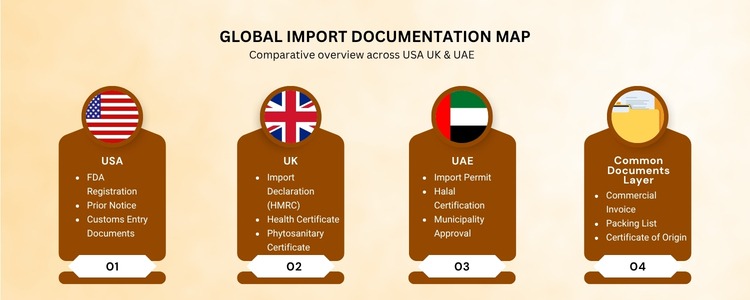
Documentation Requirements for Importing into the UAE
The UAE serves as a major trading hub for the Middle East, with a regulatory system designed to ensure food safety while facilitating trade.
Key Documents Required
- Import Permit: Issued by local authorities such as Dubai Municipality
- Health Certificate: Issued by Indian authorities
- Halal Certification: Mandatory for meat and certain processed products
- Bill of Lading and Commercial Invoice
For businesses planning to import food uae, registration with the local food control authority is often required before shipments can be cleared.
Labelling Standards
- Arabic labelling is mandatory
- Clear indication of ingredients and expiry dates
- Country of origin marking
The UAE places strong emphasis on cultural and religious compliance, particularly in relation to halal standards.
Special Considerations for Different Food Categories
UAE is a prominent trade center for the Middle East, supported by a regulatory framework, which aims to supervise food safety while allowing for trade facilities.
Some of the documents needed to import food into the UAE include the following:
- Import Permit – issued by the respective local authority (e.g., Dubai Municipality)
- Health Certificate – issued by your relevant Indian authorities
- Halal Certificate – required for meat and certain processed products
- Bill of Lading / Commercial Invoice
As part of the registration process to import food items, businesses may need to register with their respective local food control authority prior to clearing any shipments.
Labelling requirements are also strictly enforced in the UAE. Some of the specific labelling requirements include the following:
- Arabic Language (Mandatory)
- Ingredients List and Expiration Date Clear and Comprehensible
- Indication of Country of Origin
Halal Law is important to UAE culturally and religiously. Therefore, there is a significant emphasis on halal compliance in the UAE.
Customs Clearance and Inspection Procedures
Customs clearance represents a very important checkpoint because of the extent to which documentation is used to assess admissibility.
The steps to clearance include:
- The submission of an import declaration.
- The verification of documentation.
- The performance of a physical examination (if applicable).
- Payment of taxes and duties.
- Release of goods.
In developed markets like the USA, UK and UAE authorities will randomly or with a risk approach inspect documentation so that accurate documentation is a critical part of this process.
Common Challenges Faced by Importers
While there are processes that importers will follow; there are also many challenges during the clearance process that may disrupt the supply chain.
Common problems affecting the clearance process include:
- Deficiencies or inconsistencies related to documentation.
- Non-compliance with labeling requirements.
- Delays related to certification approvals.
- Variable interpretations of regulations.
For firms importing food into the USA, even the smallest deviation could trigger a hold on the shipment and therefore, it is essential to adequately prepare.
Best Practices for Smooth Import Operations
To achieve smooth imports, companies should take more of an active, systematic approach.
- Recommended Practices
- Establish relationships with seasoned exporters and logistics teams
- Stay up-to-date about regulations related to importing
- Perform pre-shipment inspections
- Standardize your documentation practices
Implement digital documentation systems to cut down on errors and improve efficiency.

Conclusion
The importation of food to the USA, UK, and UAE from India involves precise regulations and documented disciplines that provide a framework for all importing jurisdictions. While the specifics of the regulations will differ from country to country, the three underlying principles of safety, transparency, and traceability remain constant.
The key to success as an importer will be an understanding of the regulations in-depth, precise documentation, and strong partnerships with other entities in the supply chain. With demand for Indian food worldwide continuing to grow, those who effectively navigate these regulations and build strong collaboration between all parties along the supply chain will be in an advantageous position to take advantage of expanding market opportunities.

Diptanshu
Leading research and marketing at Inductus Global, Diptanshu drives the company’s vision to transcend traditional trading through thought leadership in import-export. He spearheads a research-driven approach that prioritizes quality over price arbitrage, positioning Inductus as a strategic sourcing partner rather than a transactional intermediary. His work spans market intelligence, supply chain innovation, and trade dynamics, while playing a key role in sales and business development.