

India's Pharmaceutical Export Expansion in 2026: New Markets and Product Categories
India’s pharmaceutical sector has entered a decisive phase of global expansion, marked by diversification in both markets and product offerings. Long recognized as the “pharmacy of the world,” the country is now recalibrating its export strategy to align with shifting global healthcare demands. In 2026, the momentum behind pharmaceutical export from India reflects not just volume growth, but a qualitative shift toward innovation, compliance, and market penetration.
The changing geopolitical landscape, coupled with post-pandemic healthcare priorities, has opened fresh avenues for exporters. At the same time, regulatory expectations and competitive pressures are pushing Indian firms to move up the value chain.
The Evolving Landscape of Indian Pharmaceutical Exports
The pharmaceutical industry in India is experiencing a turning point with its expansion around the world as it diversifies into new areas; both geographically and with respect to what products are available. Long considered “the pharmacy of the world,” India is reinventing its strategy for exporting products to meet changing global healthcare needs. By 2026 the growth trend with Indian pharmaceutical exports will not only be characterized by growing volume but also by moving toward greater innovation, higher standards of compliance and being more active in markets than previously.
The new geopolitical circumstances, coupled with healthcare’s new priorities following COVID-19 provide exporters with new opportunities. However, increased regulatory requirements and heightened competition are driving companies in India to add value to their existing products.
New Geographies Driving Growth
1. Africa: High-Potential Market
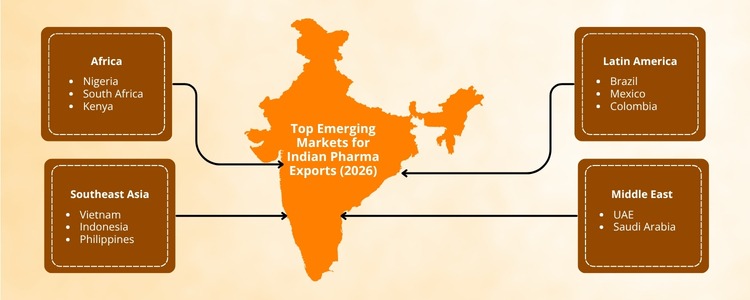
Africa is becoming an important market for Indian pharmaceutical companies’ exports. The healthcare systems are still limited in terms of necessity, but as they continue to improve, more and more people will require affordable medicine; hence, it would make sense for Indian firms to support this sector of the economy.
India continues to develop bilateral trade agreements with many African countries, which helps to streamline the regulatory process.
2. Latin America: Expanding Regulatory Horizon
As Latin America continues to open its market to Indian pharmaceutical companies, businesses such as pharma companies in Brazil, Mexico and Colombia are facing increasing scrutiny from the regulator. As they do face increasing scrutiny, more pharmaceutical companies from India have begun to invest and establish partnerships in-country to try and establish a presence within these markets.
3. Southeast Asia: Close Proximity & Strong Trade Agreements
The proximity to and existence of trade agreements between the nations of Southeast Asia makes it very desirable for Indian pharmaceutical companies to export to this region. Many Indian pharmaceutical products are being imported into the major Southeast Asian nations of Vietnam, Philippines and Indonesia. The majority of these Indian products are generic medications.
4. Middle East: Strong & Growing Demand
The Middle East is a strong market for Indian pharmaceutical companies. The demand for Indian pharmaceutical products continues to be strong due to both public sector healthcare providers and private sector healthcare providers. Many Indian pharmaceutical exporters benefit from existing trade relationships and logistical advantages.
Emerging Product Categories Reshaping Exports
The composition of exports is going through a major change. Although generics will still be the main type of exported product, there are new types of products being exported as well.
- Specialty and Complex Generics
There has been a noticeable change towards high-value generics such as injectables, biosimilars, and other complex forms of generic drugs. While these types of products are manufactured using higher technology and require more regulatory approvals to sell than traditional generics, they will also have a much higher profit margin.
- Active Pharmaceutical Ingredients (API)
India continues to improve its global supply capabilities for active pharmaceutical ingredients (API). Many global supply chains are looking for other sources as they attempt to diversify away from reliance upon supplies from just one country, creating an opportunity for Indian manufacturers to fill this void.
- Over-the-Counter (OTC) Products
The demand for consumer healthcare products, such as vitamins and health supplements, is increasing as more people trend toward preventive healthcare worldwide.
- Medical Devices and Surgical Products
More than just medicines, exports are now also going into other related product categories. The importance of surgical product wholesalers and surgical product suppliers is becoming increasingly important, especially in developing markets where an integrated healthcare solution is in-demand.
The Role of Supply Chain and Intermediaries
Efficient supply chains will only continue gaining Importance as export Markets keep Diversifying. Intermediaries in this process, such as Pharmaceutical Sourcing Agents, play an important role by bridging Manufacturers with International buyers.
They help manufacturers ensure compliance through Documentation and Negotiation, improving the efficiency of Trade Across Borders. Additionally, sourcing Services can also enable Smaller exporters access to global Markets Without requiring Significant in-house Infrastructure.
Another thing is that Reliable partners, such as Medical Equipment Suppliers, allow exporters to provide Whole solutions within healthcare rather than Just Standalone products.
Regulatory Compliance and Quality Assurance
More than any other aspect of India’s Growth of Pharmaceutical Exports, the Emphasis on Quality & Compliance Continuity is what Defines the Focus.
Global regulators such as the US FDA and EMA have Very Strictly Regulated all Enterprises, Which is why companies from India are spending Millions of Dollars on upgrading their facilities and Digital Quality Control Systems along with Traceability.
Compliance Has moved from being a Competitive Advantage to becoming an Entry-Level Requirement, and Exporters Will not have Entry into the Market if they Do not Comply.
Challenges in Sustaining Export Growth
There is some strong growth in the manufacturing of pharmaceutical products for export but there are also multiple obstacles to overcome:
Price Pressure
Global customers are seeking lower pricing particularly in the off-patent (generic) sector which puts pressure on margins.
Complexity of Regulation
Each country has its own set of rules for producing and selling pharmaceutical products and navigating those regulations can be costly due to the amount of time spent dealing with them.
Disruption of Supply Chain
The geopolitical landscape is volatile with tensions and trade routes being delayed due to congestion.
Increased Competition From New Entrants
Countries like China and Vietnam have developed capabilities to manufacture pharmaceutical products, resulting in increased competition from those countries.
Government Support and Policy Initiatives
The government of India has taken a number of steps to increase exports through the establishment of the following programs:
Production-linked incentive schemes
Export promotion councils
Trade facilitation agreements
These are meant to enhance the country’s manufacturing capability, reduce dependency on foreign goods, and make India more competitive with other countries.
In addition, the Indian government is using its diplomatic relations with other nations to open new markets and make it easier for its companies to conduct business there.
Strategic Outlook for 2026 and Beyond
Looking to the future, the predictions for India’s pharmaceutical exports are strong as a result of the growing demand around the world for pharmaceuticals and the development of new medicines based on cutting-edge research.
Exporters need to focus on four key strategic priorities in order to be successful moving forward:
- Developing new markets by reducing their dependence on traditional markets
- Investing in innovation and high-value products
- Using digital technology to make their operations more efficient and comply with all regulations
- Adopting sustainable business practices that meet or exceed international environmental standards
In the coming years, how well the industry balances its focus on quality or innovative product development with its ability to offer cost-competitive products to customers will determine the success of India’s pharmaceutical exports going forward.

Conclusion
The pharmaceutical export industry of India will change dramatically by 2026. The export market will no longer be driven solely by high-volume sales; rather it will undergo rapid growth to include a wider range of geographical locations and increasingly complex product types.
For purchasers and other organizations interested in this sector, there is strong justification to conduct business with Indian suppliers. By securing adequate elements of operational compliance, enabling cooperation among suppliers, and employing appropriate business concepts, India has positioned itself to become one of the most significant contributors to the global pharmaceutical supply chain.

Diptanshu
Leading research and marketing at Inductus Global, Diptanshu drives the company’s vision to transcend traditional trading through thought leadership in import-export. He spearheads a research-driven approach that prioritizes quality over price arbitrage, positioning Inductus as a strategic sourcing partner rather than a transactional intermediary. His work spans market intelligence, supply chain innovation, and trade dynamics, while playing a key role in sales and business development.