

Mustard Oil Export from India: Prices, Quality Standards, Top Exporters & Global Demand 2026
India’s long-standing position in the worldwide edible oil industry is well-known, with mustard oil having a unique place in Indian culture as well as a valuable culinary (and nutritionally) contribution. Mustard oil has also been experiencing positive momentum over the past few years with demand from both the Indian diaspora and the rising number of consumers outside of India who are becoming aware of the health benefits of consuming mustard oil leading to increased demand for mustard oil exports from India.
As consumer preferences change in the global marketplace toward more natural and traditional oils and supply chains continue to evolve, Indian mustard oil exporters are finding new prospects in many different regions. This article aims to provide a high-level analysis of the price dynamics, quality requirements, top suppliers of Indian mustard oil, and a long-term view of the global market for mustard oil through 2026.
Overview of India’s Mustard Oil Industry
India is currently one of the world’s largest producers of mustard seeds, which are primarily produced in Rajasthan, Uttar Pradesh, and Haryana, with the oil produced from this mustard seed being widely consumed in India, but also, as demand has increased, the exportation of mustard oil has also grown globally.
The mustard oil business has many large-scale manufacturing companies but is also made up of smaller traditional productions. The exportation of kachi ghani mustard oil from India continues to remain a strong product due to the method of cold pressing that is used to extract the oil, which preserves the inherent flavor of the oil, as well as its nutritional value.
Global Demand Trends for Mustard Oil
The consumption of mustard oil has expanded globally beyond just South Asia. Demand is increasing at a steady pace not only in South Asia but also in North America, Europe, and the Middle East.
Demand for mustard oil in the global marketplace is impacted by several factors, including:
- A growing preference for natural and minimally processed oils
- A growing awareness of health benefits associated with natural and minimally processed oils, including heart health and anti-inflammatory properties.
- Increasing numbers of people from the Indian and South Asian diasporas living in foreign countries.
- The growth of ethnic foods in the global food market.
The need for Indian mustard oil has resulted in increased trade within the Middle East, where a large expatriate community is a strong consumer.
Pricing Trends and Market Dynamics
Factors that influence pricing in the mustard oil export market include many variables such as the amount of raw material available, the cost of processing the raw material, and the amount of global demand for mustard oil.
Factors affecting pricing include:
- The production of mustard seeds and seasonal variations in mustard seed availability.
- The extraction and packaging processes.
- Freight and logistics costs.
- The variability of currency exchange rates.
In recent years, mustard oil prices have experienced moderate price fluctuations due to fluctuations in the global agricultural market and global supply chain issues. Despite these moderate fluctuations in pricing, many producers in India have been able to maintain their competitiveness by maximizing their efficiencies in production and supply chain management.
Quality Standards and Compliance Requirements
To export mustard oil, suppliers must comply with all global health-related regulations and quality control measures. Every country requesting an export may have its own specific set of rules that must be adhered to by suppliers prior to shipping their products.
An example of the above: if you are to supply Food Grade Mustard Oil to an International Market, there are several key factors that you should comply with when shipping. These will vary between countries, but for example, Food Safety and Health Certifications such as: FSSAI, ISO, HACCP and and:
- Product labelling (ingredients/nutritional values)
- Proper packaging to ensure continued product integrity throughout the shipping process
Suppliers typically engage an FDA registered 3rd party inspection company to inspect shipments, ensuring the oil is free from impurities and is safe for consumption.
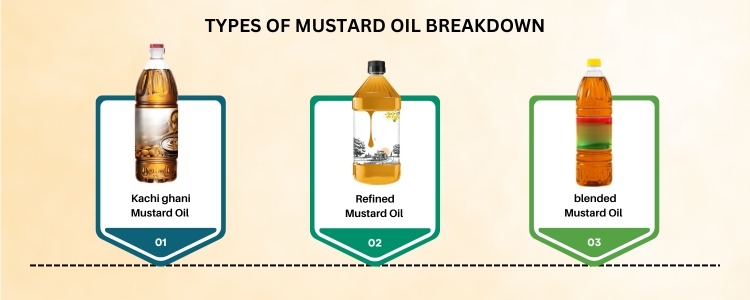
Types of Mustard Oil Exported
Indian suppliers/exporters continue producing and exporting different varieties of Mustard Oils to meet varying demands of consumers in other parts of the world;
1) Kachi Ghani Mustard Oil Is a more traditional method of processing (cold-pressing) which allows retention of the oil’s natural aroma, flavour, and nutrients; therefore making it the preferred product in higher-end markets.
2) Refined Mustard Oil Has undergone additional processing to remove impurities from the oil, as well as make it less pungent and more palatable to a larger base of consumers.
3) Blended Oils Some suppliers export both blended types of mustard oils; i.e.; blending mustard oil with other oils that are generally accepted in different parts of the world for specific needs.
Top Exporters and Supplier Landscape
The ecosystem from which we export product is very diverse; there are all kinds of suppliers within all kinds of areas that have established or start up practices. In addition to being able to supply the bulk buyer; the supplier has also had to create a retail product that meets regulatory requirements.
Characteristics of Leading Mustard Oil Exporters
Mustard oil suppliers are very successful in India as a result of:
- A sufficiently large domestic (India) production base to meet a variety of consumer demands
- They are able to produce according to international standards
- They have developed established distribution networks
- They are able to design and create customisable product packaging and branding
Exporting mustard oil requires a collaborative approach to distributor and retailer relationships in order to be able to continue to grow.
Supply Chain and Logistics Framework
Logistics play a major role in the management of product quality and time of delivery.
Logistics considerations will include the following:
- Packaging Formats (bulk, bottles, tins)
- Major Export Ports of Call (Mundra, Nhava Sheva, Kolkata, etc.)
- Shipping Type (containerized)
- Transit Times of 15 to 30 days depending on destination
Temperature control and proper sealing are required for the preservation of the oil’s quality during shipment.
Challenges in Mustard Oil Export
Exporting suppliers/exporters of mustard oil will have a number of challenges due to growing demand for exports.
- Regulatory restrictions: Some countries restrict mustard oil from importing due to concerns associated with erucic acid levels.
- Price volatility: The price of raw materials will be volatile and have an impact on the profit margin.
- Increasing competition from other edible oils: Oils like sunflower, soybeans and olive will become more common globally.
Ensuring quality consistency throughout the supply chain: Quality consistency will be critical to maintaining buyer confidence.
Opportunities and Future Outlook for 2026
The future of mustard oil exports appears bright, as a result of evolving consumption habits among consumers and as a consequence of continued expansion into new global markets.
Key to capturing these opportunities will be:
- The expansion of organic and cold pressed oils
- The Entry into non-traditional markets
- The increasing desire for Health-Based Products
- The creation of private label export partnerships
Exporters from India who focus on building quality, establishing an image through branding and adhering to regulatory standards will benefit from the current trends.

Conclusion
The continued growth in exports of mustard oil from India highlights India’s position as a rising force in the global marketplace of Edible Oils. With solid production capabilities, broad-ranging crops to offer and increasing compliance with international quality norms, India should be able to fulfil worldwide requirements for Edible Oils.
As we look to the future, exporters must continue to focus on quality control, understanding and complying with regulations, and being aware of changing consumer buying behaviours so that they can take advantage of the opportunities in the marketplace today and beyond 2026.

Diptanshu
Leading research and marketing at Inductus Global, Diptanshu drives the company’s vision to transcend traditional trading through thought leadership in import-export. He spearheads a research-driven approach that prioritizes quality over price arbitrage, positioning Inductus as a strategic sourcing partner rather than a transactional intermediary. His work spans market intelligence, supply chain innovation, and trade dynamics, while playing a key role in sales and business development.