

A Complete Guide to Exporting Pesticide Residue-Free Basmati Rice from India to the EU and UK
Introduction
What separates a successful Basmati rice exporter from one struggling with rejected shipments in Europe today? Increasingly, the answer lies not in pricing or volume, but in pesticide residue compliance.
Over the last few years, the European Union and the United Kingdom have tightened scrutiny around Maximum Residue Limits (MRLs), creating a more demanding regulatory landscape for rice imports. Exporters unable to meet these requirements risk far more than a delayed shipment. Rejected containers, damaged buyer relationships, regulatory scrutiny, and long-term reputational harm can quickly outweigh any short-term commercial gain.
However, this change is an opportunity, not a burden, for serious exporters and importers. Residue-free compliance has become a market filter that separates reliable supply partners from transactional traders. Buyers who can source and evaluate compliant Basmati rice gain a major competitive advantage in premium retail and foodservice markets
Shifting Towards Pesticide Residue-Free Basmati Rice
The movement toward pesticide residue-free Basmati rice is no longer driven solely by regulation; it reflects a broader evolution in global food sourcing standards
- Quality
First, quality is measured more and more, not claimed. European and UK buyers now expect laboratory verification of compliance with MRL requirements established under EU food safety regulations and corresponding UK food standards frameworks. In many procurement discussions, residue reports must be reviewed before commercial negotiations.
- Certifications
Certification is equally important, too. Documentation issued through APEDA, the Export Inspection Council (EIC) and recognized organic certification systems such as NPOP (India Organic) and EU Organic equivalency programs help facilitate smoother customs clearance and build buyer confidence. Certifications are verification instruments that underpin product claims throughout the supply chain.
- Organically Grown
It is also important to distinguish between organic and residue-free rice. Residue-free Basmati that meets residue levels can be achieved through controlled agricultural practices while certified organic rice has stricter production standards and certification requirements. This distinction has a direct impact in pricing, branding and retail positioning across European markets.
- Brand Recognition
Finally, sourcing practices are increasingly linked to brand reputation. Now, food safety compliance is a shared responsibility of importers, distributors and retailers. Customers are therefore selecting suppliers based on the quality of the products, but also on the credibility of their cultivation and monitoring systems.
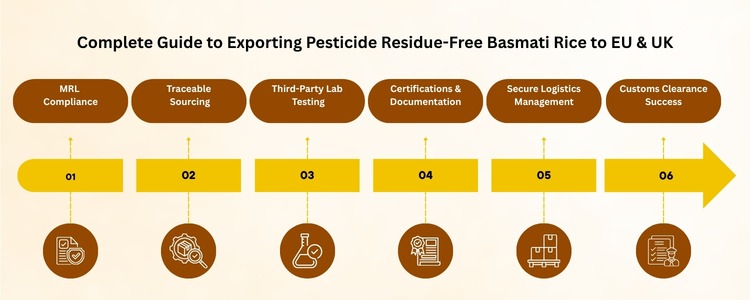
Guide to Export Pesticide Residue-Free Basmati From India to EU & UK
- Finding Reliable Exporters
The first decision point is supplier selection. Many exporters offer competitive quotes, but fewer can show complete traceability. Buyers should ask for recent residue analysis reports and check if the sourcing comes from monitored farm clusters. An exporter who cannot identify cultivation locations, farming practices, or provide batch-specific documents poses a serious compliance risk. Reliability today is measured through traceability, not brand visibility.
- Quality Verification & Lab Tests
After that comes the quality verification. Each batch must be fully tested for pesticide residues, moisture content, and contaminants such as aflatoxins before shipping. Thus, reports from NABL-accredited laboratories in India or other recognized testing facilities hold greater significance for customs and commercial buyers. One of the most common mistakes is to use old reports. A test made months before shipment provides limited assurance because the conditions of storage, handling, and source may have changed.
- Logistics Supply Movement Check
Logistics management needs equal focus. Many compliant shipments face problems because contamination happens after processing. You should check container cleanliness, fumigation history, moisture-control measures, and packaging integrity before loading. A residue-free status loses value if product quality drops during transit. Importers must also get ready for regular inspections at major European entry points like Rotterdam and Hamburg, as well as UK ports including Felixstowe and Southampton, where they may conduct documentation and physical checks.
- Contracts & Legalities
The structure of contracts is the last line of defense. Purchase agreements should specify acceptable residue limits, documentation requirements, testing protocols and liability clauses. Residue failures can reduce disputes if problems arise after shipment. Penalty clauses for FOB and CIF responsibilities disputes frequently cause operational and financial problems, so Incoterms must be precisely stated. Proper classification of HS codes is also key to avoiding customs delays and surprises with duties.
Viewed collectively, these measures create a compliance framework designed to reduce risk before cargo reaches its destination rather than attempting to resolve problems after arrival.
Differentiating between Conventional & Non-conventional Basmati Rice Suppliers: Better Decision Making for EU and UK
In the current Global scenario, most countries are switching to food that prioritises health, EU and UK buyers are increasingly switching to new buyers that guarantee pesticide residue-free, Basmati. Non-conventional suppliers generally rely on Integrated Pest Management (IPM), residue-monitoring programs, controlled farm clusters or organic cultivation practices that emphasize compliance from the field level upward. As regulatory oversight increases, these suppliers are often better positioned to meet buyer needs, reduce customs headaches, and establish lasting sourcing relationships.
| Parameter | Conventional Suppliers | Non-Conventional Suppliers |
|---|---|---|
| Pesticide Use | Standard chemical pesticide regimes | Residue-monitored, IPM-based farming |
| MRL Compliance | Frequent borderline or failed results | Consistently within EU/UK MRL limits |
| Lab Documentation | Often outdated or inconsistent | Recent, traceable, third-party verified |
| Customs Clearance | Higher risk of delays or rejection | Smoother, faster clearance history |
| Buyer Trust (EU/UK) | Price-driven relationships | Long-term, traceability-driven contracts |
| Premium Positioning | Commodity-tier pricing | Access to premium & organic shelf space |
The commercial reality is straightforward: the price gap between conventional and non-conventional sourcing continues to narrow, while the financial consequences of shipment rejection continue to rise.

Conclusion
The growing trend of pesticide residue-free Basmati rice is not just a matter of compliance, but a harbinger of the direction of international food trade. It is unlikely that the EU and the UK will loosen their regulation. Standards will likely be stricter and more closely monitored in the future.
As this evolution proceeds, the market will further polarize between suppliers able to demonstrate traceable compliance and those unable to meet rising buyer expectations. For importers, this means looking at partners through a risk management lens, not just a pricing lens. For exporters, it means investing in traceability, testing, and transparent documentation as fundamental business capabilities.

Pratibha Soni
I write where strategy meets storytelling. As a passionate writer and literary enthusiast, I craft business-focused content that transforms trading insights into compelling narratives. Drawn to global business ecosystems, I enjoy turning research, innovation, and ideas into content that informs, connects, and inspires. With an analytical mind and a creative soul, I bring curiosity, collaboration, and a sharp eye for detail to every project. Adaptable and growth-driven, I believe the right words do more than communicate; they leave an impression.