

Budget 2026 Benefits for Exporters: Tax Breaks, PLI Schemes, and Export Incentives
Why is Budget 2026 Critical for India’s Export Community?
In light of both the structural shift occurring in global commerce today and the increased geopolitical factors influencing how countries trade with each other, many benefits provided to exporters under the 2026 budget were structured to solidify India’s image as an export/manufacturing centre in the face of these challenges.
The budget does not rely solely on headline incentives; however, it uses a layered method by providing fiscal support, creating a policy of continuous support from one year to the next, and providing direct support to various industries that will allow exporters to continue expanding their businesses over the coming decade.
What Tax Measures in Budget 2026 Support Exporters Directly?
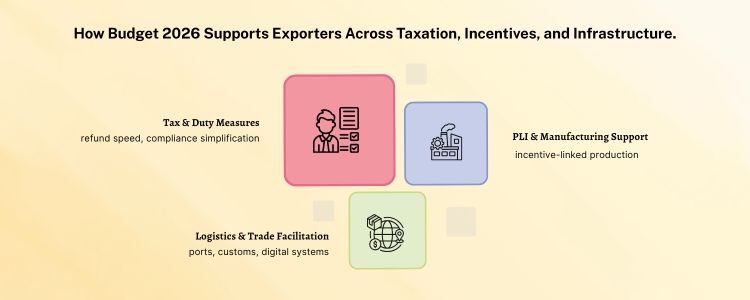
One way that governments control export behaviour is through tax policies. Budget 2026 will selectively rationalise direct & indirect taxes, providing relief and reducing operational pressures on companies whose main business is exporting.
Some of the specifics include shorter timelines for refunding indirect taxes, and simplifying compliance requirements for smaller exporters. All of these improvements will alleviate the blockage of working capital – an issue that has historically impeded the creation of new export businesses, in particular by small & medium-sized companies. In addition, there is a new emphasis on predictability & administrative efficiency as opposed to aggressive concessions that have generally been offered in the past, which is consistent with global best practices.
The calibrated tax relief for exporters in this budget will support improved cash flow, and help to ensure that the normal market pricing mechanism is not distorted.
How Does Export Duty Rationalisation Improve Competitiveness?
Export duties will, if misaligned with the realities of the market, penalise value-added exports inadvertently. Budget 2026 addresses this issue by selectively recalibrating duties on some key raw materials & intermediate goods, so that domestic manufacturers are not at a disadvantage when competing with their global competitors for export business.
The government recognises that competitiveness is influenced by both factor costs and the level of incentives received post-export. The government hopes to support both domestic availability & the ability to compete globally in certain sectors where India is emerging as a global leader by providing targeted export duty relief as part of Budget 2026.
What Role Do PLI Schemes 2026 Exports Play in Long-Term Growth?
The PLI framework remains a key tenet of the government’s industrial strategy. PLI schemes currently have a reduced view of simply creating production capacity (rather than just having it) and instead will focus on the performance of export-linked outcomes through PLI export schemes 2026.
A variety of sectors are getting renewed focus under PLI; these include exports of electronics, pharmaceuticals, renewable energy components and advanced manufacturing processes. Incentives for exporters will increasingly be based upon their incremental exports, depths of localisation and relative levels of technology being used, rather than simply upon volumes that will be produced.
As a result of this evolution, PLI will be able to create measurable export capacity levels that will provide the underpinning for India’s integration into global value chains, as opposed to simply enabling companies to produce only to an inward-oriented domestic market
How Does PLI Scheme Expansion 2026 Address Sectoral Gaps?
The budget’s PLI scheme for 2026 (which also has an expanding scope) is particularly noteworthy given it is designed for industries that can export, but have limited size / scale and capacity, and once this aspect of PLI has been accomplished, the incentive will extend to companies downstream and ancillary to manufacturing. This will allow the entire ecosystem related to the manufacturing industry to be strengthened rather than just being a singular manufacturer.
The creation of these ecosystem-based incentives for manufacturers will reduce dependence on imported materials, increase manufacturing cycle times and enhance product quality for exporters. Over time these systemic changes are anticipated to result in exporters having greater pricing power and establish long-term buyer confidence.
How Does Budget 2026 Encourage MSME Export Participation?
Micro, small, and medium enterprises remain the backbone of India’s export economy, yet they are often the most vulnerable to policy complexity. Budget 2026 simplifies export credit access, enhances guarantee coverage, and expands digital facilitation platforms.
The intent is to lower entry barriers for first-time exporters and reduce compliance friction for existing ones. These measures directly support Budget 2026 export growth by broadening the exporter base rather than concentrating benefits among large firms alone.
What Incentives Address Infrastructure and Logistics Constraints?
Overall, the ability of a nation to compete internationally depends upon its factories being productive (efficient) but also on how reliable the logistics (distribution systems) are. Budget 2026 continues to provide funding for upgrading ports, developing multimodal connections, and modernising/digitalising customs procedures.
Although these amounts may not show up as direct incentives for exporters, they will have significant effects. By providing faster clearance times through reduced delays at ports, predictable clearing times through predictable practices, and improved connections between ports and production facilities (“hinterlands”), the costs that exporters incur to perform their business will be lower due to the increased level of efficiency. For exporters whose businesses operate on very narrow profit margins, efficiency gains created by these investments will produce larger financial benefits than would be available from grants or other forms of direct financial assistance.
How Does the Budget Balance Incentives with WTO Compliance?
In the current global trading environment where there are ongoing disputes specifically related to export subsidies, Budget 2026 takes a conservative approach. Export support will increasingly be based upon the two principles of helping with production efficiency, enhancing or making support available for infrastructure development, and tax neutrality versus using direct export related subsidies.
Aligning with the multilateral rules of trade will maintain a level of policy certainty, which decreases/reduces the risk of retaliatory actions. For the exporter, having the assurance that part of their export incentive package will not be taken away suddenly as a result of foreign government pressures will give them greater confidence in making business decisions
What Does Budget 2026 Signal About India’s Export Strategy?
Beyond measuring the response of each individual measure to the Budget as a whole, the Budget reflects a more strategic approach to the Indian export sector where the emphasis will be on ‘scale’ with ‘sophistication.’ The aim is to move ‘up the value chain’ while maintaining competitive cost structures.
In aligning fiscal policy with industrial incentives and increasing levels of infrastructure investment, the Budget 2026 creates a platform for exports to be a key driver of ‘economic resilience.’ The Budget sends a clear message to the global marketplace: India is seeking not simply ‘volume’ but a higher degree of ‘integrity’ into the world’s high value trade networks over the long term.

1. Who benefits most from Budget 2026 export measures?
Manufacturing exporters, MSMEs, and firms integrated into global value chains stand to gain the most.
2. Are the tax benefits permanent?
Most measures focus on simplification and refunds rather than temporary concessions, suggesting durability.
3. How do PLI schemes support exports specifically?
Rail and coastal shipping are economical for bulk volumes; road transport suits smaller consignments.
4. Does Budget 2026 help first-time exporters?
Yes, through simplified compliance, credit access, and digital export facilitation.
5. Are service exporters covered in Budget 2026?
While manufacturing is central, logistics and digital trade facilitation also support services indirectly.
6. Will these measures impact export costs immediately?
Some benefits, such as faster refunds, are immediate, while others yield gains over the medium term.

Diptanshu Anand
Leading research and marketing at Inductus Global, Diptanshu drives the company’s vision to transcend traditional trading through thought leadership in import-export. He spearheads a research-driven approach that prioritizes quality over price arbitrage, positioning Inductus as a strategic sourcing partner rather than a transactional intermediary. His work spans market intelligence, supply chain innovation, and trade dynamics, while playing a key role in sales and business development.