


India vs Bangladesh: The Ultimate Apparel Sourcing Comparison
Apparel sourcing is an integral part of the global fashion landscape that determines the competitiveness of international retailers and, ultimately, their profitability. India and Bangladesh are two of the more significant fast fashion sourcing countries; they have both invested heavily to be respected sourcing destinations. They are both reputable sourcing markets but still differ across several factors (production values, costing and cost structures, compliance requirements and structures, supply chain integration, etc.). When faced with either of the two options for garment sourcing, a global fashion sourcing firm is not merely looking at geography; they are making a strategic choice, an important one that can impact the brand’s position and margins.
This article will provide a comparative assessment between garment sourcing in India and Bangladesh, examining their advantages and disadvantages to help inform decision makers.
The Rise of South Asia in Apparel Sourcing
South Asia has gained prominence as the epicenter of affordable fashion. As wages began to rise in our historic garment centers like China, global retailers looked to India and Bangladesh. Bangladesh’s low-cost manufacturing approach attracted the fast fashion companies, while India utilized its rich textile legacy and broad capabilities.
Cost Advantage: A Closer Look at Garment Manufacturing
For sourcing professionals, one of the top considerations is garment manufacturing cost.
Bangladesh enjoys a significant advantage in cost. Wages are still the lowest in Asia, making for a compelling argument to produce mass-market clothing there; international fast-fashion chains such as H&M and Zara depend heavily on Bangladesh’s well-established mass production factories.
In comparison, India enjoys higher labor costs. However, India offers greater productivity per worker and many more value-added products, from embroidery to technical textiles.
As such, Bangladesh is great for larger and lower-price orders, and India is better for higher-value and differentiated apparel.
Apparel Sourcing Quality Comparison
Quality is still a key differentiator. A comparison between the two markets for apparel sourcing revealed a very different take on quality:
- India: Wide variety of artisanal quality, natural fibers, and finishing capacities. Indian suppliers service brands targeting premium products with sustainable varieties and distinct aesthetics.
- Bangladesh: Excellent with standardized production at a bulk scale. After the Accord and Alliance compliance programs, the quality has improved substantially; however, widespread perceptions of Bangladesh remain anchored to the basic garments like T-shirts, jeans, and knitwear.
For retailers or brands that are trend-sensitive and fashion-forward with their lines, India is usually the more favorable option; Bangladesh will always be the backbone for essential basics.
Infrastructure and Supply Chain Readiness
Infrastructure is a deciding factor for reliability in global sourcing.
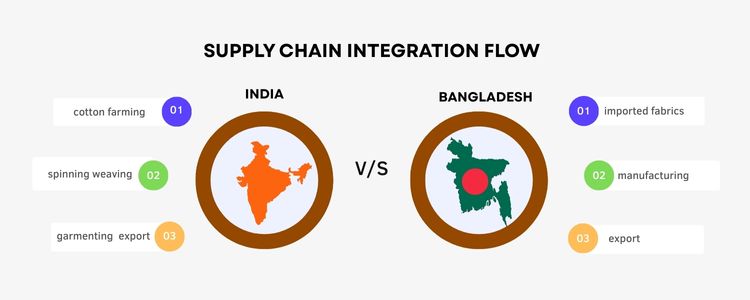
- India boasts a complete textile value chain from cotton cultivation to finished apparel within its borders. This vertical integration reduces dependency on imports and allows shorter lead times.
- Bangladesh, on the other hand, relies heavily on imported raw materials, particularly fabrics from China and India. This dependence sometimes elongates lead times despite its cost advantages.
For a global fashion sourcing company looking for agility and reduced inventory risk, India offers greater flexibility.
Compliance, Labor Practices, and Sustainability
The fashion industry globally has come under great scrutiny for its social and environmental impact. In particular, Bangladesh has been heavily criticized for past industrial accidents, such as Rana Plaza. Although significant progress has been made in improving building safety legislation and worker welfare in Bangladesh, there remains significant reputational risk.
Under Indian labor law, labor laws are tougher, and there are multiple compliance certifications, particularly in export-focused clusters like Tirupur and Noida. Moreover, India’s commitment to organic cotton and sustainability and eco-friendly textiles is closely aligned with the sustainability objectives of Western retailers.
It is possible that brands that are working to create an ethical and sustainable identity could find India is more in line with their values.
Wholesale Apparel Suppliers and Buyer Ecosystem
Sourcing options through a wholesale channel of apparel suppliers allows for adaptability in shifts in orders. Bangladesh is limited by large factories that service a global order base, which typically takes flexibility out of the equation for small or mid-market buyers.
India has a wealth of options-from small boutique manufacturers to large exporters that help sourcing companies customize supplier identification and selection according to your brand’s needs.
In short, India is set up for both luxury and mass-market players.
Logistics and Trade Agreements
Trade agreements and logistics also impact sourcing decisions:
- Bangladesh has the least developed country (LDC) status, giving it duty-free access to the European Union under Everything But Arms (EBA), which is an advantage in the EU market.
- India is not an LDC, but it has useful trade relationships formed with the US and is also working on regional agreements. Its deep, developed ports and improving logistics also enhance supply chain efficiency.
Technology Adoption and Industry 4.0
The future of sourcing is about the integration of technology: India is at the forefront of all automation, CAD systems, and digital printing. It is becoming increasingly strong in high-tech fabrics and smart textiles.
Bangladesh has some forward momentum, but they are still significantly behind India in terms of technology adoption. There is a strong focus on scale rather than innovation.
For brands thinking of digital integration in the long term, India provides a better roadmap.
Case for Bangladesh: Strength in Scale
Bangladesh’s central advantage is in its scale. With large industrial groupings in Dhaka and Chittagong, Bangladesh can produce millions of units at a low cost unlike any other place. For fast fashion brands that are focused on speed and scale, this still represents a significant advantage.
Case for India: Strength in Diversity
India’s diversity is its strength we have diversity in fabrics, designs, supplier capabilities and don’t forget the diverse abilities of our manufacturers. India has all forms of organic cotton in Gujarat and silk in Karnataka, technical sportswear in Tamil Nadu etc- you will find all these products in one country with unmatched variety.
Final Verdict: A Strategic Balance
There may not be one definitive answer to the question of garment sourcing in India vs Bangladesh. The answer will depend on strategic priorities:
- For cost-conscious basics, Bangladesh is the clear winner.
- For premium/sustainable/full range diversification sourcing, India is the better option.
- For balanced sourcing strategies, a lot of brands use a combination of the two and feature Bangladesh for the bulk and India for specialty collections.
- For a global company sourcing fashion, the most practical approach is a dual sourcing model, benefitting from Bangladesh’s cost effectiveness while utilizing the quality and flexibility of India.
Conclusion
The contrast between India and Bangladesh exemplifies a larger truth: apparel sourcing reflects much more than cost; It also reflects the suppliers’ capabilities and fit with the brand strategy. Sourcing professionals will be needed to place long-term vision ahead of short-term savings as the fashion sector moves toward sustainability, agility, and digitization.