

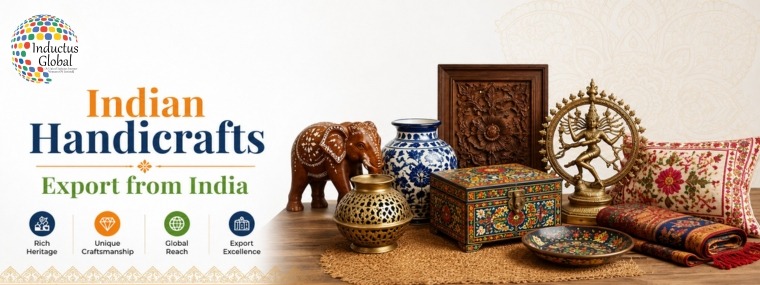
Indian Handicrafts Export from India: Process, Compliance & Cost Insights
Into India's Vast Handicraft Market
What if the most globally traded “Made in India” product isn’t software or pharma, but a hand-carved wooden bowl from Saharanpur? It sounds counterintuitive until the numbers speak for themselves. India’s handicraft exports reached Rs. 33,122.79 crore (US$ 3.72 billion) in FY25, with momentum carrying into FY26.
This is not a cottage industry footnote, it’s a quietly massive export economy hiding in plain sight, built on 318 GI-tagged products and 455 formally classified craft categories. From Moradabad’s metalware to Jaipur’s blue pottery to Channapatna’s lacquered toys, India’s clusters form a decentralized manufacturing network few countries can replicate. For B2B buyers, this scale isn’t just impressive, it’s an invitation to look closer.
Why Indian Handicraft Stand-Out?
Indian handicrafts don’t compete on price. They compete on a story buyers can resell. Four things set them apart.
- Heritage craftsmanship — GI-tagged products and techniques passed down for centuries give every piece provenance, not just production value.
- Material diversity — from terracotta to brass to natural fibers, India’s category breadth lets buyers source an entire home decor catalog from a single origin market.
- Sustainability appeal — handmade, low-carbon-footprint manufacturing aligns naturally with the ESG narratives Western retailers are racing to satisfy.
- Customization capacity — artisan clusters can fulfill bespoke, low-MOQ orders that mass manufacturers simply won’t touch.
Find another origin market offering all four simultaneously. It’s a short list, and India sits at the top of it.
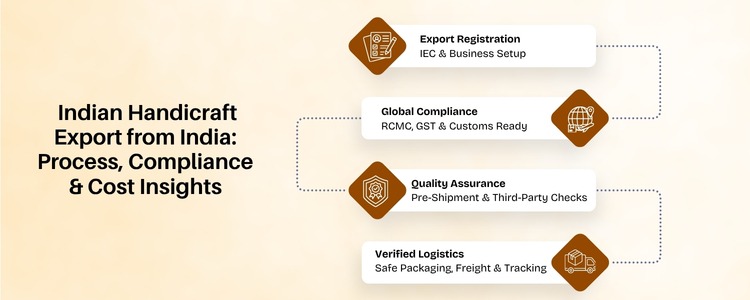
Steps for Easy Export of Indian Handicraft
Every export journey starts the same way: with paperwork that opens doors. Registering the business and securing an IEC (Import Export Code) is step one, without it, nothing moves. From there, exporters identify the right buyer or market, often through B2B platforms or trade fairs like the IHGF Delhi Fair, now in its 60th edition and still the industry’s most important meeting ground.
Next comes sampling and costing, tested against buyer expectations before any bulk commitment. Once an order is secured, the focus shifts to documentation and customs clearance, unglamorous but non-negotiable. Shipment closes the loop. Each step builds toward the next, which is exactly why compliance deserves its own spotlight.
-
Cost Insights
Most new exporters price for production. Far fewer prices for risk, and that gap quietly eats into margins. Artisan labor is often underestimated, especially for intricate, time-intensive work. Packaging for fragile, handmade goods adds another layer, since standard cartons rarely protect ceramics or glasswork in transit.
Freight is its own decision tree: sea freight suits bulky decor items on a budget, while air freight serves urgent or high-value orders at a premium. Compliance and certification fees accumulate across IEC, RCMC, and destination-market requirements. And currency or payment-term risk, letters of credit versus advance payment, can swing realized revenue meaningfully if left unmanaged.
-
Overhaul Process
Becoming export-ready is less about ambition and more about overhaul rebuilding a workshop built for local demand into one ready for world-class buyers. That starts with standardizing production, so a batch of 50 looks consistent enough to fulfill a contract, not just satisfy one customer.
Basic digital inventory and order tracking follows, replacing memory and notebooks with systems buyers can trust. Packaging needs an upgrade too, built for international transit rather than a short trip across town. And an English-language-ready catalog with clear specifications becomes the calling card that separates an export-ready supplier from a hobbyist seller.
-
Regulatory Compliance
Regulatory compliance isn’t bureaucratic friction, it’s the credibility signal that lets a serious buyer trust a supplier at first glance. The foundation is IEC registration, followed by the RCMC issued by EPCH, the apex body that has organized the sector into a multibillion-dollar industry since 1986-87.
GST and customs documentation must be airtight, and exporters increasingly track destination-country rules too, from the EU’s REACH norms on certain materials to the US CPSC’s safety standards for children’s items like wooden toys. EPCH has recently been in dialogue with India’s environment ministry over the EU Deforestation Regulation (EUDR), a reminder that compliance is a moving target, not a one-time checklist.
-
Legal Compliance
Where regulatory compliance governs permission to trade, legal compliance protects what’s traded. GI tag usage rights ensure only authentic regional producers can market a craft under its protected name, a Pochampally ikat or a Kashmir pashmina, for instance.
IP protection guards against design replication once a product reaches foreign shelves. Labor law adherence within artisan clusters matters increasingly to ESG-conscious buyers performing supply chain audits. And contract enforceability across borders determines whether a dispute gets resolved or drags on indefinitely, a shared-interest framework protecting both the exporter’s livelihood and the buyer’s supply chain integrity.
-
Quality Check
In handicraft exports, variability is either a defect or a story, and quality control decides which. Pre-shipment inspections catch issues before they return. Third-party certification adds an external layer of trust for buyers who can’t inspect in person.
Sample approval, agreed before bulk production begins, prevents costly surprises down the line. And natural material inconsistencies- wood grain that shifts piece to piece, glaze that pools unevenly- aren’t flaws to hide but proof of the human hand behind the product.
-
Verified Logistics
Shipping a hand-carved table or a crate of glass lanterns is a different puzzle than shipping standardized cartons. The first decision is freight forwarders versus direct courier, depending on order volume and urgency.
Packaging innovation matters most for breakage-prone goods- terracotta, glass, ceramics where a single oversight voids an order. Customs documentation accuracy prevents port delays that quietly cost time and trust. And increasingly, buyers expect verified logistics partners offering real tracking transparency, not just a number that goes dark for two weeks.
An Overview of Statistics of Indian Handicraft
Numbers tell a story of where Indian craftsmanship has already won trust.
| Country | Why It Imports Indian Handicrafts |
|---|---|
| USA | The largest export market, accounting for approximately 37% of total Indian handicraft exports, driven by strong demand from home décor retailers and lifestyle brands. |
| UK | Imports a wide range of art items, crocheted products, woodware, imitation jewellery, and is a major buyer of handmade carpets. |
| UAE | A significant importer of hand-printed textiles, embroidery goods, and art metalware, supported by gifting, luxury retail, and hospitality sector demand. |
| Germany | Consistent demand for handmade carpets and fashion-adjacent handicraft accessories, aligned with sustainable and artisanal consumption trends. |
| Netherlands & France | Among the top European destinations for Indian handicrafts; France particularly values handcrafted home décor and fashion accessories. |
Conclusion
Indian handicraft export isn’t a legacy trade clinging to relevance; it’s a structurally advantaged industry for B2B buyers and sourcing partners willing to navigate its process correctly. The heritage is real, the compliance is learnable, and the demand, from Manhattan showrooms to Dubai hotel lobbies, is only growing. The only question left is whether your supply chain is ready to meet it.

Pratibha Soni
I write where strategy meets storytelling. As a passionate writer and literary enthusiast, I craft business-focused content that transforms trading insights into compelling narratives. Drawn to global business ecosystems, I enjoy turning research, innovation, and ideas into content that informs, connects, and inspires. With an analytical mind and a creative soul, I bring curiosity, collaboration, and a sharp eye for detail to every project. Adaptable and growth-driven, I believe the right words do more than communicate; they leave an impression.