

How Global Buyers Reduce Costs by Importing Food Products from India
The agricultural and processed food export industry of India has become one of the leading areas of export growth around the world. Many buyers choose to import food products from india because they provide a unique combination of quality, diversity in product offerings and competitive pricing, as well as reliability in meeting delivery commitments to customers.
As global markets are becoming more sensitive to pricing changes, businesses must find ways to find a balance between the price they pay for products and the quality of those products.
The purpose of this article is to demonstrate how importing food products from India allows global buyers to reduce their total cost, and still receive an acceptable level of quality.
India’s Competitive Advantage in Food Exports
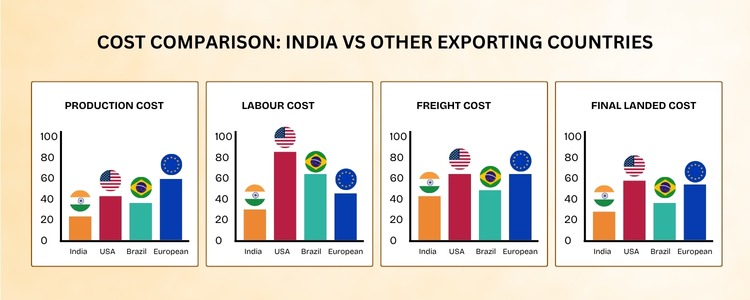
India’s food products are produced at very low production costs, due in large part to the high-quality land available in India, the favourable climate for producing food, and the inexpensive cost of labour.
In addition, there are many different kinds of ag commodities raised in India ( grains, spices, pulses or legumes, fruits and processed foods).
As a result of these favourable conditions, Indian food exporters have an advantage over other food exporters in being able to sell their products at a lower price but still provide acceptable quality products to their customers. Because of lower production costs and larger size of production volume, food exporters typically sell their product at a price that is less than what the same or similar product would sell for in North America or Europe.
Diverse Product Portfolio and Market Flexibility
India’s food export sector is unique for its vast array of products available for purchase from one country by multiple buyer types, meaning that they have fewer suppliers to manage across multiple countries.
The major product export categories from India are:
– Rice and other cereal grains
– Spices or condiments, including oils or sauces
– Pulses/lentils
– Ready-to-eat meals, such processed as frozen foods
– Fresh produce fruits/vegetables
By providing buyers with so much variety in one country, it will make purchasing easier and take away some of the administrative and logistical burden of dealing with several different suppliers across multiple countries.
Lower Production and Labour Costs
The cost structure of India’s economy is heavily driven by its labour market and agricultural practices. In India, the cost of labour is low as compared to developed countries and has a direct impact on the prices of the goods being exported from India.
In addition, many of the agricultural practices are done using traditional equipment, rather than having to rely on expensive mechanisation. This results in lower input costs and then lower selling prices for buyers.
Efficient Supply Chain and Export Infrastructure
In recent years, India has dedicated much of its resources to enhancing the country’s export infrastructure such as ports, cold storage facilities and logistics networks.
What Are Some of India’s Key Infrastructure Advantages?
- India has an extensive range of major seaports such as Mumbai, Chennai and Mundra.
- The cold chain logistics for perishable goods continues to grow.
The Indian government provides various export promotion schemes that can assist exporters in ensuring timely delivery as well as reducing transit losses, which will eventually lower the overall procurement expenses for buyers.
Bulk Purchasing and Economies of Scale
Why Do Buyers Benefit from Bulk Purchasing?
- Reduced cost per unit
- Fewer frequencies of shipments
- More efficient inventory management
Over time, the cost savings from bulk purchasing can be substantial for businesses that have consistent demand.
Favourable Trade Policies and Export Incentives
There are numerous ways the Indian government has been actively involved in encouraging food exporters through policy frameworks and incentives.
Examples of this include:
- Export subsidies for agricultural products
- Reducing export duties on select commodities
- Benefits provided by APEDA (Agricultural and Processed Food Products Export Development Authority)
The benefits of these programs are that exporters can continue to offer internationally competitive prices to the buyers.
Growing Demand for Organic and Specialty Foods
India is seeing increased manufacturing of both specialized and organic food items to satisfy the demands of niche market segments throughout the world.
Certified organic foods produced by a qualified exporter will meet the international standard, while still providing a lower cost comparative to like product suppliers that reside in Europe or North America, allowing buyers to target high-end market segments without incurring exorbitant costs through procurement.
Reduced Logistics Costs Through Strategic Location
With India being located in close proximity to the Asian, Middle Eastern, and African regions affords its exporters a location advantage from a logistical standpoint, providing less expensive freight costs due to shorter transportation times and reduced spoilage risk.
Adding to the benefits, by working with Indian food suppliers residing in the United States allows buyers in Western markets to combine sourcing internationally while utilizing the suppliers’ warehousing and shipping capabilities domestically to facilitate distribution.
Quality Assurance and Compliance Standards
Cost cutting do not come at a cost to quality, because exporters in India must comply with international standards, which include:
- FSSAI and HACCP Certifications
- ISO Certifications
- Phytosanitary Regulations
Additionally, third-party inspection reports enhance the validity of a transaction between the buyer & seller.
Comparative Advantage Over Other Exporting Nations
When compared to other major food-exporting countries, India offers a unique balance of cost and variety.
Factor | India | Europe | USA |
Cost Competitiveness | High | Low | Moderate |
Product Variety | Extensive | Moderate | Moderate |
Labour Cost | Low | High | High |
Organic Options | Growing | Strong | Strong |
Buyers working with wholesale indian food suppliers uk often find Indian products more affordable, especially when sourcing in bulk.
Risk Management and Cost Control Strategies
Although there are many benefits to purchasing from India, buyers should develop good risk management practices.
Recommended best practices include:
- Supplier audits
- Secure forms of payment (i.e., Letters of Credit)
- Third-party Inspection Agencies
- Clearly defined contracts
These will reduce the amount of risk, as well as control costs consistent
Case Insight: Cost Savings Through Indian Sourcing
An example of an European retail chain sourcing spices from India resulted in an overall 25% reduction in the costs for procuring expected products in comparison to previous suppliers. The company utilized consolidation & long-term pricing contracts to further increase their margin against other retailers.
This creates a clear demonstration of the real advantages to strategic sourcing from India.
Future Outlook for Indian Food Exports
India’s food export industry continues to be very strong. There is significant growth in global markets that will increase demand, improvements in infrastructure, and government support through favorable policies/initiatives for the food export sector, which positions India very well to continue growing its market share.
Technological improved efficiencies in the areas of supply chain management and quality assurance will further help reduce the cost of food to international buyers.
Conclusion
International buyers, by importing food products from India, can have a strategic advantage by reducing their costs while still having high-quality and reliability in the supply chain of the product due to competitive pricing, the variety of food products offered, and the continuing improvement to the infrastructure necessary to support food exports from India.

Diptanshu
Leading research and marketing at Inductus Global, Diptanshu drives the company’s vision to transcend traditional trading through thought leadership in import-export. He spearheads a research-driven approach that prioritizes quality over price arbitrage, positioning Inductus as a strategic sourcing partner rather than a transactional intermediary. His work spans market intelligence, supply chain innovation, and trade dynamics, while playing a key role in sales and business development.