


Procurement Outsourcing vs. In-House Procurement: Which One is Right for You?
A middle-sized manufacturer that is expanding rapidly has suppliers with erratic price levels and has a limited procurement department with a low staffing rate. It is presented with a common boardroom dilemma: ideas to maintain the procurement operation internally or contract product sourcing companies and sourcing firms to run the operation?
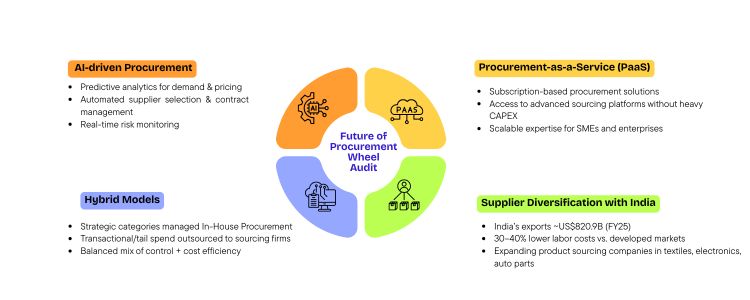
This is not a mere tactical decision; it impacts the margins, compliance and scalability of the company. The emerging global sourcing role of India provides an additional layer, with exports projected to reach $820.9 billion in fiscal year 2024-25, a sourcing strategy that helps India to achieve supply resilience along with economic benefit.
Procurement often affects a large proportion of company expenditure, leading procurement organizations capable of making a difference of 60-90% of individual company spend, and is frequently associated with measured cost savings. An increasingly large Procurement-as-a-Service (PaaS) and procurement outsourcing market demonstrates the trend of companies outsourcing expertise to gain economies of scale on procurement savings. Such trends have a direct impact on competitive positioning and finance.
Three Functional Models – The Procurement Spectrum
The word ‘procurement’ is on the spectrum, not binary:
- The fully In-House Procurement: Ownership held by company teams.
- Hybrid Model – Core categories remain in-house; transactional/tail spend is outsourced to product sourcing agents or companies.
- Full Procurement Outsourcing – Sourcing companies/Product sourcing firms operate the entire procurement.
A Quick Deciding Comparison
Decision Factor | In-House Procurement | Procurement Outsourcing / Product Sourcing Companies |
Cost Efficiency | Higher fixed cost; possible lower long-term margins if the team is not optimised | Faster variable cost savings; scale -led supplier leverage |
Speed & Agility | Slower to scale; dependent on internal hires | Rapid ramp-up, global supplier networks |
Control & Transparency | Full control, direct governance | Requires tight SLAs and reporting for transparency |
Tech & Analytics | Needs investment in e-procurement tools | Outsourcers bring platforms (PaaS) and analytics. |
Supplier Relationships | Direct, often strategic | Broader network; specialists manage multi-vendor sourcing. |
Compliance & Risk | Tight internal control | Outsourcers add compliance expertise but need oversight. |
Self-Score Decision Matrix
Give 0, 2 or max 2 points per statement (0 = no, 1 = partly, 2 = yes). Obtaining a higher total would be in favour of outsourcing.
- You require the quick global sourcing and diversification of suppliers.
- Your purchasing department does not cope with online tools and analytics.
- You have high transactional/tail spend that takes away core team focus.
- You may have to shrink time-to-market or enter new geographies within a short period of time.
When the majority of the responses are “2”, then it will make sense to outsource the procurement or to engage product sourcing agents or sourcing organisations. In-House Procurement may be strengthened in case the majority are “0”.
India Factor
The story of manufacturing and exports in India offers an economic benefit to buyers who can align with sourcing strategies: strong export growth (USD 437B in FY25), low-cost labour and increasing supplier clusters in textiles, electronics and components.
For companies considering expanding sourcing or engaging product sourcing firms, India has increased the ecosystem to drive down landed cost and allows diversification beyond reliance on one-country sourcing.
Future Snapshot
- PaaS & AI: Procurement-as-a- Service platforms are integrating with AI to enable supplier scoring and demand forecasting and are also gaining steam. The PaaS market has a high growth pattern, and hybrid/outsourced models have become more potent.
- Hybrid will reign:More businesses are likely to retain categories that are strategic and outsource those that are high volume and/or low complexity to third-party sourcing firms and product sourcing specialists.
- India will be a key focus of suppliers in the portfolio as companies pursue cost, capacity, and government incentives.
Practical Advice (Advisory POV)
- Map spend: Determine Spend Under Management (SUM). Make your decision after raising SUM.
- Pilot outsourcing: Select non-strategic categories and evaluate savings, risk and supplier performance.
- Partner choice: Pick procurement firms that have exhibited proven capabilities of the India supply chain amidst robust technology stacking.
- Manage with KPIs: Monitor cost savings, supplier lead time, compliance events and percentage of spend affected.
- Go hybrid: Develop a roadmap in which the strategy belongs in-house, and outsourcers are responsible for execution.
Conclusion
Outsourced Procurement is not the magic bullet, and In-House Procurement is not a thing of the past; it is rather a decision that you should make based on your spend profile, digital maturity, and growth strategy, many firms are currently finding a happy balance, using a mix of product sourcing companies and sourcing firms to create the benefits of efficiency and Indian-linked economic benefit that the market now presents.

Unlock smarter procurement with Inductus Global. Whether you need end-to-end procurement outsourcing, reliable product sourcing agents, or advisory support to strengthen in-house procurement, we help you achieve cost savings, compliance, and supply resilience. With India’s sourcing edge and global reach, Inductus Global delivers agility and measurable impact.