


Product Sourcing Challenges in USA: Manufacturing Costs and Alternative Markets
Why Are Product Sourcing Challenges Intensifying in the USA?
In recent years, US sourcing strategies have gone through a major reassessment as companies face rising input costs, a lack of skilled workers, increased regulations, and sustained disruptions to the supply chain. As a result, traditional domestic sourcing models are becoming difficult for many companies to maintain, especially for larger manufacturers and retailers.
These pressures now require product sourcing companies in the USA to balance cost control with reliability, compliance, and speed to market. What used to be primarily a domestic or nearshore decision has now evolved into a global evaluation of risk and sustainability, long-term competitiveness, and the ability to develop systems that support them all.
How Have Manufacturing Costs in the USA Changed?
Manufacturing in the US has continued to see month-over-month increases in costs with no sign of relief. Structural forces are driving a higher cost of doing business, not just temporary inflationary shocks. For example, manufacturing labour is still much more expensive than labour costs in most emerging countries, and there has been an increase in energy, environmental compliance, and insurance costs.
Thus, numerous manufacturers have suffered from labour shortages that contributed to a tight labour market, which has restricted their workforce’s flexible ability to ramp up quickly. This has resulted in extended lead times and higher minimum order volumes for sourcing teams, even when there were quality advantages or proximity advantages, increasing costs have reduced profit margins to unacceptable levels.
What Role Do Supply Chain Disruptions Still Play?
Though global logistics have returned to a more stable state since the peak of the pandemic, embedded vulnerabilities still exist in the system’s infrastructure. Port congestion, weather-related disruptions and geopolitical tensions are still disruptive factors impacting the flow of materials throughout the world.
For US-based buyers, the dependence upon a limited number of suppliers has had significant cost implications. Because of the inadequate flow of inventory and the speed with which delays travel through the inventory cycle (or time), buyers’ fulfilment commitments have often not been met; therefore, further solidifying the necessity for multiple sourcing solutions instead of relying upon either one supplier or one country.
Why Are Companies Looking Beyond Domestic Sourcing?
The advantages to sourcing from domestic suppliers are two-fold: the regulatory environment is understood, and shipments will arrive faster to the buyer; however, due to cost constraints and limited capacity in North America, most US companies are currently re-evaluating their current offshore and multi-country sourcing strategies in order to compete successfully in the marketplace.
This move towards more domestic sourcing should not be construed as a loss of interest in domestic manufacturing; rather, the movement towards domestic sourcing by US companies is more a function of a company’s desire to segment its supply chain—keeping the strategic or high-value manufacturing within its own country and looking for cost-effective alternatives to produce large volumes of goods.
Is Sourcing From India Gaining Momentum Among US Buyers?
Alternative countries are becoming more popular; in particular sourcing in India has seen a resurgence. Manufacturing in India has the advantage of manufacturing ability, low-cost labour, and growing industrial/Manufacturing base in many industries including textiles, engineering goods (toys, machinery, tools, etc), electronics, and consumer products.
As India aligns further with global standards with respect to quality and compliance, further investments in areas such as infrastructure, digitalization, and export facilitation, have made India more reliable as a source of product, and as such India is now easily considered a long-term product source versus a tactical product substitute.
How Do Cost Structures in India Compare With the USA?
To a varying degree, depending on the product category, manufacturing in India tends to provide lower labour and overhead costs versus comparable products produced in the US. This difference provides US importers/buyers the potential ability to absorb the inflationary costs associated with materials and/or services supplied by US suppliers, thereby maintaining price competitiveness of their products sold to end users in their respective lower-priced markets.
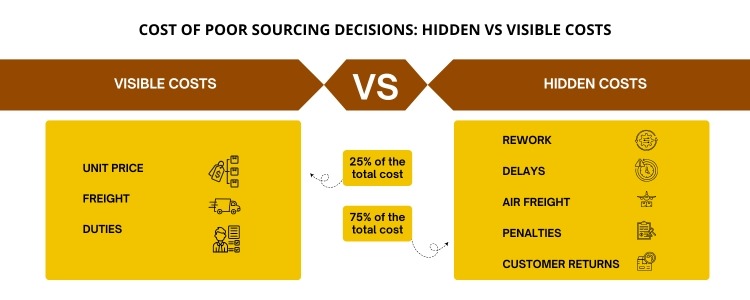
However, there is no assurance of savings resulting from sourcing in India. The successful product source will be determined through supplier choice, supplier quality control, and a realistic perspective on lead times. Companies who consider an offshore product source as a solely price transaction will often find hidden costs that will diminish the initial savings.
What Are the Risks of Shifting to Alternative Markets?
Sourcing products from outside of the US can create additional risks, such as, communication, quality assurance and compliance risks. These risks can be negated by effective management of these additional risks in order to offset the corresponding cost advantages created from sourcing in these countries.
Many firms utilize a product sourcing agent or a structured product sourcing partner with local expertise, in order to mitigate these additional risks. The product sourcing agent or structured product sourcing partner provides guidance in identifying a supplier who has the ability to meet the expectations of the buyers and thus generally reduces the friction that frequently occurs in the supply chain.
How Are US Companies Managing Vendor Relationships More Strategically?
Sourcing has moved from transactional buying to a more disciplined approach to managing suppliers. As a result, U.S. companies are focusing more on supplier performance metrics, visibility, and long-term partnerships.
Buyers who use this approach will be able to see early indications that their suppliers are experiencing problems—such as capacity strain, quality drift, or compliance issues—before those problems get out of control. Additionally, by effectively managing your suppliers, you create a stable cost environment through predictable production schedules rather than buying on the spot.
What Role Do Sourcing Agencies Play in This Transition?
As sourcing footprints continue to grow, a growing number of companies are turning to sourcing agencies to help them source suppliers, perform audits, and monitor production. These agencies can act as extensions of a buyer’s internal procurement team, especially when a buyer does not have a physical presence in the sourcing market.
Sourcing agencies do not solely assist with the supplier search; they serve many purposes for buyers. Effective sourcing agencies also help buyers with quality control checks, shipping coordination, and documentation to assist the buyer in navigating the unfamiliar regulatory and operational landscape with greatly improved confidence.
How Does Sustainability Influence Sourcing Decisions?
Many retailers need to show responsibility in how they source products while continuing to deal with increases in their costs. Thus, sustainability is becoming part of every retailer’s sourcing strategy, especially in consumer-facing businesses. Retailers must prove they are sourcing responsibly while continuing to insulate themselves from rising costs.
To balance costs and the Sustainable Sourcing goals of the retailer, a retailer must be very selective when choosing suppliers and develop precise standards for how those suppliers must conduct business. Suppliers in emerging sourcing markets who use cleaner manufacturing processes and provide transparency regarding their labor practices will have opportunities for developing long-term sourcing relationships.
Are Alternative Markets a Long-Term Solution or a Stopgap?
Alternative sourcing markets don’t just serve as temporary fix for many US firms but rather represent segments within a wider portfolio of diversified sourcing strategies. We aim not to replace domestic manufacturing fully but rather to develop flexibility.
By spreading our sourcing sufficiently across geographies, we’ll be able to limit our exposure to regional disruptions and/or to shocks in supply chain costs. Additionally, this approach improves our total supply chain resilience and increases our negotiation leverage.
How Should US Companies Approach Sourcing Strategy Going Forward?
Realistic and disciplined sourcing strategies engender the greatest supply chain resilience. Companies need to determine which products warrant domestic production and which products can be successfully sourced from an international supplier without becoming unduly exposed to risk.
For global sourcing to become a source of stability, there must be strong alignment between, at least, our procurement, finance and operations functions, and we must all be supported by reliable supply chain partners and formalized processes.

1. Why are product sourcing challenges increasing in the USA?
Rising labour costs, regulatory pressure, and supply chain disruptions are key drivers.
2. Is offshore sourcing cheaper in all cases?
Not always. Savings depend on supplier reliability, quality control, and logistics planning.
3. Why is India emerging as a sourcing alternative?
India offers competitive costs, manufacturing depth, and improving infrastructure.
4. Do sourcing agents reduce risk?
Yes. They provide local oversight and help align suppliers with buyer standards.
5. Can US companies maintain quality when sourcing abroad?
Yes, with structured quality control and supplier governance.
6. Is sustainability compatible with offshore sourcing?
It can be, provided suppliers meet environmental and labour standards.

Diptanshu
Leading research and marketing at Inductus Global, Diptanshu drives the company’s vision to transcend traditional trading through thought leadership in import-export. He spearheads a research-driven approach that prioritizes quality over price arbitrage, positioning Inductus as a strategic sourcing partner rather than a transactional intermediary. His work spans market intelligence, supply chain innovation, and trade dynamics, while playing a key role in sales and business development.