


Sustainable Procurement Services: Eco-Friendly Supplier Selection Guide
Accountable and innovative practices have established sustainable procurement services; as the foundation of an ethical, responsible business is the global marketplace. With increased levels in environmental demands and regulations, sustainability within the business supply chain has changed from being a “good-to-have” position, to being viewed as a fundamental strategy of every corporation.
The discussion of sustainability has changed from whether to implement sustainability to how-to successfully execute it by using supplier partnerships that will help corporations fulfil the requirements of environmental, social and governance (ESG).
Why Should Businesses Prioritize Sustainable Procurement Services?
Sustainable procurement also demonstrates corporate ethos, and strategic foresight, in addition to satisfying compliance requirements. By implementing sustainable procurement services, businesses achieve a number of measurable benefits such as cost savings, improved corporate reputation, and long-term supply stability.
Multinational corporations and small businesses are currently in various stages of developing new procurement systems to reduce their environmental impact and minimize ethical risks. These companies will achieve the following: less landfill waste, reduce the wastage of resources, and increase the level of confidence held by various stakeholders.
In the manufacturing, retail and construction industries, there is an increasing investor demand for evidence of responsible sourcing practices. Additionally alignment with global sustainability initiatives such as the United Nations Sustainable Development Goals (UN SDGs) is now a requirement and not simply a preferred option.
How Do Sustainable Procurement Services Work?
Fundamentally, sustainable procurement alters the way businesses choose, assess and manage suppliers by including environmental and ethical factors in all aspects of decision making; from sourcing raw materials through to distribution.
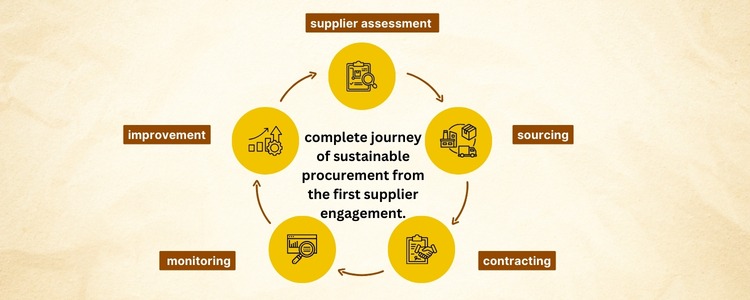
A procurement firm that offers these types of services will typically start with an extensive sustainability assessment of the supply chain. This includes reviewing carbon emissions, working conditions, material sources, and compliance with environmental regulations.
The sustainability assessment is done using a data driven process which includes supplier scorecards, lifecycle assessments, and ongoing monitoring. Technology such as blockchain traceability systems and AI-based procurement dashboards are important components to create transparency within the entire procurement process.
What Makes a Supplier “Eco-Friendly”?
A sustainable supplier is more than just environmentally friendly; they have integrated sustainability into all facets of the business including energy efficiency, waste management and circular production processes.
- Indicators of an environmentally responsible supplier include:
- Verification of certification (e.g., ISO 14001 or B Corporation).
- Utilising renewable resources and low emission equipment.
- Adopting ethical labour practices and fair trade policies.
- Demonstrated reductions in both water and energy.
Companies that use sustainable procurement services will frequently establish codes of conduct for suppliers to ensure that their suppliers comply with company principles.
What Are the Key Elements of Sustainable Supplier Evaluation?
A sustainable framework for supplier evaluation adopts a defined method that combines quantitative and qualitative aspects.
- Environmental Impact Assessments include measuring carbon footprints, waste management and energy use by suppliers.
- Social Responsibility assessments look at labour conditions, diversity policies and community engagement.
- Economic Viability assessments consider suppliers’ long term financial viability as well as their fair pricing.
- Innovation Index measures the extent to which suppliers can innovate in sustainable production.
The use of a balanced scorecard provides a basis upon which a trusted procurement partner can make responsible procurement decisions through the evaluation process.
How Can Technology Accelerate Sustainable Procurement?
Modern procurement systems rely heavily on digital transformation through the application of AI, big data analytics and blockchain technology to redefine how sustainability metrics are monitored and verified.
For example, by utilising blockchain, companies are able to trace the entire supply chain for each raw material back to its origin and to track it all the way through to delivery. Predictive analytics make it easier to anticipate interruptions to the supply chain. Real-time sustainability performance information is provided to procurement managers through AI powered dashboards.
Integrating these technologies into procurement solutions, allow companies to automate their compliance process, optimise sourcing and accurately benchmark against sustainability objectives.
What Challenges Do Companies Face in Implementing Sustainable Procurement?
There are many challenges to moving towards sustainable purchasing. Some of these include:
- The potential for high start-up costs as a result of needing to invest in technology and training suppliers for sustainable sourcing.
- Data gaps due to inconsistent reporting of sustainability making it hard to evaluate whether suppliers are sustainable.
- Suppliers may be resistant to changing their methods that have worked for them in the past.
- There are many different regulations related to sustainability around the world, making it difficult to find a source of supply for global operations.
Many of these challenges can be overcome through a phased approach to sustainable purchasing, good governance policies and working together with others in the industry to achieve sustainable purchasing.`
How Can Businesses Build Strong Partnerships for Sustainable Procurement?
Sustainability is a joint undertaking. When companies see their suppliers as partners instead of just vendors, they are more likely to develop lasting, robust relationships. Companies can bring their goals into alignment throughout the supply chain by consistently meeting together, engaging in sustainability workshops.
Sustainable procurement programmers are also a very logical path for companies to take. They typically generate multiple benefits for both companies and suppliers to realize the value of sustainable procurement. Many forward-thinking companies use performance-based contracts to offer incentives to suppliers with measurable sustainability improvement.
What Are the Measurable Benefits of Sustainable Procurement?
A considerable number of scholarly studies have indicated that companies implementing sustainable procurement methods achieve several benefits such as:
- Cost efficiency – companies reduce or eliminate cost by eliminating waste and optimizing resources.
- Improved brand image – many customers choose to purchase goods and services from those with articulated and credible ESG portfolios.
- Regulatory compliance – suppliers take actions to mitigate their legal and reputational risks.
- Innovation – suppliers that embrace sustainability practices are creating better, more innovative, and future-ready products.
In the long run, the benefit to a company of pursuing sustainability depends on its ability to be resilient toward anticipated disruptions to the marketplace of tomorrow.
1. What does sustainable procurement mean in practice?
It means sourcing goods and services with minimal negative environmental and social impact, ensuring ethical, efficient, and transparent supply chains.
2. Can small businesses adopt sustainable procurement?
Yes. SMEs can begin with local sourcing, supplier audits, and gradual implementation of sustainability policies.
3. How does sustainability impact procurement costs?
While initial costs may rise, long-term efficiency, reduced waste, and enhanced brand value offset the investment.
4. What role does technology play in sustainable procurement?
Technology ensures transparency, automates compliance, and helps monitor sustainability metrics effectively.
5. How do procurement services ensure supplier accountability?
Through periodic audits, performance scorecards, and transparent communication channels that align suppliers with sustainability objectives.
6. Why is sustainable procurement crucial for ESG reporting?
It provides tangible data to support environmental and social claims, improving credibility in ESG disclosures and investor relations.

Diptanshu
Leading research and marketing at Inductus Global, Diptanshu drives the company’s vision to transcend traditional trading through thought leadership in import-export. He spearheads a research-driven approach that prioritizes quality over price arbitrage, positioning Inductus as a strategic sourcing partner rather than a transactional intermediary. His work spans market intelligence, supply chain innovation, and trade dynamics, while playing a key role in sales and business development.