

How to Vet Product Samples Before Bulk Procurement
Whether in global trade or competitive sourcing, the first mistake one makes in product evaluation can have devastating consequences. Often, companies will have difficulty scaling from sample to bulk order. Products that look and feel right at small-scale delivery can exhibit density, color, pattern, and/or design problems far worse than simply requiring rejection of the bulk. These challenges can lead to bad sales decisions and sometimes ruin a relationship with your end customer. Therefore, you can begin to see why product sampling as part of this procurement process is not merely a customary corner, but an important checkpoint for purchaser decision-making.
Product sampling requires a little more than scanning what is in the box and looking at the finish quality and packaging. It requires detailed inspections, which are necessary under a systematic sampling methodology, with clear standards and framework, before a purchaser can consider payment for what they are about to order at some quantity and price.
The Importance of Sampling Before Procurement
Sampling acts as the initial safeguard against unintentional risks in mass manufacturing. Well well-selected sample is representative of both the supplier’s abilities and will help to avoid problems down the line. For purchasing managers, it means:
- Correctness of the product and compliance specifications
- Early detection of issues related to design or workmanship
- Peace of mind for long-term supply contract negotiations.
Step 1: Define Specifications and Expectations Clearly
The vetting process begins long before a sample arrives, but rather it starts with how procurement teams communicate their requirements to suppliers. Procurement teams must provide suppliers with a list of requirements that clearly indicate:
Material type and tolerances.
- Dimensional accuracy.
- Packaging requirements.
- Possible compliance certificates.
The less clear the procurement team is at the start, the more the sample will mislead them, and valuable time will be wasted.
Step 2: Initial Visual and Physical Examination
When samples are received, the first step is to conduct a comprehensive visual and physical inspection. To examine:
- Examining surface finishes, colors, and size
- Testing weight, strength, and functioning components
- Comparing known results to approved specifications
Deviations from the sample, even in small amounts, can create large defects in bulk production.
Step 3: Conduct Functional and Performance Tests
In addition to aesthetics, procurement personnel need to determine if what they are purchasing does what it is supposed to do. For example:
- Electronics may need to be tested for functionality in various conditions.
- Apparel samples need testing to determine stitch strength and washing performance.
- Packaging should be checked for stress and moisture exposure.
This is where sample testing of products in procurement can be so important, ensuring that the products over which contracts are negotiated meet the expectations for performance.
Step 4: Engage Third-Party Testing Agencies
From independent lab testing and evaluation, the laboratory will provide unbiased analysis of all samples and is impartial to suppliers and product types as these generally apply when a product is contained in a regulated category, whether they relate to food, chemicals, or electronics, with the agency resuming chemical compositions, durability, and compliance certifications.
Although this phase represents an additional cost to procuring the materials, it insulates buyers from losing money as a great deal can be lost to regulatory losses if samples are rejected, lost money on unsold, unopened products if the customers were dissatisfied with the product’s performance.
Step 5: Verify Consistency Across Multiple Samples
When considering a quality supplier of product materials, having a single perfect test sample to evaluate the supplier will not suffice. You’ll want to study multiple samples of materials taken at different time frames from the same supplier to evaluate consistent quality materials. This will allow you to see if quality product samples can be effectively mass-produced.
This step reinforces the importance of providing product samples with quality control, demonstrating to yourself (and the supplier) with certainty, that the supplier can provide quality product consistently, not just once.
Step 6: Supplier Evaluation and Communication
Without evaluating the supplier’s transparency, willingness to change, and responsiveness, the vetting process is not complete. Procurement should consider:
- The turnaround times for corrections.
- Their willingness to provide alternate solutions.
- What quality management systems do they have in place in their facility?
Product quality assurance in sourcing comes full circle because suppliers that proactively and quickly resolve discrepancies are usually the most reliable partners.
Step 7: Simulate Real-World Usage Conditions
Most products do not fail during testing; they fail in actual use. Procurement managers should simulate actual work conditions to check on quality. Examples are:
- Consumer products should be tested in environmental variations.
- Industrial items should be tested for load-bearing.
- Food items must be tested for shelf life.
This stage ensures the quality check of the product before a bulk order is based on realistic situations.
Risk Mitigation Through Sampling
Vetting samples assists organizations with reducing:
- Financial risk – by eliminating losses and rejections.
- Operational risk – by making sure the goods can arrive on time in usable form.
- Reputational risk – maintaining the trust of the customer due to consistency in quality.
Balancing Cost and Efficiency
Careful sampling may add time and costs to the procurement process, but it is worth the long-term process efficiencies. The cost of a failed bulk order is far greater than the cost of properly exploring during the sampling process.
Conclusion
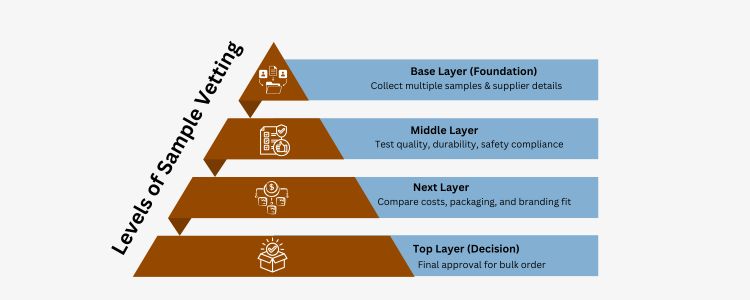
Procuring, like many areas of business, requires diligence. Reviewing those item samples is not a rubber-stamp process; it is a discipline. Each layer of diligence, from defining a scope of what you want to test, to testing, to considering and evaluating how the supplier responds, is a way to build a layer of protection against the risk associated with the scale of your procurement. In the end, effective sample review should provide a foundation for a procurement decision that is accurate, trustworthy, and sustainable.

Frequently Asked Questions (FAQ)
Electronics, pharmaceuticals, renewable energy, and textiles will all be drivers.
India provides cost-effectiveness, skilled labor, and positive policy choices, making India a secure addition to global supply chains.
Textiles, pharmaceuticals, agro-processed products, and electronics.
Very competitive due to regulatory compliance, quality, and cost parity with similar products, and benefits from a tariff-free trade agreement.
Suppliers provide flexibility, scale, and reliability to global buyers and thus mitigate the supply chain disruption inherent in supply chain risks.
Great people, great policy, together with a variety of industry clusters.