

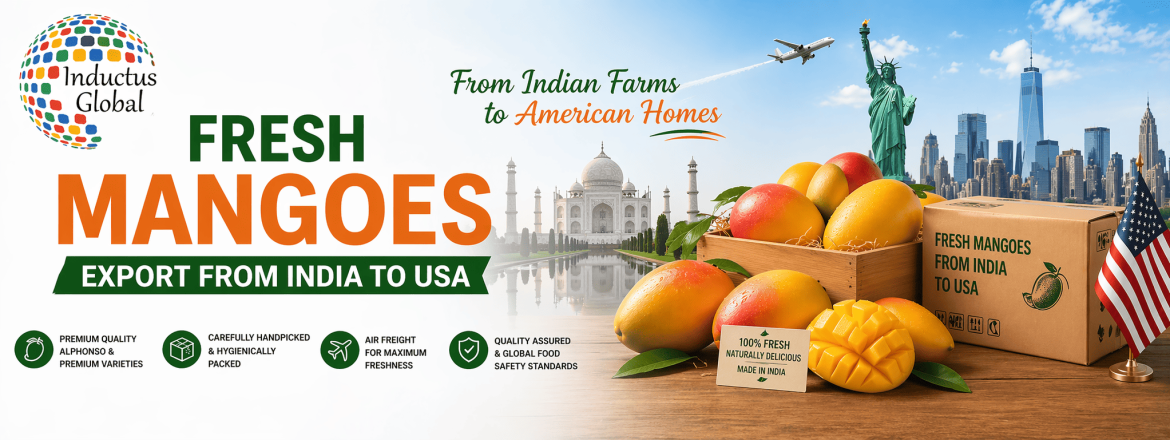
Fresh Mangoes Export from India to USA: A Complete B2B Overview
India is considered to be the largest mango producer globally and is a key node in the fruit trade. One of India’s most lucrative export markets is the USA, where consumer demand is high and regulations are stringent. Mango exporters will need to work closely with their U.S. buyers in terms of product quality, documentation, and logistics due to the many regulatory requirements involved in exporting mangoes from India to the U.S. The content presented in this article provides an overview of the B2B mango export ecosystem, regulatory requirements, supply chain dynamics, and commercial opportunities for participants in the India-U.S. mango trade.
Export Mangoes from India to USA: Market Overview
There is a continuously increasing requirement for Indian mangoes like Alphonso, Kesar and Banganapalli amongst not only South Asian Diasporas within the United States of America but also amongst gourmet fruit buyers as well. While volume is significant to the US market, quality is equally as important; all shipments conform to stringent phytosanitary regulations.
Overall the fruit exporters from India have also grown continuously, with mangoes being one of the most popular fruits. Even though the overall volume of exports to the USA is lower than the Middle East, the value of the exports generated from complying with strict regulations and limited seasonal supply places India in the premium category for premium pricing.
In order to do business with the United States vegetable importers, Indian vegetable exporters must adapt their operations to meet the necessary standards set by the United States vegetable importers; therefore, the result is a more structured approach to doing business while establishing greater profitability through compliance with established guidelines.
Understanding Mango Export from India to USA Regulations
Mango exports from India to the USA are subject to one of the most stringent global regulatory frameworks. The USDA and APHIS have established highly restrictive regulations that are designed to avert the introduction of pests and diseases into the USA.
The major requirements for mangoes exported to the USA are described below:
Irradiation Treatment – All mangoes exported to the USA must be irradiated to eliminate any potential pests.
APEDA Certification – Mangoes exported from India to the USA must be certified by APEDA, which guarantees that the mangoes meet quality standards for export.
Phytosanitary Certificate – Issued by Indian authorities after confirming that the mangoes are free from pests.
USFDA Compliance – The USFDA has established distinct Food Safety Standards, and consequently shipping mangoes to the USA must conform to these requirements, including traceability of products shipped into the USA from India.
There are approved irradiation facilities in India that can process mangoes for export to the USA, which creates additional levels of coordination for each shipment of mangoes exported from India to the USA.
Supply Chain and Post-Harvest Management
Successful mango exports from India to the USA depend on good post-harvest handling. Mangoes are highly perishable products; therefore, maintaining the quality along the supply chain is essential.
The typical steps are:
- Optimal maturity, harvesting
- Sorting and grading based on quality and size
- Hot water treatment (in some instances)
- Irradiation at an approved facility
- Packaging into an export carton
- Cold chain transport
Temperature control is vital; any break in the cold chain can lead to spoilage, loss of quality, and loss of market value.
Exporters must also ensure that they maintain uniformity in packaging and labeling, as US retailers and distributors have very rigid standards.
Role of Buyers and Mango Importers in USA
In order for international trade to work well in the mango importation marketplace there must be cooperation between the exporters and importers. An importer takes care of the customs clearance, distribution, and retail distribution for the mangoes that are imported from India to be sold in the United States.
Importers typically receive requests from buyers based on criteria that include:
- Consistent quality and grading
- consistency of supply to meet buyer’s timelines
- compliance with US food regulatory specifications
- competitive prices
When sellers and buyers maintain long-term contracting agreements it helps to stabilize the supply chain and reduce uncertainties that may develop during peak selling seasons.
Popular Indian Mango Varieties in the US Market
There are numerous types of Indian mangoes that fit different taste preferences amongst mango consumers in the U.S.
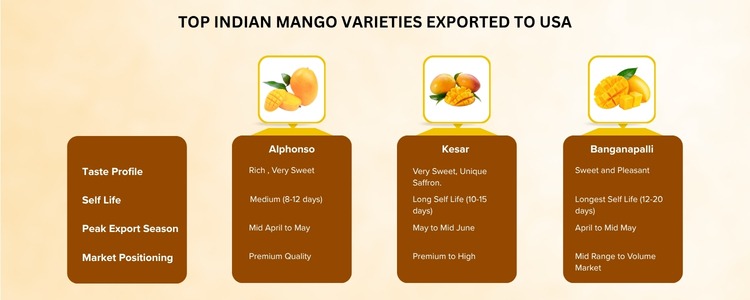
- Alphonso – rich flavor and aroma; promotes itself as a premium product
- Kesar – sweet and beautiful colour
- Banganapalli – larger and longer shelf life
The export of Indian mangoes to the USA consists mainly comprised of these three varieties, with Alphonso making up the bulk of premium exports.
By looking at the exporting and importing timeframes, one can see how significant seasonality affects the export of Indian mangoes to the USA. Exports of Indian mangoes to the USA occur from April through July.
Pricing Dynamics and Cost Structure
There are many different factors that affect pricing in the US. Exporters will be wise to consider each of these influences on their pricing strategy.
Critical components of the cost structure are:
- Procurement/Farm costs.
- Irradiation fees.
- Packaging & handling.
- Freight costs (most common via air).
- Compliance/certification fees.
Because the cost of air freight is so high, Indian mangoes are viewed as premium imported products in the US market. This helps to create volume limitations but ensures that quality-focused exporters can create a larger margin for themselves.
Logistics and Transportation Considerations
Logistics is one of the most critical aspects of mango exports to the US. Given the perishable nature of the product, air transport is the preferred mode.
Key logistics considerations include:
- Transit time (typically 2–5 days)
- Temperature-controlled storage
- Efficient customs clearance
Major Indian airports such as Mumbai, Delhi, and Hyderabad serve as primary export hubs. Coordination between exporters, freight forwarders, and importers is essential to ensure timely delivery.
Challenges in Exporting to the US Market
Despite its attractiveness, the US market presents several challenges for Indian exporters.
Common issues include:
- High compliance costs
- Limited irradiation facilities
- Stringent quality checks
- Fluctuating freight rates
Additionally, rejection rates can be high if shipments fail to meet US standards, leading to financial losses.
To mitigate these risks, exporters must invest in quality control, training, and infrastructure.
Opportunities and Future Outlook
The future of mango exports from India to the US appears promising, driven by growing consumer awareness and demand for exotic fruits.
Opportunities include:
- Expansion into mainstream retail chains
- Development of value-added mango products
- Improved cold chain infrastructure
As trade relations strengthen and logistics improve, the scope for scaling up exports is likely to increase.
Conclusion
The journey to export mangoes from india to usa is complex but rewarding. It requires a careful balance of quality, compliance, and logistics efficiency. For exporters willing to invest in the necessary infrastructure and processes, the US market offers premium returns and long-term growth potential.
Similarly, buyers benefit from access to some of the finest mango varieties in the world, provided they partner with reliable exporters who understand the nuances of international trade.

Diptanshu
Leading research and marketing at Inductus Global, Diptanshu drives the company’s vision to transcend traditional trading through thought leadership in import-export. He spearheads a research-driven approach that prioritizes quality over price arbitrage, positioning Inductus as a strategic sourcing partner rather than a transactional intermediary. His work spans market intelligence, supply chain innovation, and trade dynamics, while playing a key role in sales and business development.






2 Replies to “Fresh Mangoes Export from India to USA: A Complete B2B Overview”
aditya bindra
22 May 2026I want to import some mangoes
Global
27 May 2026Let’s Connect My Team member- 91+ 9599689402