

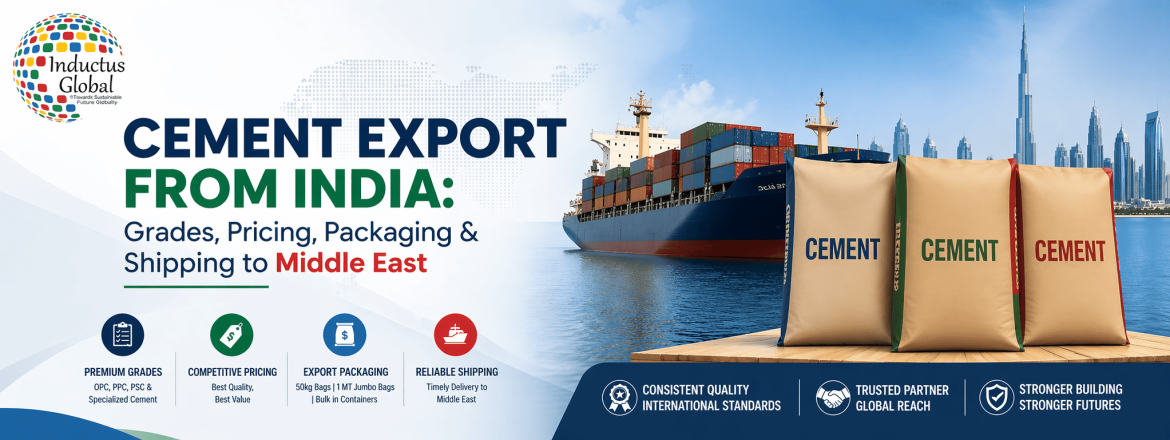
Cement Export from India: Grades, Pricing, Packaging & Shipping to Middle East
Infrastructure Investment Continues To Drive Demand For Cement, Middle Eastern countries continue to make large investments in infrastructure, housing, and industry, providing consistent demand for cement. Although most countries in the Middle East have domestic cement production capacity, they still rely on imports of cement to fill supply gaps and address high construction needs during shifts in seasonal demand.
In this regard, bulk cement exports from India have become an important part of the cement supply chain for the Middle East region.
With abundant raw materials available for manufacturing and large-scale production capacity, India’s cement industry has established itself as a viable player in the international cement market. It is essential for customers in the Middle East to be aware of the many variables associated with grades, pricing, packaging, and shipping when purchasing cement to help make an informed decision about where to procure it.
Understanding Bulk Cement Export from India
Bulk cement exports are often defined as transporting cement to the final customer in bulk quantities without individually bagging the cement. The goal of bulk cement export is to ship the cement via specialized bulk carriers with the right conditions to maintain the quality of the product and to protect the product from contamination.
There are several reasons driving the growth of bulk cement export from India to the Middle East. These include:
- Competitive manufacturing costs in India.
- Close geographic proximity to the Middle East from India.
- Well-developed port infrastructure in India.
Some of the Middle Eastern countries that frequently import cement are the United Arab Emirates (UAE), Oman, Bahrain, and Kuwait. Trade routes for Indian cement exports to the UAE and adjacent areas have become much safer and more efficient, allowing the time and cost of shipping cement from India to the Middle East to be reduced substantially.
Grades of Cement: Choosing the Right Type
Choosing the correct grade of cement is vital for maintaining the structural integrity and performance of a project. In India, exporters supply a wide variety of cement types, each designed to fit different types of construction needs.
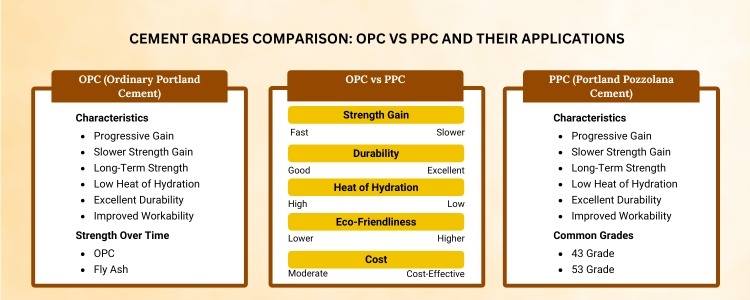
Ordinary Portland Cement (OPC)
Ordinary Portland Cement (OPC) is one of the most commonly used types of cement; it can be used in a variety of applications, including:
– General Construction
– Structural Applications that Require High Strength
– Precast Concrete Elements
OPC is often selected as a preferred choice for large scale projects due to its fast setting time and high durability.
Portland Pozzolana Cement (PPC)
PPC is recognized for its higher durability and resistance to chemical attack. It is often used in marine structures, mass concreting works, and extended longevity infrastructure projects.
The popularity of PPC-OPC bulk cement suppliers from India demonstrates their versatility in a variety of construction environments.
Selecting a Grade Based on Application
When selecting between OPC vs PPC, several factors must be taken into consideration, including:
- The Condition of the Environment
- Load Bearing Requirements
- The Length of Time Required for Each Phase/Stage of the Project
Consulting with an experienced) Engineering Professional will ensure that the selected grade will meet or exceed all of the project’s specifications.
Pricing Dynamics in Cement Exports
One important factor buyers take into account when making purchases is the price. However, there are many factors that affect the price of cement that have nothing to do with the base cost of making the cement.
Cost Factors
The total price for an importer of cement is made up of:
- Ex-Factory Price
- Freight Charges and Shipping Costs
- Insurance
- Port Handling Fees
- Customs Duties
It is important for buyers of cement to understand these costs so that they can evaluate the total price amount that is going to be expected as the landed cost.
Market Influences on Price
A variety of external factors affect the pricing of cement, such as:
- Fluctuations in Fuel and Energy Prices
- Changes in Raw Material Pricing
- Fluctuations in Currency Exchange Rates
As an example, India ships cement to Bahrain and the other Gulf countries based on the demand cycle in each region and their cost of shipping.
Packaging Methods for Bulk Cement
Packaging protects the cement quality during transit and the bulk export of cement is done through a specially designed system rather than traditional bagging.
Systems for Shipping Cement
Cement can be shipped in:
- Pneumatic Vessels
- Bulk Carriers With Sealed Compartments
These systems are designed to limit the exposure of the cement to moisture and environmental contamination.
Advantages of Bulk Packaging
There are numerous advantages to using bulk packaging when shipping cement, including:
- Reduced Packaging Costs
- Faster Loading and Unloading
- Minimised Risk of Material Loss
This method can be especially beneficial for large projects that need to receive cement on a continuous basis.
Shipping and Logistics to the Middle East
Logistics that are efficient help companies by providing on-time delivery of products at efficient costs. India’s location allows it to take advantage of its proximity to the Middle East.
Main Shipping / Export Routes
The following are the main shipping routes from Indian ports to destinations for cement exports:
- Exporting to Cement Ports in the UAE
- Exporting to Cement Ports in Oman
- Exporting to Cement Ports in Kuwait
Shipping routes are supported by a good maritime infrastructure, providing regular, reliable shipping.
Handling and Storage of Cement
When the cement arrives at the port, it must be handled carefully to preserve its quality. Buyers should be certain the following is available.
- A Bulk Unloading Equipment
- Adequate Storage Space
- An Effective Distribution Network
Coordination amongst the exporters and the buyers in the local market is necessary for smooth operations.
Role of Exporters in Ensuring Quality and Consistency
Exporters are essential to the quality and consistency of the cement supply chain. Exporters, with a reputation to uphold, utilize comprehensive quality control procedures at every level of their operations.
The following are necessary steps in the Quality Assurance process:
- Testing the raw materials
- Monitoring the production process
- Inspections prior to shipping
All of these processes will guarantee the cement shipped to international destinations meets accepted international standards.
Working with experienced Exporters who deal specifically in Building Materials Export from India provides buyers with a number of features that include:
- Product consistency
- Clear communication
- Timely delivery
Creating long-term partnerships with reliable Exporters can help buyers increase their purchase efficiency.
Regulatory Compliance and Documentation
Exporting cement to the Middle East requires meeting regulatory standards; the foundation for ensuring a smooth customs clearance is complete and accurate documentation.
Each buyer and exporter must ensure all of the following documents are available to their import and exporting partners:
- Certificate of origin
- Bill of lading
- Quality certificates
- Commercial invoices
Each Middle Eastern country has established its own standards for cement that is imported into its jurisdiction. Therefore, if the Exporter complies with the local standards of the Middle Eastern country, it reduces the likelihood that there will be delays or rejections.
Challenges and Risk Management
Bulk cement to the Middle East is also a great way to take advantage of the various advantages, as well as face certain hurdles. What are some hurdles that occur?
- The shipping costs can differ and rise.
- The port operations provide long delays.
- Due to improper handling of cement products there will be quality differences.
To mitigate these hurdles as best as possible, the buyers of the product should consider taking the following actions.
- Conduct thorough vendor evaluations.
- Use third-party inspection services, if available.
- Establish written, clear contractual obligations.
These three actions will help to minimize the risk to the buyer when procuring the bulk cement.
Future Outlook for Cement Trade
The outlook for cement trading between India and the Middle East is good. The continued investments in infrastructure and urbanisation will continue to create the need for cement.
In the next few years India’s cement market is expected to have:
- Modern technology
- Expanded production capacity
- Better trade relations
India will continue to provide significant support to the Middle East with regards to cement and will be a critical supplier for the region’s needs.
Conclusion
India supplying cement in bulk to the Middle East has become a significant part of the construction supply chain in the Middle East; providing a secure and reliable product at a competitive price point; an extensive range of products; and effective logistics to supply regional contracts.
Each buyer will have to ensure their success by utilizing facts to understand what type of grades they are purchasing and how to assess their prices. They will also have to manage the packaging of the cement correctly and effectively manage the logistics of transporting the product. If all buyers take a structured approach and conduct effective logistics processes, all stakeholders will maximize the value of their bulk cement procurement and will help to ensure the completion of their projects in a timely manner.

Diptanshu
Leading research and marketing at Inductus Global, Diptanshu drives the company’s vision to transcend traditional trading through thought leadership in import-export. He spearheads a research-driven approach that prioritizes quality over price arbitrage, positioning Inductus as a strategic sourcing partner rather than a transactional intermediary. His work spans market intelligence, supply chain innovation, and trade dynamics, while playing a key role in sales and business development.