

TMT Steel Bars Export from India: Prices, Grades, Standards & Top Suppliers for GCC Projects
The infrastructure and real estate sectors in the Gulf Cooperation Council (GCC) region continue to expand at an unprecedented rate, with examples of project types including smart cities and transport corridors. The construction of all projects makes use of steel; therefore, one of the most vital products of steel is Thermo-Mechanically Treated (TMT) bars, which provide structural strength and durability. The export of TMT steel bars from India to the GCC is becoming more popular, as buyers in the GCC now prefer to purchase their TMT bars from India due to cost and quality.
The steel industry of India has become a reliable source of export, with India having a steel industry that produces a large quantity of steel as well as advances in technology. To make the best sourcing decisions, developers, contractors, and procurement managers in the GCC must know about the pricing, grades, and standards associated with TMT bars.
Understanding the Role of TMT Steel in GCC Construction
TMT bars have been utilized in reinforced concrete structures because of their tremendous tensile strength and resistance to corrosion. The high humidity and salinity levels within the GCC region where TMT is being employed make quality TMT bars even more important.
TMT bars also provide:
- An increase in ductility and durability when compared to other materials used for seismic resistance.
- Greater adhesion to concrete or composites than those used for TMTs.
- The ability to tolerate environmental elements such as corrosion and thermal loading (i.e., Stress).
These characteristics of TMTs make them ideal for large scale commercial construction projects, with high-rise buildings, bridges, and manufacturing plants being some examples. As contractors continue to use TMTs on their projects throughout the GCC region, many choose to include TMTs in their plans to obtain both environmentally sustainable and structural outcomes.
TMT Steel Bars Export from India: Market Overview
India is now one of the leading producers of steel in the world, and its ability to export has risen tremendously within the last ten years. With a competitive pricing strategy, quality control and a close geographical distance to GCC countries, the TMT bars manufactured in India have become increasingly popular in the GCC market.
Export advantages
- Exporters of TMT bars in India have significant advantages such as:
- Lower production costs than many suppliers from Western markets.
- Established shipping routes to the ports of the GCC.
Many different grades and specifications available for customers.
In addition, Indian manufacturers of TMT bars are using processes that meet internationally recognized standards, making them suitable for the global marketplace.
Demand trends in GCC
There has been continued heavy investment in infrastructure across many GCC countries, including UAE, Saudi Arabia & Qatar, resulting in a consistent need for TMT bars, especially for the large and significant government contracts currently under construction.
Pricing Dynamics: What Influences TMT Steel Costs
There are many different elements to consider when purchasing TMT Steel, however one of the most important variables influencing the price of TMT Steel is reflected in the price paid for raw materials.
Raw Materials
Iron ore and coal prices will determine the cost of producing steel from TMT steel. Therefore, the fluctuation of iron ore prices and/or coal prices can influence the price to export TMT steel from India.
Freight/Logistics
The cost of shipping and freight can also have an impact on the final price of TMT steel, therefore, any changes (positive or negative) in items such as fuel costs or payment for port services and vessel availability must be taken into account when calculating all logistics and freight expenses to the final destination.
Exchange Rate
Since TMT steel (and most products) are sold internationally, many companies purchase TMT steel using foreign currency. Therefore, an increase or decrease in the foreign currency price can ultimately impact the final price paid by all Gulf Corporation (GCC) buyers.
It should be noted by all buyers of TMT steel rods from India to always consider the total landed cost as well as the base price per ton when making their purchase decision.
Grades of TMT Steel: Choosing the Right Specification
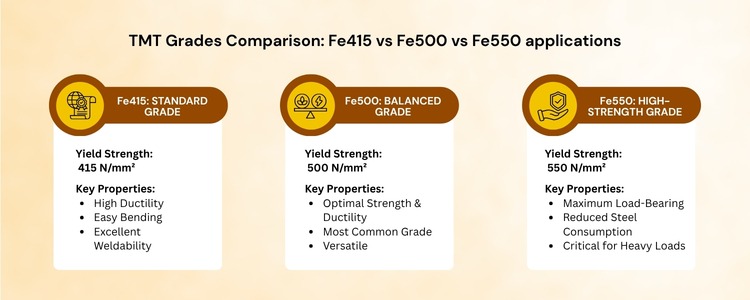
Structural integrity is ensured by selecting the correct TMT bar for the construction project. Different grades of TMT bars are produced for use in different applications.Currently in the export markets you will find 3 Commonly used TMT bar grades:
Fe415 – for residential construction projects
Fe500 – for general construction projects
Fe550 and above – for heavy and high load bearing structures.
Fe500 TMT bars manufactured in India are popular since they have a good balance of strength and flexibility.
When selecting a grade of TMT bar, you should consider the following:
- Load-bearing requirements
- Environmental conditions
- Specific requirements of the project
It is also recommended to consult with structural engineers as well as TMT bar suppliers to ensure that you select the right grade of TMT bar for construction.
Standards and Compliance: Ensuring Quality Assurance
It is also essential to follow the recognised standards set forth, in order for TMT bars to be reliable. For TMT bars produced in India, exporters will adhere to both Indian and International standards to meet the expectations of the global market.
Indian Standards (IS 1786)
The production and quality requirements for TMT bars produced in India are governed by the IS 1786 standard. Standards specify:
- The Mechanical Properties of TMT bars
- The Chemical Composition of TMT bars
- The Test Procedure for TMT bars
By sourcing TMT steel suppliers who adhere to the IS 1786 standards, you are assured that TMT Bars sourced from India will meet the stringent test and quality standards required.
International Certifications
Many TMT bar exporters from India have also complied with International Certification Agencies that are required to supply GCC countries (this may include a number of 3rd party tests for TMT bar verification and/or TMT bar quality).
Identifying Reliable Suppliers
The procurement process begins with picking the correct supplier. Key things to keep in mind when picking a supplier are their reliability, consistency, and transparency.
Some things buyers should look at when evaluating suppliers include their production capacity and scalability; past performance regarding exports; their quality assurance program.
Most suppliers will provide some form of written documentation verifying compliance, physical characteristics and/or physical testing (i.e., certification of quality and/or conformance), etc.
Developing a long-term partnership with a supplier can translate into better prices, priority access to materials and improved coordination over time; this is especially beneficial with respect to large, multi-year capital projects.
Logistics and Supply Chain Considerations
Logistical competencies are vital in meeting delivery timelines while controlling costs associated with a product. When TMT bars are shipped internationally, they are normally bundled and require appropriate handling and storage.
In regard to shipping/handling activities, exporters should be able to:
- Provide secure packaging of TMT bar bundles to avoid damage
- Have established loading and unloading procedures
- Ensure compliance with local shipping laws
At the time of receipt, TMT bars should be stored in a manner that prevents moisture and/or corrosion from coming into contact with them. Appropriate inventory control assists in ensuring that all facets of a project are executed smoothly.
Challenges and Risk Management
Importing TMT bars has many benefits, but buyers should be aware of some risks too.
Risks
Risks associated with importing TMT bars include:
- Fluctuating prices in international markets
- Delays in shipping and customs processing
- Variable quality of TMT bars
Ways to Reduce Risks
There are several ways to reduce risks when importing TMT bars, including:
- Conducting a thorough investigation of suppliers
- Using independent inspectors
- Specifying contract terms clearly
Taking these steps will help make sure the purchasing process goes smoothly.
Future Outlook: Strengthening India-GCC Steel Trade
The outlook for steel trade between India and the GCC looks positive. The GCC has many ongoing infrastructure projects, as well as efforts to diversify its economy, which should continue to drive demand for TMT bars.
Indian exporters will have several advantages when it comes to exporting TMT bars to the GCC due to the following factors:
- Advancements in technology for producing steel
- Greater emphasis on quality and sustainability of steel products
- Strengthened trade partnerships with countries in the GCC
For these reasons, India will continue to be an important supplier of TMT bars to the GCC.

Conclusion
TMT steel bars play a vital role in the structural integrity of modern construction projects. For GCC buyers, sourcing from India offers a combination of quality, affordability, and reliability. However, successful procurement requires a clear understanding of pricing, grades, standards, and supplier capabilities.
By carefully evaluating these factors, buyers can make informed decisions and ensure that their projects benefit from high-quality steel. The continued growth of TMT Steel bars export from india underscores its importance in supporting the GCC’s ambitious development plans.

Diptanshu
Leading research and marketing at Inductus Global, Diptanshu drives the company’s vision to transcend traditional trading through thought leadership in import-export. He spearheads a research-driven approach that prioritizes quality over price arbitrage, positioning Inductus as a strategic sourcing partner rather than a transactional intermediary. His work spans market intelligence, supply chain innovation, and trade dynamics, while playing a key role in sales and business development.