


How Sourcing Agents Manage Quality Control Risks in India for US and European Importers
Why is Quality Control in India More Complex Than It Appears?
Quality checking seems simple enough at the outset, just check specifications, sample the goods and release the shipment. In reality, though, QC in India is part of a multi-layered manufacturing ecosystem that is influenced by regional customs, informal outsourcing and different compliance standards. Most international customers see the finished goods sample and receive a digital report, but they cannot see the actual manufacturing conditions inside the factory.
Professional sourcing agents are essential in this situation as they act as a physical remote extension of the international customer. Agents analyse potential invisible risks during the course of conducting inspections remotely through email or video conferencing or while viewing pre-shipment photographs. The agent’s value comes from both conducting inspections and interpreting compliance in the context of the inspection: understanding context, intent and deviation from writing to meet quality control standards.
What Do Sourcing Agents Assess Before Production Even Begins?
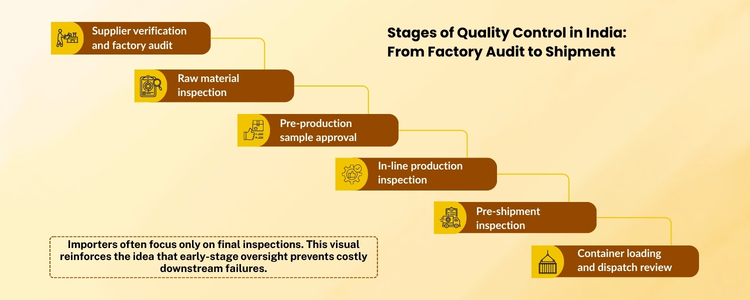
Before any products are produced, sourcing agents apply a rigorous due diligence process on suppliers that goes well beyond reviewing product catalogs or supplier certifications. They will determine whether the factory being used will produce the product themselves or if a trading intermediary will receive orders and then have them produced, and this can have a significant effect on who will be accountable for the quality of the products being produced.
After assessing a factory’s production capacity against order size and checking to see if the factory will have any intention of subcontracting without notifying the sourcing agent, the sourcing agent completes the assessment process by verifying the raw materials used to produce the product, to ensure that the raw materials used to produce the product meet the specifications that were agreed to and that they are consistent from one production run to another. Unless the buyer is physically inspecting the pre-production checks performed by their sourcing agent, the buyer will not see any evidence of these pre-production checks, but these checks are the foundation upon which a quality finished product is built.
How Do Sourcing Agents Monitor Quality During Production?
As soon as production starts, the quality risks associated with mass production significantly increase. A minor variation in any of the raw materials, machinery settings or worker skill can adversely affect the product and potentially cause defect(s) in the finished product. In-line inspections by the sourcing agent help to identify and correct defects during the production process, before they are damaged or irretrievably damaged.
Sourcing agents will observe workflow adhere to standard operating procedures and consistency among shifts. Equally as important, they will verify that experienced workers are not being replaced with temporary workers during heavy production periods. These types of issues are seldom included in any of the standard inspection reports, but are critical to the reliability of the finished product.
What Hidden Compliance Risks Do Agents Identify on the Factory Floor?
Compliance encompasses much more than a product specification; sourcing agents review a variety of aspects of the supply chain when assessing compliance, including compliance with regulatory requirements regarding labor practices, safety standards, and environmental regulations; all of which have the potential for exposing a buyer to a legal or reputational risk. Even if a factory has valid certificates of compliance, there’s no guarantee that it will adhere to these standards on a consistent basis.
Sourcing agents confirm that safety equipment is in use at factories, that workers are not overworked, and that the factories are disposing of waste according to regulations. Compliance checks are essential to all brands, but particularly for brands selling products in highly regulated markets, as non-compliance can lead to fines and the rejection of imported goods.
The level of oversight that a sourcing agent provides is critical not only to ensuring the quality of the product, but also to the long-term credibility of the brand.
Why Are Pre-Shipment Inspections Not Enough Without Local Oversight?
Pre-shipment inspections can provide a momentary picture of inspection results, however, they only provide an assessment of the condition of the goods at the time of inspection; they do not provide any information about the conditions under which these goods were manufactured prior to reaching the time of inspection. This is where sourcing agents can provide additional value – by placing inspection results into context.
It’s possible that a particular batch of products may have passed inspection, but due to conditions that existed earlier in their shipping process, it will show signs of damage, inconsistency, or improper packaging – making them susceptible to greater levels of damage in transit. Sourcing agents can identify these borderlines between compliance and non-compliance and recommend appropriate action prior to the products being shipped.
The manner in which sourcing agents provide this level of judgment based assistance defines sourcing as professional; while the manner in which inspectors perform their inspections confers a checklist-based assessment.
How Do Sourcing Agents Evaluate Packaging and Export Readiness?
Industry research has shown that packaging failure as a cause of post-shipment complaints is significant. Packaging inspection by sourcing agents includes evaluating carton strength, moisture resistance, label accuracy as well as cartons’ ability to withstand the rigors of long-distance transport over varying climatic conditions (e.g., temperature and humidity).
Complying with marking and paperwork requirements for the country of destination is critical to minimizing delays at customs, and identifying these details is often the lowest priority for buyers focused mainly on product specifications. Thus, in this regard, export readiness is an extension of quality, not an afterthought.
What Role Do Sourcing Agents Play in Quality Dispute Resolution?
If there is a quality dispute, the distance compounds the issue. Sourcing agents provide third-party representation that verifies the claim, negotiates a remedy for the dispute, and works with the supplier for rework or replacement.
Additionally, sourcing agents’ understanding of the regional manufacturing culture allows them to resolve problems in a practical way, rather than in an adversarial manner. This creates less escalation, protects the supplier-buyer relationship, and results in a quicker resolution of the dispute.
Such intervention from a sourcing agent is particularly useful when buyers do not have sufficient leverage or a local presence to independently enforce corrective actions.
How Does Quality Control in India Differ Across Industries?
Quality control in different industries can vary widely. In the textiles and crafts sector, the main focus is consistency with craftsmanship and the variation in the raw materials. In the engineering g industry, the emphasis is on the dimensional accuracy of the goods and the standards and tolerances to which the products are built by the final manufacturer.
Sourcing agents tailor their inspections according to these differences between the industries. This industry-specific knowledge of sourcing agents enables them to apply appropriate industry benchmarks instead of generalized standards. It also means that they can advise buyers on what limits and thresholds are realistic in terms of these products.
Why Can’t Technology Fully Replace On-Ground Quality Checks?
Digital technologies such as video inspections, live dashboards and AI-based monitoring have improved the visibility of the supply chain, but cannot replace the need for a physical presence in production facilities. Technologies provide data, and sourcing agents use their experience to understand behaviour, intent, and anomalies that cannot be assessed through technology.
For example, a production line may look to be complying with regulations through a live camera feed, but subtle signs such as hesitation from workers, the substitution of raw materials, or short cuts in production processes require human discretion to understand. Sourcing agents blend data with experience to perform quality control using both analytical and intuitive methods.
What Should Importers Look for When Choosing a Sourcing Agent?
When choosing their sourcing agents, importers should seek agents with expertise related to their industry, capable of performing product inspections, and free from ethical conflicts of interest. Reliability indicators include the clarity and frequency of reporting, the number of times agents visit worksites, and how clearly defined their escalation procedures are.
Agents that provide integrated Procurement Services can also help importers align their sourcing decisions with quality results, reducing the friction amongst cost vs speed vs compliance.
1. Why is quality control in India challenging for overseas buyers?
Distance, supplier opacity, and production variability make remote verification difficult without local oversight.
2. What does a sourcing agent check that buyers cannot?
They assess production discipline, subcontracting risks, labour practices, and early-stage deviations invisible in final samples.
3. Is quality control only about finished products?
No. Effective quality control spans pre-production, in-process monitoring, and export readiness.
4. Can sourcing agents prevent all quality issues?
They significantly reduce risk but cannot eliminate it entirely. Early detection and mitigation remain their primary value.
5. Are sourcing agents necessary for small orders?
Even small orders face quality risks. Local oversight often proves cost-effective in preventing losses.
6. How often should inspections be conducted?
Ideally at pre-production, mid-production, and pre-shipment stages, depending on order complexity.

Diptanshu
Leading research and marketing at Inductus Global, Diptanshu drives the company’s vision to transcend traditional trading through thought leadership in import-export. He spearheads a research-driven approach that prioritizes quality over price arbitrage, positioning Inductus as a strategic sourcing partner rather than a transactional intermediary. His work spans market intelligence, supply chain innovation, and trade dynamics, while playing a key role in sales and business development.