

Top 10 Construction Materials India Supplies to the Middle East
The increased global reach of India’s infrastructure trade has been well received in the Middle East. There is increasing use of infrastructure, as well as substantial government-led initiatives and prolonged construction through real estate projects in the region contributing to a reliable and constant need for quality material for the construction of buildings and other structures. As the construction of buildings and other structures continues to evolve in the region, it is becoming important for an Indian construction materials supplier in the Middle East to serve as a bridge between supply capacity and demand for construction materials.
The reputation of Indian exporters has developed over the years by providing cost-effective, reliable and diverse materials for construction through a variety of project types. The variety of materials exported includes everything from structural components to decorative finishes, and the different categories are growing as exporters embrace innovation and expand their respective supplying capabilities.
India’s Strategic Role in Middle East Construction Supply
Countries in the Middle East such as the UAE and Saudi Arabia have become prime destinations for India’s exported construction-related materials. Contributing factors to the continuous growth of export construction-related materials to the Middle East include the close geographic proximity, established shipping routes, and competitive pricing.
There is an ongoing investment of funds and resources in the Middle East to create and develop infrastructure projects (e.g., Smart Cities and tourism). These initiatives have created a sustainable demand for both bulk and specialised construction materials, and by being able to service multiple supply categories to meet this demand, India is becoming a reliable source.
1. Steel and Reinforcement Materials
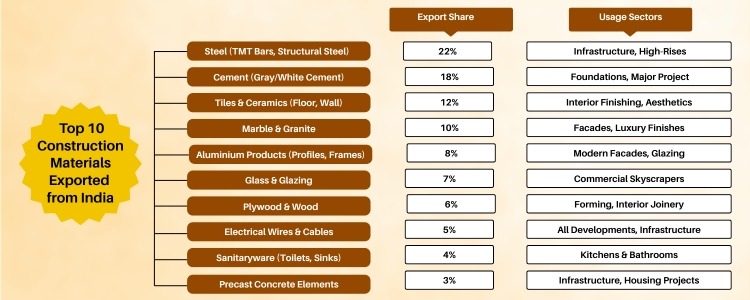
The structural framework of contemporary buildings is largely made of steel, and India is one of the top exporters of steel around the globe. Hair rods (bars used for strengthening buildings), structural steel, and components prefabricated off-site are all widely available throughout the Middle East.
These materials are highly regarded by engineers and contractors for being strong, long-lasting, and in full compliance with international standards. Their use in towering skyscrapers and other big building projects necessitates that they be employed as a fundamental resource.
2. Cement and Clinker
Cement is another product sold widely in the construction sector. Suppliers in India supply both cement and clinker to support the large-scale use of cement by builders throughout the Middle East.
The consistent supply of both products at competitive prices make India a preferred destination for contractors that have large quantities of cement or clinker not only to purchase but also to avoid dealing with late shipments or product shortages.
3. Ceramic and Vitrified Tiles
India has also become a global center for tile manufacturing. A vibrant network of distributors in India support residential and commercial contractors in the region by providing quality materials for tiling projects.
As well as having a wide selection of different types and styles of tile, the average price of tile manufactured in India tends to be significantly lower than those of other countries.
Online ordering of tiles in the United Arab Emirates from India has also made it easier for distributors and developers to obtain tile for their projects.
4. Natural Stone and Marble
India’s natural stone industry is globally recognised, with marble and granite exports forming a significant segment.
An established Indian marble exporter Middle East caters to premium construction and interior projects, offering materials that combine aesthetic appeal with long-term durability.
These materials are widely used in luxury developments, hotels, and commercial spaces.
5. Glass and Aluminium Products
The global market recognizes India’s natural stone industry, with a large portion of its exports consisting of granite and marble products (natural stones) to other countries.
An Indian supplier of granite and marble products specializes as a granite and marble exporter to the Middle East, supplying products for luxury construction and interior design projects, with long-lasting performance along with great aesthetics.
Luxury building development (i.e., luxury hotels) and commercial spaces continue to use these products, including hotels and commercial buildings.
6. Plumbing and Sanitary Ware
The sanitary products exported include pipes, fittings, and bathroom fixtures.
Indian manufacturers of sanitary products offer products that meet the international standards required by local regulations, in both the affordable as well as the more expensive segments. The ability to provide products in both market segments has helped Indian exporters maintain significant market share in the area.
7. Electrical and Wiring Materials
Cables, switches, conduits, and other electrical supply items are critical to supporting the development of infrastructure. In addition to providing quality and competitively priced electrical supplies for both residential and industrial applications in the Middle East
8. Prefabricated Building Components
Indian suppliers also provide prefabricated construction products, which are becoming popular in the Middle East due to their efficiency and cost savings.
Indian suppliers can provide:
- Pre-engineered buildings
- Modular construction components or systems
- Panels designed for ready installation
These types of products will be of particular use in the completion of large-scale projects that are to be completed within a short time frame.
9. Paints, Coatings, and Adhesives
Successful export operations are based on building relationships that create trust and consistency. Long-term partnerships between Indian exporters and Saudi importers have several benefits, including:
- Predictable demand and supply cycles
- Better pricing arrangements
- Facilitated communication and coordination
- Joint venture or collaborative opportunities
Ongoing engagement, quality assurance and timely delivery are critical to preserving these relationships.
10. Wood and Engineered Panels
Wood-based products—such as plywood, MDF, and laminate—are widely used to construct the interiors of buildings and structures. Indian suppliers sell high-quality engineered panels made to international standards that will be used for many applications in residential and commercial construction.
Trade Dynamics and Regional Demand Trends
The rise in India’s exports of building materials to Saudi Arabia is just one aspect of the overall increase in regional exports. Government-sponsored large-scale projects are generating sustained demand for construction materials.
The entire Middle East is heavily investing in infrastructure, tourism, and urban development. This investment will provide a continuous supply of projects.
Indian exporters are well-positioned to meet this demand because of the ability to offer a large variety of materials at competitive prices.
Logistics and Supply Chain Efficiency
Logistics play an important role in maintaining export volumes; the primary mode of transport is by sea through well-connected ports from India to Saudi Arabia.
The following advantages exist for India to maintain its share of the building materials exported to Saudi Arabia:
- Transit times are shorter than other global suppliers.
- Shipping routes already exist and have been established.
- Bulk shipping options are available.
For timely delivery of products, the packaging, documentation, and coordination with logistics partners must be carried out correctly.
Challenges in Exporting to the Middle East
There are many issues that exporters experience, even if the demand is strong (e.g. fluctuation in project demand; competitive pressures from other exporting nations; quality consistency across shipments; regulatory requirements). To solve these issues takes a systematic and disciplined approach to quality management, compliance and market intelligence.
Future Outlook for Indian Construction Exports
While overall construction materials exports from India to the Middle East remain positive, due to the continued investment in infrastructure and growing urbanisation, demand for Indian construction materials will continue to be sustained. Indian suppliers are also investing in technology and product innovation to provide higher quality products, and increase their ability to export.
As the Middle East continues to develop, the role of India as a key supplier will also continue to develop.
Conclusion
When choosing a supplier of construction materials in the Middle East, it is essential for the end user to choose a reputable and dependable supplier and have a structured procurement process in place in order to ensure quality and consistent product availability.
1. Why is India a major supplier of construction materials to the Middle East?
India offers competitive pricing, diverse products, and reliable manufacturing capabilities.
2. What are the most exported materials from India?
Steel, tiles, cement, marble, and sanitary products are among the top exports.
3. How do buyers ensure quality when sourcing from India?
Through certifications, third-party inspections, and supplier audits.
4. What is the primary shipping method?
Sea freight is the most common and cost-effective option.
5. Are Indian materials compliant with international standards??
Yes, many manufacturers adhere to global quality and safety standards.
6. What drives demand in the Middle East construction sector?
Large infrastructure projects, urbanisation, and government initiatives.

Diptanshu
Leading research and marketing at Inductus Global, Diptanshu drives the company’s vision to transcend traditional trading through thought leadership in import-export. He spearheads a research-driven approach that prioritizes quality over price arbitrage, positioning Inductus as a strategic sourcing partner rather than a transactional intermediary. His work spans market intelligence, supply chain innovation, and trade dynamics, while playing a key role in sales and business development.