

What Are the Export Standards for Wholesale Leather Goods Shipped from India to Europe?
The emergence of India as a global production centre for leather goods has resulted in an ever-increasing array of leather goods being exported to Europe. However, it is not enough for an Indian company simply to produce and then ship leather to Europe; it must also comply with rigorous regulatory, environmental and quality standards, all of which are inspected for compliance throughout the production and shipping processes of goods intended for export to Europe.
Wholesale leather goods companies must understand what the standards are to ensure compliance, to reduce the risk of a shipment being rejected for noncompliance, and to build and maintain strong trading relationships over the long term.
Regulatory Framework Governing Leather Exports to Europe
The European Union (EU) has developed a wide-ranging regulatory framework, which is designed to safeguard the health and welfare of consumers as well as the environment and workers who manufacture leather goods to be shipped to the EU. Every Indian exporter of leather goods must be compliant with EU laws and regulations if that exporter wants to access and continue to sell leather goods to the EU.
REACH Compliance
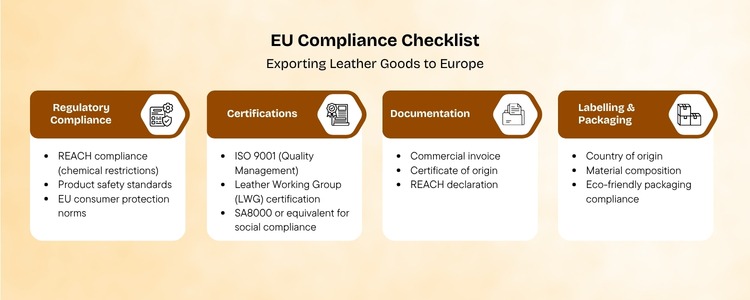
A cornerstone of the EU regulatory framework is known as REACH (the Registration, Evaluation, Authorisation, and Restriction of Chemicals), which regulates the use of chemicals in the manufacturing of leather goods.
REACH requires the following from the leather goods exporter:
To not use any hazardous substances in the manufacturing process, such as chromium VI, dyes, or formaldehyde
To have all leather materials tested for compliance with the requirements of REACH, prior to export
To provide documentation of compliance for all leather goods exported to the EU
Quality Standards and Product Specifications
Quality, durability and finishing are areas in which European buyers have high expectations of Indian Manufacturers of leather goods being exported from India. Manufacturers must meet well-defined specifications.
Material Quality
Full-grain / top-grain leather preferred; even texture / colour consistency; no defects such as scars or rips in the leather
Workmanship
Stitches and edging must be precise; hardware must be of good quality; products must be durable enough for regular use.
Many retailers in Europe perform independent quality checks on the product they import, making product consistency across batches must be non-negotiable.
Environmental and Sustainability Requirements
Buyers want to know that a company’s sourcing and production practices are environmentally conscientious. The expectation from buyers for sustainable products has increased.
For the European Market, there are a number of environmental specifications for leather production:
- Tannery waste management systems must be adequate
- Water use and treatment must be closely monitored
- Carbon footprint of leather production must be reduced
Certifications such as leather working group (LWG) ratings are preferred; Indian exporters that implement eco-friendly manufacturing processes will be able to gain a competitive advantage in the European Market.
Packaging and Labelling Norms
Not only is packaging functional, but it also serves a regulation and safety purpose. European regulations focus on safety and traceability, as well as the recycling and reuse of materials used for packaging.
Packaging Requirements:
- Must be made with recyclable or biodegradable materials
- Must provide appropriate protection from moisture and damage
- Must comply with EU packaging waste directives
Labelling Standards:
- Must include a clear description of the product
- Must include the country of origin
- Must include information about what materials were used to make the product
Properly labelled products are transparent and give consumers confidence in them.
Testing and Inspection Protocols
Before shipment, products often undergo rigorous testing to ensure compliance with EU standards.
Common Testing Parameters
- Chemical composition analysis
- Color fastness
- Tensile strength and durability
- Resistance to wear and tear
Independent laboratories are frequently engaged to certify that products meet European benchmarks. This is particularly relevant for suppliers catering to diverse markets, including those dealing with wholesale leather handbags USA, where similar quality expectations prevail.
Tariffs, Duties, and Trade Agreements
In addition to assessing product quality before arrival at a market, understanding how much it will cost your company to export products is very important as well. Exporters from India have access to certain trade benefits but must keep abreast of tariffs on imported goods in each country.
Important Information: Import Tariffs for Products being Brought into the EU Countries; Benefits of Generalised System of Preference (GSP) and VAT & other Costs, will all have an effect on your company’s ability to compete without sacrificing margins. Pricing strategies should reflect the above-named costs in order to maintain profitability.
Supply Chain Transparency and Traceability
The expectation of transparency in the entire supply chain has increased in requirements by European buyers. Origin of raw materials must also be tracked.
Procurement & Transparency Requirements / Compliance Expectations
- Documentation of leather procurement
- Documentation of tanning processes
- Documentation of any subcontracting facilities
Exporters of leather that sell to global customers like wholesale leather suppliers in the UK are often required to maintain detailed records to ensure accountability.
Challenges Faced by Indian Exporters
Indian exporters are facing many challenges to be able to meet European standards even though they have strong capabilities.
There are many common issues that exporters are up against:
- Raw material quality can vary a lot
- Compliance has large costs associated with it
- A lot of documentation is needed
- Regulations are frequently changing
Exporters who are in the small or medium size range will struggle to keep up to date with changes in regulation without assistance from others.
Strategies for Compliance and Market Success
If exporters want to do well in the European market they need to take a proactive and structured approach to their exporting initiatives.
They should consider implementing the following:
- Invest in modern tanning and manufacturing technology
- Get certified with global certifications
- Create lasting relationships with compliant suppliers
- Stay up to date on regulatory changes
Working together with a reliable supplier of wholesale leather bags can also improve how an exporter runs their business and will provide exporters with the consistency of quality that they need from their suppliers.
Conclusion
Exporting wholesale leather goods from India to Europe is a precise process built on compliance and adaptability. The European market rewards quality and responsibility, so exporters must comply with high levels of legislative and legal requirements at every stage of production and distribution.
By focusing on the areas of compliance with regulations, sustainability and transparency, Indian exporters can meet EU expectations, gaining a reputation as reliable partners in the global leather industry. The journey may be difficult, but for those who successfully complete it, the potential rewards from entering European markets will be large, long-lasting and real.

Diptanshu
Leading research and marketing at Inductus Global, Diptanshu drives the company’s vision to transcend traditional trading through thought leadership in import-export. He spearheads a research-driven approach that prioritizes quality over price arbitrage, positioning Inductus as a strategic sourcing partner rather than a transactional intermediary. His work spans market intelligence, supply chain innovation, and trade dynamics, while playing a key role in sales and business development.