


What is Procurement in Business? A Complete Guide 2026
What Does Procurement in Business Really Mean Today?
Procurement refers to the formalised (structured) way to obtain goods, services, or works needed for the continuity of an Organisation’s Business Operations. Starting from early 2026, Procurement has developed significantly beyond ordering goods / issuing purchase orders and negotiating with Vendors.
Today, at the new intersection of cost management, risk mitigation, compliance and creating value for the future, Procurement is integrated into every aspect of an Organisation’s business.
In today’s global economy, Procurement is no longer a distinct support function; it affects financial performance, operational stability (continuity) and can even impact an Organisation’s reputation. Procurement decisions affect supply chain stability, product quality and the degree to which an Organisation can respond to an unpredictable market.
How Has Procurement Evolved From a Transactional Role?
In the past, Procurement was primarily administrative in nature, with its focus primarily on acquiring inputs (goods, services or works) for the best possible price while being less concerned for long-term financial viability / risk of Suppliers. As Globalisation promoted the creation of larger Supplier Networks and introduced more complexity to Procurement Operations, this model began to change.
The creation of Globalised Supplier Networks, coupled with a growing number of Events impacting Global Supply Chains in the last 10 years, e.g., geopolitical tensions, freight / transportation bottleneck issues etc. have accelerated the change in Procurement Management. Procurement Leaders are now expected to manage risk by forecasting potential risks, encouraging Supplier Innovation and providing insight into longer-term Organisation Growth Plans. Therefore, Procurement has matured into what is now referred to as Procurement Management, a Strategic Function where the justification of Procurement Operations is based on more than just price, i.e., the justification also includes Resilience and Strategic Fit.
What Are the Core Objectives of Procurement in Business?
Although cost savings are still one of the primary objectives of procurement, they are no longer the only consideration for procurement teams today. Affordability, as well as reliability, compliance, and ethical considerations, must be balanced by Procurement Professionals in today’s business environment. Some of the key considerations for procurement include ensuring that supplies are available without interruption, meeting quality standards, mitigating supplier risk, and aligning with corporate strategy.
Additionally, procurement is increasingly involved in supporting corporate sustainability commitments and regulatory compliance. This broadened mandate means that procurement decisions must now consider a larger view of the business beyond simply being a “purchasing paper” expert.
How Does the Procurement Process Typically Work?
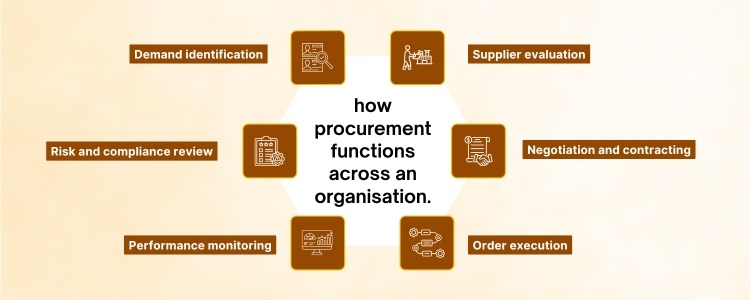
The procurement process generally starts with demand identification, supplier evaluation and selection, contracting, and monitoring supplier performance. While this framework is often described as a linear process, it is actually an iterative decision-making process supported by data.
Having a clear plan for demand is critical to eliminating urgency-driven purchases, which can create inflated prices. Evaluating suppliers involves more than just comparing price; it also includes evaluating the supplier’s capacity to perform the work, performing due diligence on the supplier’s compliance with all applicable laws, and reviewing the historical performance of the supplier. Once the contract is signed with the supplier, the supplier’s performance will be monitored on a regular basis to ensure continued compliance with all of the contract requirements. By following this structured procurement process, companies will achieve fewer reactive purchases and increase their ability to predict future purchasing behaviour.
Why Are Procurement Services Increasingly Outsourced?
Due to the growing complexity of procurement, many organizations are turning to specialty Procurement Services in order to augment their internal capabilities. This can include supplier audit and cost benchmark services for materials as well as contract management and risk assessment services.
By outsourcing some procurement activities, companies can access specialty knowledge without increasing their internal staffing levels. Firms with multiple geographical areas or industries as part of their business will benefit the most from outsourced procurement assistance, due to the need for local market knowledge and awareness of regulatory requirements. The outsourced procurement service complements the organization’s oversight of these functions through specialized knowledge rather than replacing it.
What is Strategic Procurement and Why Does It Matter?
Strategic procurement focuses on long-term value rather than cost savings in the short term, and it aligns sourcing decisions with business goals such as entering new markets; increasing innovation; or building a more resilient business model. The strategic procurement approach emphasizes creating partnerships with suppliers rather than having transactional relationships—e.g., through the use of long-term contracts, collaborative forecasting, and shared performance metrics. By integrating procurement into the overall strategic plan of the organization, companies can reduce their exposure to volatility and have the ability to quickly adapt to rapidly changing market conditions.
How Does Strategic Sourcing Strengthen Business Outcomes?
When making sourcing decisions, strategic sourcing evaluates supply risk, cost drivers and market dynamics. These analyses provide insight into the best sourcing strategy.
Strategic Sourcing uses data from various sources (ad-hoc negotiations) instead of relying on the negotiation process. By providing more information about the supplier’s position in the market and the business objectives of all parties involved, there is now more reason to be confident about the outcome of negotiations. In addition to confidence in the outcome, using strategic sourcing also increases the negotiation strength of the purchasing department and creates greater accountability on the part of suppliers.
What Role Does Technology Play in Modern Procurement?
With digital tools, procurement has evolved into a more efficient operation – providing increased visibility to both procurement and suppliers. Procurement automation platforms facilitate routine processes, such as purchase order approval, monitoring POs, and reconciling invoices.
It is important to note that technology should be seen as an enabler of business; it does not replace judgment in the execution of the business. Therefore, effective procurement teams utilize both automation and consideration of human judgment when making procurement decisions based on available data. Digital technology, in conjunction with a thoughtful process will lead to improved accuracy, reduced cycle times, and enhanced audit readiness.
Why is Ethical Sourcing Becoming a Procurement Priority?
The decision-making process for procurement is subject to scrutiny from an ethical standpoint, as labour practices, the environment and supplier behaviour are now seen as impactful to brand image and regulatory compliance. This change in perspective means that sourcing ethically is no longer just about image; instead, it is now a requirement under governance requirements.
For businesses, sourcing ethically means that they need to ensure that their suppliers meet acceptable standards of conduct—not just in their direct operations but the extended supply chain as well. The procurement team has an important role to play in establishing these expectations through contracts, audits and ongoing engagement.
How Does Procurement Support Overall Business Performance?
Procurement has an important impact on the rest of the organisation. Effective procurement enables an organisation to continue producing its products (continuity) while having cost stability and margin protection. In addition, procurement activities contribute to an organisations innovation by providing early engagement with suppliers in developing products and improving processes.
Thus, procurement is a key driver in creating competitive advantage. A well-designed Business procurement system will allow a company to grow in size with good scalability while managing uncertainty, which is especially important in an unstable business climate.
What Skills Define Procurement Professionals in 2026?
In order for the procurement professional in 2026 to be equipped for success, he/she will require a diverse skill set. These include analytical skills; negotiation skills; a high level of understanding of risk; and excellent communication skills at a cross-functional level. Digitally literate; an understanding of both the regulatory environment and how regulations would affect the procurement professional’s function are also key to effectively succeeding in procurement.
Besides having skilled and knowledgeable procurement professionals, it is important for procurement professionals to have a strategic mindset. Procurement leaders must understand how sourcing decisions will directly impact finance, operations and long-term growth. This strategic perspective is what separates modern procurement from previous transactional forms of procurement.
1. What is procurement in business in simple terms?
It is the process of sourcing and managing goods and services needed for business operations.
2. Is procurement only about cost reduction?
No. It also focuses on quality, risk management, compliance, and long-term value.
3. How is procurement different from purchasing?
Purchasing is transactional, while procurement is strategic and lifecycle-oriented.
4. Do small businesses need formal procurement processes?
Yes. Even simple structures improve cost control and supplier reliability.
5. What role does technology play in procurement?
It improves efficiency and visibility but works best alongside human judgement.
6. Why is ethical sourcing important in procurement?
It reduces regulatory risk and protects brand reputation.

Diptanshu
Leading research and marketing at Inductus Global, Diptanshu drives the company’s vision to transcend traditional trading through thought leadership in import-export. He spearheads a research-driven approach that prioritizes quality over price arbitrage, positioning Inductus as a strategic sourcing partner rather than a transactional intermediary. His work spans market intelligence, supply chain innovation, and trade dynamics, while playing a key role in sales and business development.