

How Global Retail Chains Find the Best Bulk Snack Suppliers (And How You Can Too)
The snack market has grown considerably over the last ten years due to dynamism, urbanization, and an appetite for on-the-go convenience. The supply of snacks through physical retailers, from legacy multinational chains to the latest boutique retail start-ups, has increased significantly.
For some of the larger retail chains, their selection of bulk suppliers of snacks has become a more complicated decision than simply deciding where to source products… it’s now a well-thought-out methodical process that incorporates supplier evaluation, supply chain resiliency, price-competitiveness/efficiency, and product quality.
Many of the guidelines used by large retailers can also be applied to smaller operators looking to create sustainable, reliable supply relationships with their suppliers. Accessibility to information on how these organizations are able to identify and work with quality suppliers can offer great insight to retailers looking to be competitive in today’s evolving, fast-paced food industry
The Strategic Importance of Bulk Snack Suppliers
High-volume, frequent supply cycles are prevalent in large retail chains. Because snacks are among the fastest selling consumer products, their availability must always be consistent and of quality.
This is why retailers typically partner with reliable suppliers that can supply bulk amounts of snacks without compromising quality.
Reliable suppliers allow retailers to:
– Maintain consistent availability of products throughout many locations
– Negotiate lower priced goods via economies of scale
– Decrease negative impacts of logistics inefficiently
– Expedite the introduction of new snack products
Retailers often feel that reliability of their supply chain has the same level of importance as the appeal of their products. If a retailer’s supplier were to have a supply chain disruption, it would result in empty shelves and significant revenue loss.
How Global Retailers Identify Reliable Suppliers
Global retailers typically do not make their supplier selection decisions based solely upon any one criteria. They typically complete a multi-step evaluation process that is designed to provide both stability in operations and a long-term asset to their business.
1.Supplier Reputation and Industry Experience
Established retailers complete comprehensive background investigations on all potential suppliers prior to doing business with them. They often do this through an investigation of:
– Length of operation
– Experience with similar customers
– Ability to comply with food safety regulations
– Certifications related to food safety, such as ISO, HACCP, and FSSC
The supplier that has previously established a history of servicing large retail networks is most likely to be selected when the supplier is a snack food supplier to a supermarket. Examples of common supplier requirements when working as a snack food supplier to a grocery store include packaging consistency, proper labelling, and delivery timelines that are consistent with agreed upon terms between the supplier and retailer.
2. Production Capacity and Scalability
Retail chains require suppliers that have the capability to scale up production based on seasonal demands or promotional events.
For example, during holiday seasons or larger advertising promotions, demand for snacks can increase significantly and retailers want to know which suppliers are capable of increasing their production quickly and with no delays.
Vendors that have strong manufacturing capabilities, automated processes, and a consistent source of raw materials are more precious to the retailer as reliable business partners.
3. Pricing Transparency and Cost Efficiency
One of the core issues for large retailers is managing their costs.
Typically, retail chains will ask for detailed purchasing agreements that contain:
Production breakdowns
Transportation charges
Packaging costs
Minimum order quantities
Most retailers prefer to work with wholesale snack distributors to save money on bulk pricing to keep their retail margins competitive.
However, the lowest price on an item does not always guarantee the retailer the best relationship with the vendor. Retailers examine reliability and product quality along with the price.
4. Supply Chain Stability
A key takeaway for international retailers after supply chain disruptions over the last few years has been identifying resilient supply chains.
Retailers assess their suppliers for:
Sourcing alternatives for raw materials
Alternate manufacturing sites
Efficient supply chain logistics
Retailers sourcing internationally for snack foods typically work with suppliers that have the ability to provide international distribution and adhere to the regional guidelines for food.
This provides retailers the flexibility to maintain a consistent flow of products to all countries where products are sold.
5. Quality Assurance and Compliance
Safety was always a fundamental piece of the puzzle.
Retailers require suppliers to adhere to international safety standards, including:
- A chain of custody that tracks ingredients from the source to the store
- A quality control method that verifies the quality of all incoming ingredients prior to production
- Hygiene and sanitation methods that are used throughout manufacturing and distribution
- Shelf life management that allows retailers to sell all of their products in the appropriate time frame
Retail chains continually audit their manufacturers through factory audits and perform random quality tests to verify that they maintain the same quality.
The Role of Data and Market Insights
Recent changes in retail procurement have created an environment that is more data-driven.
Analytical methods are becoming very important for large retailers to analyze consumer behaviour, demand by region, and category trend growth. This allows them to determine which types of snack food will be sourced and how much of each item should be ordered.
Demonstrating the ability to track demand patterns and to align production with retail sales cycles provides benefits to suppliers.
Retail chains are also increasingly looking for suppliers to work with them on providing market intelligence, achieving product innovation, and forecasting demand within each respective category.
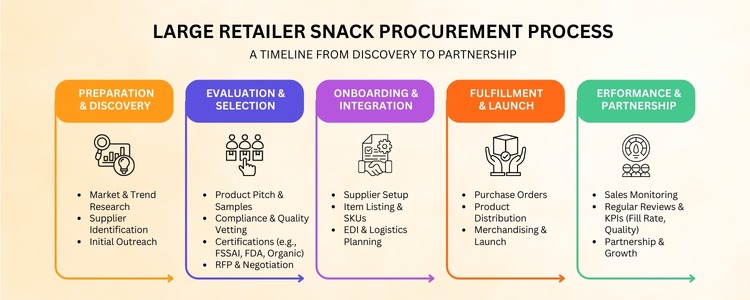
Building Long-Term Supplier Partnerships
The majority of retailers plan for their future suppliers to develop stable partnerships instead of constantly switching. This stable partnership provides benefits to both retailer and supplier.
Benefits of Long-Term Supplier Relationships
- Improve supply planning
- Optimise logistics route
- Reduce Procurement Cost
- Improve Product Introductions
In many cases, retailers work closely alongside their wholesale snack suppliers to create unique snack assortments or private label items; thus, allowing them to differentiate themselves while remaining competitive in terms of costs.
The development of a long-term partnership creates trust between the two parties involved. Trust is a key component when it comes to managing supply chain risk.
How Smaller Retailers Can Apply the Same Strategy
Larger multinational retailers have bigger purchasing operations and resources than smaller retailers. But that doesn’t mean smaller retailers can’t implement similar sourcing strategies.
- Supplier Reliability is Key
When working with multiple, inconsistent vendors, a retailer will have difficulties. To prevent this, businesses should choose suppliers whose production and delivery performance is dependable. Verifying a supplier’s certification and requesting product samples can give retailers reliable partners.
- Assess Logistics Capabilities
Even the best supplier can become a problem; delivery methods can be unreliable. Thus, retailers should evaluate transportation systems, shipping schedules, and warehousing assistance before selecting suppliers.
- Negotiate a Written Agreement
Establish clear definitions for agreements to avoid confusion later. Agreements must define:
- Pricing Formula
- Delivery Schedules
- Quality Standards
- Return Procedures
A well-written agreement provides protection for both parties, the retailer and vendor.
- Beginning with a Pilot Order
Retailers often place smaller pilot orders to compare before committing larger orders. This allows retailers to evaluate product quality, packaging uniformity and delivery reliability before increasing their commitment to the supplier.
- Monitor Market Trends
Consumption habits for snack foods are changing rapidly. Examples of recent trends include health-oriented snacks, plant-based products, and new flavor innovations from around the world. Retailers who stay up-to-date with snack trends will have opportunities to work with suppliers to develop snack products before their competitors do.
The Future of Snack Procurement
As consumer behaviors and innovations in supply chain management shape the future of the global snack industry; retailers are placing increasing emphasis on:
Sustainable sourcing practices
Healthier snacks
Regional flavour variety
Transparency within their supply chains
Retailers that choose suppliers that meet these criteria will be better positioned to establish long-term retail partnerships.
Additionally, advances in digital procurement platforms and supply chain technologies have streamlined the process of finding suppliers, making it easier than ever for retailers of all sizes to access global supplier networks and develop sound sourcing strategies.

Conclusion
Major retailers have established a comprehensive, methodical approach to identifying trustworthy suppliers, which includes evaluating manufacturing capabilities and checking for compliance with government regulations. Each step in this process is designed to reduce risk and guarantee product quality.
Businesses that want to enhance their sourcing strategy can benefit from this approach. Retailers can establish a stable relationship with their bulk snack suppliers and guarantee continuous product availability through a focus on reliability, transparency, and long-term collaboration.
With the intense competition amongst grocery retailers for shelf space and consumer attention, partnering with the right supplier could ultimately be the deciding factor in whether a retailer is able to expand and succeed.
Frequently Asked Questions (FAQ)
Sourcing services companies are professional firms that assist businesses with supplier relationship management, with an emphasis on efficiency and compliance, enjoying a long-term relationship and collaboration.
Agents usually manage single transactions, whereas sourcing companies create a working relationship with suppliers by employing a complete supplier relationship management process with strategic oversight.
Because trust and compliance help assure quality, minimize risk, and ensure delivery performance.
Technology provides transparency, risk monitoring, and automates and enables collaboration between buyers and suppliers across borders.
Sourcing services firms help mediate disputes, enforce contractual obligations and formalize a corrective actions plan, whilst assuring business continuity.
No. Small and medium-sized enterprises will also leverage the knowledge of sourcing services companies and access to their network to connect to global suppliers without excess overhead.