

How the Iran–USA–Israel War is Disrupting Global Supply Chains in 2026
In 2026, Iran and the U.S. have had to deal with major geopolitical tensions and have created long-term ramifications outside the battlefield. One of those systems is international trade; thus, global supply chains (the basis of international trade) are being affected in a significant fashion. A region of the world that is critical for both energy exports and key commercial transportation routes, as conflicts continue to escalate, companies and governments are starting to experience a very disruptive moment.
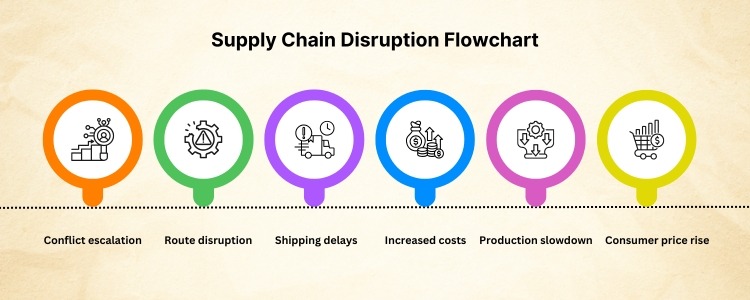
The impact of this new crisis is being felt through shipping delays, increases in freight costs, changes in logistics routes, and resource shortages. The ramifications are both immediate disruptions and longer-term ramifications. This article will discuss how the ongoing conflict will continue to change trade patterns and procurement methods and impact long-range economic planning.
Strategic Importance of the Middle East in Trade
The Middle East has historically served as an essential center for global trade and business activity, mainly due to the region’s strategic placement over many critical waterways (such as the Strait of Hormuz) that cross through the region. Approximately 20% of the world’s petroleum passes through these narrow channels every day, which means any kind of conflict or other disruption on land and/or sea in this area affects the global supply chain and economy very quickly.
By 2026, as military operations were increasing rapidly, many nations began placing blockades in hostile areas (mostly by the blockading of shipping routes), increasing naval patrols in the waters adjacent to the blockading nations, and as a result high insurance requirements were required for any vessels trying to navigate the blockaded areas. These actions caused many shipping companies to either postpone their operations until later in the year or find alternate routes that were much longer and much more expensive (around the Cape of Good Hope). These blockades were creating both additional time delays and considerable financial strain, to an already extremely weakened global trading network.
Energy Supply Disruptions and Cost Inflation
The immediate loss due to this conflict is energy. As a large oil-exporting and producing nation along with areas of it containing crucial infrastructures like oil refineries and transport routes, any attacks on either would serve to reduce the amount of oil available globally.
As prices of crude oil rise, so too does the cost of transporting goods and producing goods made of crude oil, creating exceptional profit pressure on industries that are very reliant on fuel—airlines, shipping, and heavy manufacturers—all of which are seeing significant pressure on their profitability. This type of increase in profit pressure will have inflationary ramifications for many developing economies due to increases in their currency’s value relative to other developed currencies.
Increasing energy prices will also negatively affect agricultural productivity because fertilizer and irrigation systems rely heavily on fuel, creating significant cost-push inflation forces through all industries.
Breakdown in Logistics and Shipping Networks
One of the most visible impacts of the war is the disruption of logistics networks. Ports in conflict-adjacent regions are either operating at reduced capacity or have been temporarily shut down due to security concerns.
Global shipping giants have issued advisories, warning of delays and congestion. Containers are being stranded, and delivery timelines have become increasingly unreliable. This unpredictability is forcing companies to rethink their inventory strategies.
The traditional “just-in-time” model is rapidly losing favour. Businesses are now shifting towards maintaining higher inventory buffers, even if it increases holding costs. This marks a significant shift in supply chain management practices, where resilience is taking precedence over efficiency.
Impact on the Procurement Process
Disrupted logistics systems are one of the most obvious effects of this conflict. Ports in close proximity to conflict zones are working either at greatly reduced capacities or, in some cases, have suspended operations due to safety concerns about remaining operational.
Global shipping companies have already issued advisories about delays and port congestion, while many containers have been abandoned without any means to relocate for the foreseeable future, significantly reducing reliability and predictability for delivery timelines and causing many to rethink their inventory management strategies.
The “Just in Time” inventory management strategy is quickly losing its popularity; therefore, retailers are now focusing on having excess inventory (even at a significant increase in holding costs) as they plan to shift towards increasing inventory buffers. This will significantly change supply chain management practice by moving from a focus on efficiency to a focus on resilience.
Rerouting and the Rise of Alternative Trade Corridors
With traditional trade routes experiencing disruption recently, many new trade corridors have emerged to fill that space. Most notably, the International North – South Transport Corridor (INSTC) connecting India to Europe and Russia through Iran, has been significantly impacted by the war, resulting in fluctuating levels of viability.
Additionally both Southeast Asia and Africa are positioning themselves to be new, alternative trade routes. While these new routes may be logistically longer, they provide more stable options. Government investment is being made in infrastructure to develop this shift, including port expansion and rail upgrades.
The potential reconfiguration of global trade routes is not simply a temporary change but could represent a more permanent shift in the world’s global commerce patterns.
Strain on Procurement and Sourcing Services
Companies that currently rely on procurement services and external sourcing services are facing tremendous challenges. Third party service providers are being pressured to offer companies dependable alternatives during a volatile time.
As a result of increasing demand for real time information, companies are requiring access to risk assessment tools and contingency plans. Additionally, more companies will rely on the use of technology and data analytics in order to navigate uncertainty and risk in business activities; however, smaller companies who do not have these resources will continue to struggle and suffer.
Finally, this will lead to the widening of the gap between larger corporate entities that have strong risk management programs and smaller enterprises that are unable to adapt as quickly.
Technological Adaptation and Risk Mitigation
Companies use technology to lessen the effects of disruptors through digital solutions like analytics, machines learning, and blockchain tools to improve visibility throughout their supply chains.
Companies are investing in predictive analysis to allow them to prepare and react to disruptors. Digital twins, which are computerized copies of real-world supply chains, can be used to analyze multiple scenarios and create plans to deal with possible issues.
As great as these tools can be, there is significant cost associated with the implementation of these systems. Therefore, there is inconsistency in the level of adoption around the world between industries.
Sector-Specific Impacts
The automotive industry is experiencing the direct impact of both the automotive and semiconductor industries.
The automotive industry is suffering from a lack of critical parts and delays in shipping products to meet customer demand, which affects the overall production of new automobiles.
The electronics industry is experiencing problems associated with the supply chain of semiconductors.
The pharmaceutical industry is experiencing delays in obtaining raw materials necessary for production.
The retail industry is having shortages of inventories available to serve customers. Retail prices are also increasing as a result of the increase in costs to supply their customers.
Because of the interconnectedness of industries, the impact of disruptors is compounded across multiple sectors.
Long-Term Implications for Global Trade
The conflict of Iran versus U.S.A. versus Israel will have an extremely long-term impact on the state of global trade and businesses will shift their focus from cheaper to more resilient ways of conducting business. This can lead to a more regionalised manner of doing business with fewer organisations using suppliers across long distances, but rather, using suppliers located closer to them, in their region, or in some cases, setting up their own supply network.
Governments as well are re-evaluating how they do business with other nations and their levels of dependency upon their trade with other nations. More focus will shift towards developing strategic stockpiles of materials, encouraging domestic manufacturing through incentive programs, and diversifying trade agreements with more countries outside of their normal trade pattern.
In all essence, this crisis will just accelerate and reshape existing trends, affecting the entire future framework of global commerce
Conclusion
The disruptions taking place in 2026 due to the Iran–U.S.A.–Israel conflict have demonstrated that all of today’s interconnected economies (i.e., global supply chains) have been built upon the concept of “efficient” / “cost-effective” supply chains and being now put to the test for their resilience against future disruptive events due to geopolitical risk.
The future success of companies, as they adjust to this ever-changing business landscape, will depend on their ability to adapt. The ability of companies to quickly respond to disruptive events either via replacing legacy technologies with newer/trending technologies or expanding their supplier base is paramount to any organisation’s ability to continue operating successfully in the future years to come
Frequently Asked Questions (FAQ)
Sourcing services companies are professional firms that assist businesses with supplier relationship management, with an emphasis on efficiency and compliance, enjoying a long-term relationship and collaboration.
Agents usually manage single transactions, whereas sourcing companies create a working relationship with suppliers by employing a complete supplier relationship management process with strategic oversight.
Because trust and compliance help assure quality, minimize risk, and ensure delivery performance.
Technology provides transparency, risk monitoring, and automates and enables collaboration between buyers and suppliers across borders.
Sourcing services firms help mediate disputes, enforce contractual obligations and formalize a corrective actions plan, whilst assuring business continuity.
No. Small and medium-sized enterprises will also leverage the knowledge of sourcing services companies and access to their network to connect to global suppliers without excess overhead.