

Why European Buyers Prefer Indian Spices for Retail & Food Manufacturing
India: The Land of Diverse Spices
What if a single nation’s soil could season half the world’s kitchens? For India, that isn’t a rhetorical stretch; it’s a working reality. From the cardamom-laced hills of Kerala to the coriander belts of Rajasthan, the chilli fields of Andhra Pradesh, and the cumin and fennel tracts of Gujarat, Indian spices draw their character from a geography few competing origins can replicate.
This agro-climatic range is not incidental; it’s the foundation of a spice trade legacy stretching back centuries, one that has quietly matured into a modern export infrastructure. The question today isn’t whether India can supply the world’s spice cabinets; it’s why European buyers, in particular, keep choosing it first.
Why Indian Spices Stand-Out as No.1 Choice for European Buyers?
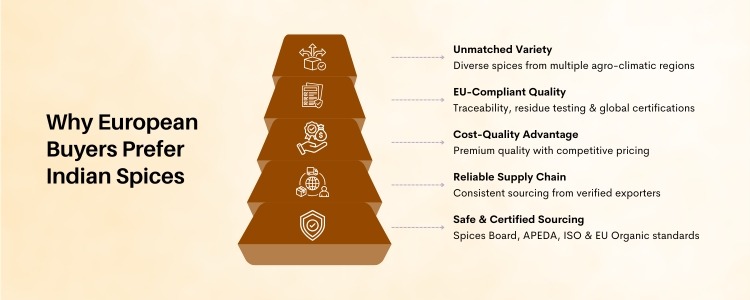
Scale is the first argument. As the world’s largest producer and exporter of spices, India is one of the few origins capable of servicing a boutique European retailer’s curated order and a continental food manufacturer’s bulk requisition in the same season, without asking either to compromise. But volume alone has never won loyal buyers; quality has.
Indian exporters have steadily aligned with EU food safety expectations, investing in traceability systems and residue-testing protocols that reassure procurement teams long before a shipment reaches port. Then there’s the economics: few origins match the price-to-quality ratio that spices from India consistently deliver, giving European buyers room to protect margins without diluting product standards.
And underlying all of it is dependability, a dense, established network of Indian spices suppliers and Indian Spices Exporters that European FMCG and retail brands can integrate into their supply chains with minimal friction. Put simply: for European buyers, India isn’t an alternative sourcing origin. It’s fast becoming the default one.
Advantages of Indian Spices in European Retail & Food Manufacturing
The case for Indian spices isn’t anecdotal, it’s structural. Laid side by side, the advantages hold up across both ends of the value chain, from a supermarket shelf in Hamburg to a processing line in Lyon.
| Advantage | Relevance to Retail | Relevance to Food Manufacturing |
|---|---|---|
| Unmatched Variety & Range | Wide assortment for private-label, branded, and premium SKUs to meet diverse consumer preferences. | Consistent access to multiple raw material grades for different product formulations and production needs. |
| Cost Competitiveness | Improves retail profit margins through competitive sourcing and pricing. | Reduces large-scale procurement costs, improving manufacturing efficiency and profitability. |
| Certifications (FSSAI, EU Organic, ISO, HACCP, BRCGS) | Enhances consumer confidence and supports premium shelf positioning. | Simplifies compliance with international food safety and regulatory requirements. |
| Shelf-Life & Processing Standards | Minimizes product wastage and extends inventory turnover cycles. | Ensures consistent quality, longer storage stability, and reliable production performance. |
| Supply Reliability | Reduces stockouts, maintains consistent product availability, and supports long-term retail planning. | Ensures an uninterrupted supply of raw materials, preventing production delays and maintaining manufacturing schedules. |
Seen this way, sourcing from India stops being a cost decision and becomes a structural advantage buyers can build strategy around.
Safe Sourcing Guide for Exporting Indian Spices
For a European buyer evaluating a first-time or expanding partnership, safe sourcing starts with credentials, not catalogues. Begin by verifying that a prospective partner is registered with the Spices Board of India and holds valid APEDA certification, both are non-negotiable markers of legitimacy in this trade. From there, insist on lab-tested quality reports covering pesticide residue and aflatoxin levels; a credible exporter will produce these without hesitation, not after repeated requests.
Commercial terms matter just as much as compliance. Understanding the Incoterms commonly used in spice trade, FOB and CIF chief among them, protects buyers from ambiguity over risk transfer and cost allocation. Commodity-specific due diligence is equally essential: for turmeric export from India, buyers should scrutinize curcumin content and moisture standards, while for Red Chilli Export from India, colour value (ASTA) and pungency consistency are the details that separate a reliable shipment from a disputed one. Working with established Turmeric Exporters who can document traceability from farm to packaging isn’t a bonus, it’s the baseline for a partnership built to last beyond a single order.
Potential Risks & Challenges Involved
No sourcing origin is without friction, and European buyers tend to trust transparency more than a flawless pitch. Quality can vary sharply among smaller, unregistered exporters, a risk largely mitigated by sourcing exclusively through Spices Board-certified partners. Climate remains a genuine variable too: monsoon dependency can affect chilli and turmeric yields year to year, though diversified sourcing across regions helps buyers absorb the shock rather than feel it directly.
Regulatory ground is also shifting, EU thresholds on Maximum Residue Limits and the post-2021 tightening around Ethylene Oxide have raised the compliance bar, rewarding exporters who invest in testing infrastructure and penalizing those who don’t. Add to this the occasional logistics and documentation delay at customs, and the picture is clear: the risks are real, but they are manageable, predictable, and increasingly priced out by the exporters who take certification seriously.
Conclusion
So, what if a single nation’s soil really could season half the world’s kitchens? For European retail and food manufacturing buyers, the evidence increasingly says it already does. Diversity of produce, growing compliance readiness, and an expanding, more reliable base of Indian spices suppliers together make India not just a sourcing option, but a structural advantage. The risks are known and manageable; the upside is compounding.
For buyers ready to move beyond one-off orders, the next step is simple: connect with verified Indian Spices Exporters and start the sourcing conversation today. In global spice trade, India isn’t competing for the top shelf, it’s already there.

Pratibha Soni
I write where strategy meets storytelling. As a passionate writer and literary enthusiast, I craft business-focused content that transforms trading insights into compelling narratives. Drawn to global business ecosystems, I enjoy turning research, innovation, and ideas into content that informs, connects, and inspires. With an analytical mind and a creative soul, I bring curiosity, collaboration, and a sharp eye for detail to every project. Adaptable and growth-driven, I believe the right words do more than communicate; they leave an impression.