

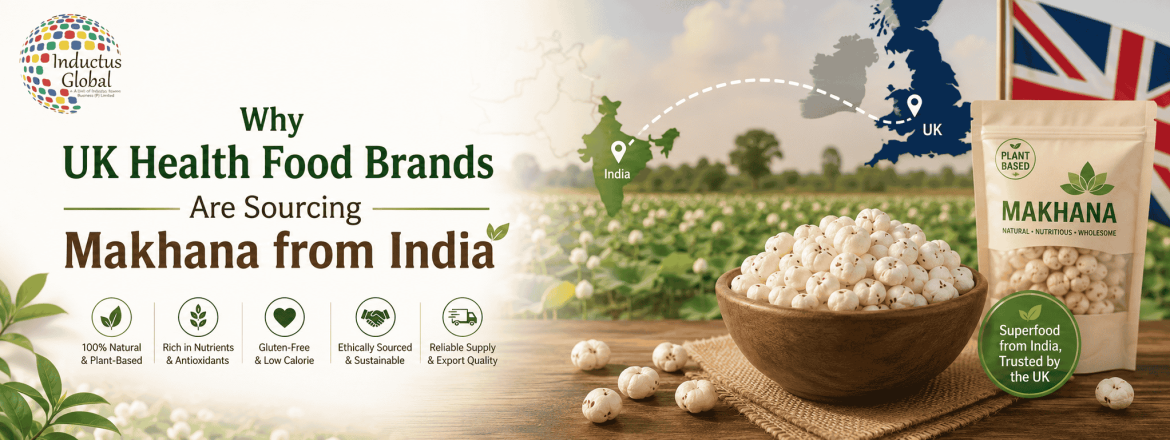
Why UK Health Food Brands Are Sourcing Makhana from India
Foxnuts: The Trend of Health Industry
What does a temple offering in Mithila have in common with a wellness aisle in London? Increasingly, the answer is makhana. What began as a ceremonial Indian snack has quietly popped its way onto European shelves, riding the same wave that has turned “clean label” into a retail imperative. Consumers are no longer just buying snacks; they are buying ingredient lists. Low-calorie, gluten-free, plant-based, minimally processed, the criteria keep narrowing, and fewer snacks keep qualifying. Foxnuts do.
Naturally low in fat, rich in fibre and protein, and free of the additive baggage now facing shelf-edge scrutiny, makhana sits precisely where functional snacking is heading. For B2B buyers scouting the next category-defining ingredient, sourcing makhana from India is fast becoming less a niche curiosity and more a strategic decision, and the reason starts with supply.
India as Top Supplier of Foxnuts (Makhana) in 2026
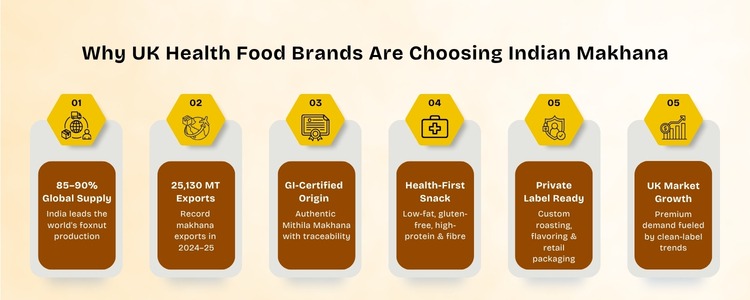
No conversation about foxnut export from India can skip the numbers, because they tell a story of near-total dominance. India supplies an estimated 85–90% of the world’s makhana, a position built on decades of cultivation expertise concentrated almost entirely in one state. Export volumes climbed from 6,700 metric tonnes in 2020 to over 25,000 metric tonnes by 2024, a compound annual growth rate north of 39%, according to APEDA data.
What’s changed isn’t just volume; it’s composition. Where exporters once shipped mostly raw or lightly processed grades, the basket has diversified into roasted, flavoured, and private-label-ready formats, precisely the shelf-ready SKUs UK retailers want, not undifferentiated bulk commodities. That shift from raw-material exporter to finished-product partner is what separates a genuine makhana export from India supplier from a mere trader.
Origin, Stats, and Cultivation of Makhana in India
Every export story needs an origin, and this one runs through Bihar’s Mithila region, where Mithila Makhana carries a Geographical Indication tag secured in 2022, a credential UK importers increasingly ask for, since GI status converts a commodity claim into a traceable, authenticated one.
Did you know makhana isn’t grown on land at all? Euryale ferox, the aquatic plant behind the seed, is cultivated in shallow ponds and wetlands and hand-harvested by local communities using traditional bamboo tools, before the seeds are sun-dried and roasted into the familiar popped form. It’s labour-intensive, seasonal, and still largely unmechanised, details that matter to ESG-conscious UK brands building sourcing narratives around farmer livelihoods, not just ingredient specs. The government’s newly formed Makhana Board, backed by a dedicated multi-year central scheme, signals this cottage industry is now a national policy priority.
United Kingdom and its Growing Health Food Industries Demands
On the demand side, the UK tells its own compelling story. The country’s snacking market was valued at roughly £55+ billion in 2025 and is forecast to keep climbing through the next decade, but the growth that matters to health-food brands isn’t just size, it’s composition. Seventy-one percent of UK adults now actively try to avoid ultra-processed foods, and nearly six in ten snackers say they seek out products with specific health benefits, a figure that climbs past three-quarters among younger shoppers.
Add incoming HFSS advertising restrictions tightening the space available to indulgent snacks, and a question forms naturally: what fills the shelf space health-conscious brands are racing to claim?
Why UK’s Health-Focused Brands are Sourcing Makhana from India
The answer, for a growing number of UK buyers, is makhana, and the reasoning is more calculated than trend-chasing. Nutritionally, foxnuts undercut popcorn and rice cakes on glycaemic index while outperforming them on protein-to-calorie ratio, giving brands a genuine functional claim rather than a marketing one. Commercially, India’s production scale keeps per-unit costs competitive even as demand climbs across multiple markets simultaneously.
On compliance, growing FSSAI, ISO, and HACCP certification among Indian processors gives UK procurement teams the documentation trail their due-diligence checklists now demand. And for brands unwilling to build a supply chain from scratch, Indian foxnut suppliers increasingly offer private-label and white-label manufacturing, roasting, flavouring, and packaging to UK retail specification. Sourcing makhana from India, in other words, isn’t a single decision; it’s four separate ones that happen to point the same direction.
How UK Becomes Leading Foxnuts Importer From India
The UK’s climb up the importer rankings hasn’t happened by accident. Trade discussions easing agri-import duties between the two countries have made the corridor more commercially viable, while established logistics routes, from Bihar’s processing hubs through Kolkata and Delhi to UK ports, have shortened lead times considerably.
It’s a telling comparison: while makhana importers in the USA still command the largest share of India’s exports by volume, the UK has carved out a smaller but notably premium-priced position, reflecting a market that buys on quality and branding rather than bulk. As ambient-shelf-stable, cold-chain-free logistics make foxnuts easier to move than many rival “superfoods,” that UK-India corridor looks set to keep tightening rather than loosening.
Last Five-Year Analysis Table
Trend lines rarely lie, and this one tells its own story of a category moving from curiosity to commodity. The figures below combine confirmed APEDA export data with CAGR-based estimates for the interim years where granular annual data isn’t separately published:
| Year | India’s Makhana Export Volume | Status | UK Market Signal |
|---|---|---|---|
| 2020–21 | 6,700 MT (Actual – APEDA) | Emerging category | Negligible presence |
| 2021–22 | -9,300 MT (CAGR-based estimate) | Early acceleration | Early-stage sourcing |
| 2022–23 | -12,900 MT (CAGR-based estimate) | Scaling exports | Growing retail interest |
| 2023–24 | ~18,000 MT (CAGR-based estimate) | Mainstream entry | Private-label pilots |
| 2024–25 | 25,130 MT (Actual – APEDA) | Record export year | UK market share strengthens |
| 2025- 26 | 18,150 MT (Actual – Partial Year) | US-tariff-driven diversification | UK accounts for ~10% of exports at ~US$20/kg premium pricing |
Note: 2020-21 and 2024-25 figures are actual reported APEDA export volumes; 2021-22 through 2023-24 are trend-derived estimates based on the reported 39% CAGR; 2025-26 reflects partial-year actuals (Jan–Oct) impacted by US tariff shifts.
The inflection is clear: once exports crossed the 18,000-tonne mark, premium markets like the UK stopped being an afterthought and became a pricing strategy.
Conclusion
Makhana’s UK ascent isn’t a passing wellness fad; it’s the latest chapter in India’s broader transformation from raw agri-exporter to sophisticated, brand-ready supplier. The infrastructure, certifications, and GI-backed provenance now exist to support long-term partnerships, not one-off shipments. For UK health food brands weighing their next sourcing decision, the opportunity isn’t just a snack, it’s a supply chain built for where the category is headed.

Pratibha Soni
I write where strategy meets storytelling. As a passionate writer and literary enthusiast, I craft business-focused content that transforms trading insights into compelling narratives. Drawn to global business ecosystems, I enjoy turning research, innovation, and ideas into content that informs, connects, and inspires. With an analytical mind and a creative soul, I bring curiosity, collaboration, and a sharp eye for detail to every project. Adaptable and growth-driven, I believe the right words do more than communicate; they leave an impression.