

Exporting Makhana (Fox Nuts) from India in 2026: Certifications, Documents, and Global Market Guide
India’s agricultural export basket has been steadily diversifying, and among its rising stars is makhana, also known as fox nuts. Traditionally cultivated in Bihar and parts of eastern India, makhana has gained international attention for its nutritional value and versatility. In 2026, makhana export from india is witnessing a notable surge, driven by increasing global demand for healthy, plant-based snacks.
With consumers shifting towards low-calorie, gluten-free, and protein-rich food options, makhana has found a place in premium health food markets worldwide. However, entering this export segment requires a clear understanding of certifications, documentation, and global market dynamics. This guide provides a comprehensive overview for businesses and entrepreneurs looking to tap into this growing opportunity.
Global Demand and Market Potential
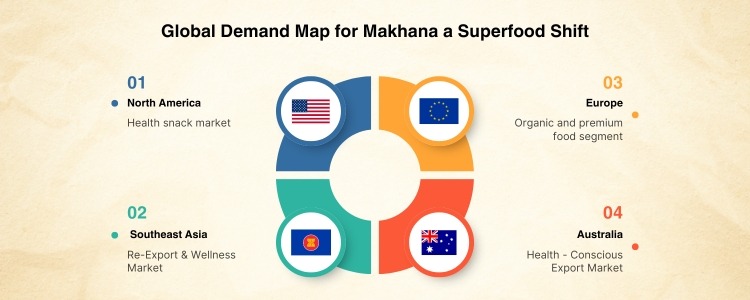
The global market for makhana (or fox nuts) is growing quickly, especially in North America, Europe, and Southeast Asia. Increasingly health-conscious consumers are looking for natural snacks that are good for them; so, due to its nutritional content, makhana fits this trend.
The rise in exports of fox nuts from India can be attributed to:
- Growing awareness of the advantages of plant-based diets
- Increasing demand for gluten-free snacks
- Growth in the organic and wellness food segments
- Growing popularity of Indian “superfoods” throughout the world.
The United States, Canada, UAE, Germany, United Kingdom, and Australia are significant emerging importers of this healthy, nutty snack; they are prepared to pay top dollar for quality.
Understanding the Export Landscape
India dominates the global makhana production market with a very large share. Bihar provides nearly 80-90% of India’s total makhana production and is therefore at the centre of this industry.
Companies that want to start exporting makhana from India need to be familiar with both the supply dynamics in India and the demands of international markets for their products. Quality control, consistent product grading, and compliance with the requirements of global markets are some of the key features of long-term success in this business.
Makhana Export from India: Key Certifications Required
International exporters looking to get into foreign markets must have several certifications in order to ensure their products are of good quality and safe to eat.
- FSSAI certification – A requirement for all food businesses based in India to certify that the product complies with Indian food safety standards.
- APEDA registration – Required to sell agricultural goods outside of India.
- Phytosanitary certificate – Proof that the product is free of pests, and diseases, and conforms to international needs as far as importing is concerned.
- Organic certification (optional) – It is advisable to apply for the optional organic certificate if you are exporting to a premium market (ie, Europe or Northern America).
- ISO and HACCP certifications – Participation in the ISO (International Standards Organization) and HACCP certification programmes improves a company’s ability to sell on an international scale.
By meeting all of these requirements, exporters can have a level of compliance to the various international markets that they serve and at the same time can build trust with their customers.
Makhana Export Documentation: What You Need
The proper documentation for the export of makhana is very important for smooth customs clearance and international trade processes.
Key documents for exporting include:
Import Export Code (IEC)
Commercial invoice
Packing list
Bill of lading or airway bill
Certificate of origin
Phytosanitary certificate
Insurance documents
If any of these documents are incomplete or incorrect, there can be delays, penalties, or a rejection of the shipment. Therefore, exporters should ensure that they are accurate and compliant at every point in the process.
Step-by-Step Makhana Export Process
The process of exporting makhana requires multiple steps, which should include careful planning and execution throughout the process.
- Sourcing and Processing
Makhana is sourced from farmers and goes through the process of cleaning, grading, and roasting to be ready to sell.
- Quality Control
It is essential to ensure that the makhana has a uniform size, colour, and taste in order to meet the international standards.
- Packaging
Packaging used for exporting should have a moisture barrier and meet any labelling requirements.
- Documentation and Compliance
Prior to shipping, exporters must have the certifications and documentation required for the export of makhana completed.
- Logistics and Shipping
When choosing between shipping by air or by sea, factors such as cost, volume, and delivery timelines should be considered to determine the most appropriate method of shipping.
A streamlined process will help minimize risk and provide timely deliveries.
Packaging and Quality Standards
Proper packaging is critical to maintaining product quality throughout shipping; therefore, it is important for exporters shipping products to comply with internationally accepted packaging guidelines (such as):
– Food-grade, moisture-protective packaging materials
– Packaging material that provides accurate labelling showing nutritional composition
– Packaging materials that conform to local regulations at destination (or import) counties
Investing in quality packaging not only preserves the freshness of products but can also contribute to enhancing brand image when meeting competition in the marketplace.
Challenges in Makhana Export
Although there is a growing interest in exporting makhana, there are a number of challenges to exporting makhana including:
– Supply chain limitations caused by reliance on specific growing regions;
– Quality inconsistency caused by discrepancies in size/processing;
– Increased transportation costs due to logistics; and,
– Highly competitive marketplaces due to an increase in the number of global suppliers.
In order to adequately address these challenges, it will require investment into adequate infrastructure, training, and quality control systems.
Opportunities and Future Outlook
The future of Makhana (Fox Nut) exports out of India looks bright with the rise in global demand for healthier types of snacks, such that Makhana could now be a more mainstream product in many of the international marketplaces known today.
Key factors for this growth are:
-Rise in Health Consciousness Among Consumers.
-Increasing Availability of E-Commerce Solutions for The Food Sector.
-Government Support for Agricultural Export Development.
-Innovation and Introduction of Product Line Extensions.
Exporters who focus on quality and branding, as well as meeting regulations will be able to achieve competitive advantage.

Conclusion
The other current development trend for Makhana is it broadens the overall trend of moving away from product categories and into products with higher market value per produced unit.
Exporting Makhana from India can provide businesses with unprecedented opportunity within an established high growth and value-added Agricultural Product.
To be successful and capture potential, businesses must be knowledgeable on certifications, documentation requirements and changing market dynamics. When done properly, Makhanas can have a significant role in meeting the Agro-export growth target for India, and overall.

Diptanshu
Leading research and marketing at Inductus Global, Diptanshu drives the company’s vision to transcend traditional trading through thought leadership in import-export. He spearheads a research-driven approach that prioritizes quality over price arbitrage, positioning Inductus as a strategic sourcing partner rather than a transactional intermediary. His work spans market intelligence, supply chain innovation, and trade dynamics, while playing a key role in sales and business development.