

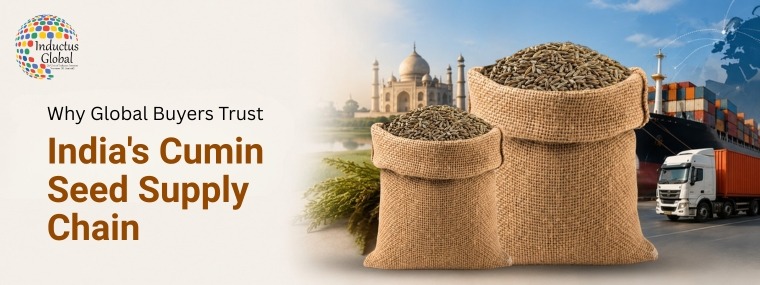
Why Global Buyers Trust India's Cumin Seed Supply Chain
What does it take for a single seed to season half the world’s kitchens? Long before it lands on a spice rack in London or a processing line in Ho Chi Minh City, cumin makes a quieter journey through the fields of Gujarat, the trading floors of Unjha, and the compliance desks of India’s most disciplined exporters.
Cumin seed exports from India aren’t a footnote in the global spice trade; they are its backbone, commanding the lion’s share of world supply year after year. This is a buyer’s lens into why India remains the first name importers search for, and why that trust is earned, not inherited.
India: Land of Premium Cumin Seeds
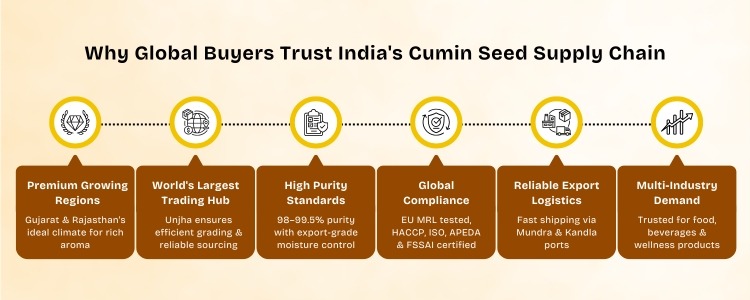
Call it an ecosystem, not a growing region. India’s cumin belt runs through the semi-arid plains of Gujarat and Rajasthan, where dry, low-humidity conditions do what no processing plant can replicate, concentrating essential oil deep within the seed. This is precision written into geography, refined over generations of farming expertise.
At its centre sits Unjha, Gujarat’s legendary trading hub and the largest cumin market on earth, where lots are graded and dispatched with an efficiency built over decades of trade infrastructure. Set this against competing origins like Syria, Turkey, or Iran, and the gap is measurable: Indian cumin consistently carries a richer volatile oil content, translating into bolder flavour, longer shelf stability, and steadier buyer satisfaction downstream.
India isn’t merely the largest cumin producer on paper; it accounts for the overwhelming majority of the world’s traded volume, a dominance renewed each season by the combined output of Gujarat and Rajasthan. It is reinforced by consistent quality initiatives from bodies like the Spices Board of India.
It is not just the largest crop. It is the most trusted.
From Cuisines and Drinks, to Spice Blends and Digestion Meds: Indian Cumin
Cumin is the connective tissue across industries buyers rarely link together, and that quiet versatility is precisely its strength as a sourcing category.
- On the plate, it anchors the world’s spice cabinets: curry powders, Mexican taco seasoning, Middle Eastern za’atar, and North African blends all lean on Indian jeera for their signature earthy warmth.
- In the glass, cumin is riding an unexpected wave; jeera-infused waters and functional detox drinks are gaining ground fast in health-conscious Western markets.
- And in the medicine cabinet, its digestive and anti-inflammatory properties have made it a quiet staple of Ayurvedic-inspired supplements now finding shelf space across Europe and North America’s growing wellness aisles.
For a B2B buyer, this isn’t trivia; it’s insurance. Sourcing cumin isn’t a single-sector bet; it’s a hedge across food, beverage, and wellness demand simultaneously, each pulling from the same reliable supply base. Where else does one seed serve the plate, the glass, and the medicine cabinet at once?
Why Global Buyers Demand Indian Cumin Seeds
Every sourcing decision is really a risk calculation. Here is the buyer’s decision matrix, a trading-desk brief, not a spec sheet, laying out why Indian cumin consistently wins the comparison against competing origins.
| Parameter | Indian Cumin Advantage |
|---|---|
| Essential Oil Content | 2.5–4% volatile oil, typically 20–30% richer than Turkish or Iranian cumin, providing a stronger aroma, deeper flavour, and longer shelf life. |
| Purity & Moisture Control | Sortex-graded lots achieve 98–99.5% purity, with moisture maintained below export-safe limits for long-distance international shipments. |
| Aflatoxin & Pesticide Compliance | Every batch can be tested to meet EU Maximum Residue Limits (MRLs), with ETO or steam sterilisation available for markets requiring enhanced microbial safety. |
| Price Competitiveness | Cost-effective sourcing compared to Syrian, Turkish, and Iranian origins, offering stable value even during seasonal price fluctuations. |
| Export Infrastructure | Efficient exports through Mundra and Kandla ports, supported by established container logistics, warehousing, and global shipping networks. |
| Certifications Available | Available with FSSAI, ISO 22000, APEDA Registration, HACCP, and Organic Certification (on request), depending on buyer requirements. |
| Supply Consistency | Supported by the large production base of Gujarat and Rajasthan, ensuring reliable year-round availability and dependable export volumes. |
Purity, compliance, price, infrastructure, certification, and consistency rarely align this cleanly from a single origin. That alignment is what converts a cautious first-time importer into a repeat buyer year after year, and it’s why searches for cumin seed suppliers so often end at Indian spices suppliers carrying verified export credentials.
Guide for Global Buyers to Import from Premium Indian Cumin Seeds Exporter
Importing well is a sequence, not a single transaction. Here is the playbook serious buyers follow when sourcing from a premium exporter.
- Vet the exporter first. Confirm the IEC code, GST registration, and active APEDA or Spices Board membership, and ask for a documented shipment history, not just a sales pitch. Established cumin seeds exporters in India will produce this without hesitation or delay.
- Request and test samples. Check essential oil percentage, purity, and foreign matter content before committing to volume, ideally against an independent lab report.
- Negotiate terms with the season in mind. FOB or CIF, minimum order quantities, and pricing benchmarks all shift meaningfully around the February–April harvest window.
- Lock the documentation. Phytosanitary certificate, certificate of origin, fumigation certificate, and quality or lab test reports are non-negotiable, insist on all four before shipment clears, not after.
- Plan logistics deliberately. Shipments typically move through Mundra or Kandla; confirm lead times and container versus bulk options well ahead of the sailing schedule.
- Secure payment. Letters of Credit remain the safest structure for new relationships; advance payment or escrow arrangements suit established, repeat partnerships.
Top Precautions to be Taken by Buyers
Precaution, here, isn’t hesitation; it’s leverage. The informed buyer protects margin and reputation by watching six pressure points before, during, and after shipment.
- Quality inconsistency across shipments — insist on batch-wise lab reports, not a single blanket certificate for the entire order.
- Aflatoxin and pesticide residue limits — critical for EU-bound cargo, where MRL compliance is strictly non-negotiable.
- Exporter credibility gaps — treat an unverifiable export history or missing GST/IEC registration as a hard red flag, no exceptions.
- Packaging and moisture control — poor packaging invites spoilage and infestation mid-transit, especially on longer sea routes.
- Price volatility — harvest-season swings can move rates sharply within weeks; locking contracts pre-harvest protects margin against this.
- Mislabelling and adulteration risk — a third-party inspection from an agency like SGS or Bureau Veritas is cheap insurance against a costly downstream dispute.
Cumin seeds importers who build these checks into their standard process don’t just avoid losses, they build the kind of sourcing relationships that outlast a single season or a single harvest cycle.
Conclusion
Sourcing cumin from India was never just about securing a spice; it’s about securing certainty in a global trade environment that rarely offers any. Cumin seed exports from India carry that certainty because they’re backed by geography, scale, and compliance that few competing origins can match together at this consistency.
For buyers who verify before they commit, India isn’t just another option on the sourcing list, it’s the benchmark the rest of the market is quietly measured against.
Trust isn’t shipped in bulk. It’s built one verified consignment at a time.

Pratibha Soni
I write where strategy meets storytelling. As a passionate writer and literary enthusiast, I craft business-focused content that transforms trading insights into compelling narratives. Drawn to global business ecosystems, I enjoy turning research, innovation, and ideas into content that informs, connects, and inspires. With an analytical mind and a creative soul, I bring curiosity, collaboration, and a sharp eye for detail to every project. Adaptable and growth-driven, I believe the right words do more than communicate; they leave an impression.