

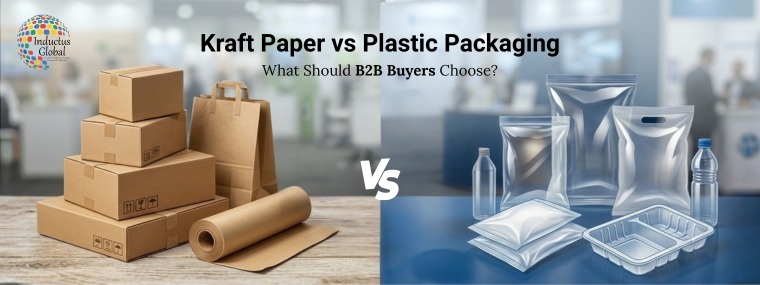
Kraft Paper vs Plastic Packaging: What Should B2B Buyers Choose?
Kraft Paper vs Plastic Packaging: What Should B2B Buyers Choose? Kraft paper packaging is no longer a procurement decision based solely on price and visual appeal. For B2B buyers, the choice between kraft paper and plastic packaging can have a tangible impact on product protection, logistics, shelf-life, regulatory compliance and brand perception.
Both materials have well-established commercial applications. Kraft paper has seen growing interest as businesses look to find recyclable, fibre-based alternatives, while plastic is widely used due to its durability, flexibility, moisture resistance and efficient use of material in many applications.
The right choice depends less on what material is considered fashionable and more on what the product, supply-chain and end-market actually require.
Understanding Kraft Paper Packaging
Kraft paper is produced from wood pulp, processed through a series of steps to yield strong paper with high resistance to tearing. It is used extensively for bags, sacks, wrapping, cartons, pouches and secondary packaging.
For businesses buying kraft paper wholesale, paper grade, GSM, strength, dimensions, printing, coating and moisture resistance can all influence suitability and price.
Paper packaging can also offer a distinctive appearance; its natural texture is often associated with simplicity and an understated retail aesthetic, making it popular with food, fashion, grocery and consumer-product packaging.
However, paper is not automatically suitable for every product. Moisture, grease and exposure to adverse conditions can all affect uncoated paper. If barrier properties are required, then coated or laminated structures may be necessary.
Understanding Plastic packaging can take a variety of forms, from polyethylene films and polypropylene bags to rigid containers, pouches and multilayer structures.
Its main commercial advantage is versatility—plastic can provide strong moisture barriers, durability and lightweight protection, making it ideal for products which require extended shelf life or protection from external conditions.
For industrial and food applications, plastic packaging can also be manufactured in precise thicknesses and formats. Transparent structures can allow visibility of the product, while printed films can provide branding without the requirement of a separate label.
However, buyers are increasingly required to consider recycling infrastructure, regulations and material composition when selecting plastic packaging.
Comparing Product Protection
The first question for a B2B buyer should be: what does the package need to protect the product from?
In terms of dry goods, clothing, grains and several retail products, kraft paper may provide sufficient protection. It can also be engineered to greater strength when used in sacks and heavy-duty applications.
Plastic generally has an advantage where resistance to water vapour, moisture, grease or contamination are of particular concern—making it relevant to products such as frozen foods, chemicals and certain agricultural commodities.
The decision should therefore be made based on actual product requirements, rather than material preference.
Cost
Look Beyond the Unit Price Material price is only one part of packaging economics. Buyers should calculate the total cost of ownership, including manufacturing, printing, storage, transportation, damage rates and disposal considerations where relevant.
Paper packaging may have a competitive cost in some applications, especially when standard bags or cartons are being purchased in substantial quantities. Plastic can also be economical due to its lightweight construction which can reduce material consumption and transportation weight.
Minimum order quantities, printing requirements, tooling and custom dimensions can further change the final quotation.
A proper comparison should therefore place equivalent packing formats and specifications side by side.
Sustainability and Regulatory Considerations Environmental considerations have moved closer to the centre of packaging procurement, especially in markets where legislation and customer expectations are changing.
Paper is often viewed favourably due to fibre-based packaging being recyclable where suitable collection and recycling systems exist. However, buyers should still examine the full construction of the package—coatings, adhesives, inks and laminations can impact recyclability.
Plastic presents a more complicated picture—different polymers have different properties and recycling prospects, while multilayer structures can pose additional challenges.
European and other international markets may also have specific rules concerning packaging waste, recycled content, labelling and material composition. Importers should confirm the requirements applicable to their destination market before approving a packaging specification.
Customisation and Branding Packaging is increasingly a component of a company’s marketing strategy. Buyers may require specific dimensions, colours, logos, finishes and printing standards.
Paper is ideal for printed bags, cartons and wraps where a tactile, paper-based presentation is desired. Plastic films can support high-resolution graphics, transparent windows and specialised finishes.
A Wholesale custom packaging supplier should be able to provide technical drawings, material specifications, print proofs and samples before commercial production.
Buyers should approve a physical sample or production proof before committing to large quantities; this is especially important for branded packaging, where colour or artwork discrepancies can make an entire batch unusable.
Supply Reliability Matters The material itself is only half of the procurement decision; the supplier’s ability to manufacture consistently is equally important.
When evaluating plastic packaging suppliers, B2B buyers should look at production capacity, quality-control systems, sourcing of raw-materials, certifications, experience with exports and lead times.
The same principle applies for paper packaging—buyers should establish whether the manufacturer produces the material in-house, or if they outsource to third-party converters.
Outsourcing is not necessarily a concern, but it should be understood, since it can influence lead times and quality control.
A supplier should also be able to explain how rejected or defective batches are handled
Packaging and Transportation Efficiency Packaging has a direct relationship with logistics. The dimensions, weight, stacking characteristics and compression resistance of the packaging can influence warehouse utilisation and freight costs.
Paper packaging may take up more space in certain applications due to its structure. Plastic films, by contrast, can be very compact before filling; however, rigid plastic containers can present a different logistics profile.
For international buyers, these factors should be considered alongside product protection; a cheaper package at the factory but which is inefficient to transport can result in a higher landed cost.
When Paper May Make Sense Kraft paper can be appropriate when buyers require fibre-based packaging, strong dry-goods bags, cartons or a paper-led presentation.
It can also fit businesses whose customers value paper packaging and where the product does not require a high moisture barrier.
However, buyers should check whether the selected paper structure can withstand the expected handling, storage and transportation conditions.
When Plastic May Make Sense Plastic remains practical for applications which require strong moisture resistance, flexibility, lightweight construction or specific barrier properties.
For food and industrial products, its technical performance can sometimes be difficult to match with uncoated paper.
That does not mean that plastic is automatically the better option; material selection should account for the product’s requirements, recycling infrastructure, regulations and the buyer’s packaging policy.
The Practical B2B Decision
There is no universal winner between kraft paper and plastic packaging. The appropriate choice depends on the product, market, logistics model, regulatory environment and commercial priorities.
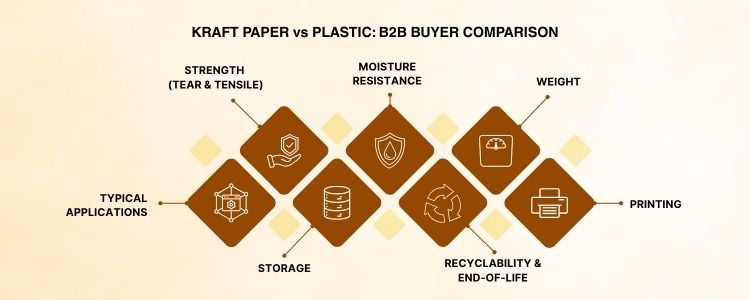
Buyers should start with a technical specification and then compare paper and plastic alternatives on protection, cost, weight, shelf life, recyclability, printing, minimum order quantity and supplier reliability.
In some cases, a fibre-based package will meet the requirements; in others, plastic will provide necessary technical performance. Hybrid or coated structures can also be considered where the application requires a balance of properties.
The strongest procurement decisions are those based on measurable requirements, rather than assumptions about either material.
1. Is kraft paper cheaper than plastic packaging?
The answer depends on the packaging format, material grade, order quantity, printing and logistics. Buyers should compare the total landed cost, rather than simply comparing the price per bag or unit.
2. Which packaging material offers better moisture resistance?
Plastic generally provides stronger moisture resistance; however, specially-coated or treated paper packaging can offer enhanced protection for particular applications.
3. Is kraft paper packaging recyclable?
Kraft paper can generally be recyclable when appropriate recycling systems are present; coatings, laminations and other components may affect how a particular package is handled.
4. Why is plastic packaging still widely used by businesses?
Plastic offers several technical benefits, including durability, flexibility, lightweight construction and resistance to moisture; these characteristics make it suitable for a wide range of food, industrial and consumer applications.
5. What should B2B buyers check when selecting a packaging supplier?
Buyers should examine material specifications, manufacturing capacity, quality-control procedures, certifications, minimum order quantities, lead times, samples, export experience and customer references.
6. Can kraft paper packaging be customised?
Yes; depending on the manufacturer, kraft paper packaging can be customised in terms of dimensions, GSM, printing, handles, closures and finishes.

Diptanshu
Leading research and marketing at Inductus Global, Diptanshu drives the company’s vision to transcend traditional trading through thought leadership in import-export. He spearheads a research-driven approach that prioritizes quality over price arbitrage, positioning Inductus as a strategic sourcing partner rather than a transactional intermediary. His work spans market intelligence, supply chain innovation, and trade dynamics, while playing a key role in sales and business development.