

Packaging Suppliers in India for USA Importers - B2B Buying Guide
For the US importer, what was once a commodity purchase has become part of a product lifecycle. As businesses look to source competitive manufacturing bases outside traditional markets, India’s packaging sector has become more attractive to importers seeking paper bags, cartons and flexible, woven and customised packaging.
While India’s wide manufacturing base offers US buyers a range of suppliers, a selection process beyond catalogues and factory quotations is required before an order can be placed. Material specifications, production capacity, quality control, shipment arrangements and US compliance standards must be considered by an importer evaluating a Packaging Supplier In India. For the importing company eyeing a foreign partnership, a systematic procurement strategy is essential to turn this sourcing opportunity into a reliable supply channel.
Why US Importers Choose India for Packaging
India’s packaging manufacturing industry caters to both domestic and international food-processing, pharmaceutical, consumer, agricultural, retail and e-commerce markets and is well diversified to meet the specifications of these industries. A US buyer can therefore choose from a wide packaging supplier base, depending on the category of manufacturer.
Depending on the manufacturer, the US importer has the option to source corrugated boxes, kraft paper bags, flexible pouches, films, woven sacks, printed cartons and other packaging formats.
India’s developed port infrastructure can facilitate international shipments, although the most economical logistics solution will depend on the location of the supplier, the size of the order and the US port of entry.
Setting a Detailed Product Specification
A detailed product specification is the starting point for negotiations with a prospective supplier. Without it, price quotations from different manufacturers will be inconsistent with the requirements.
US importers should specify:
- Material type and grade
- Dimensions and thickness
- GSM or weight, where applicable
- Strength and load-bearing requirements
- Printing and artwork
- Colour specifications
- Closures, handles or sealing requirements
- Configuration
- Palletisation
- Certifications
- Annual volume
The intended application should also be identified, since packaging for dry food, pharmaceuticals, industrial components and apparel have very different requirements.
An approved sample should ideally serve as a baseline for production.
Evaluating Indian Packaging Manufacturers
Actual manufacturing capability is one of the key areas to focus on when due diligence on a prospective Packaging Materials Exporter. A supplier’s website is a good starting point, but it will not always disclose production capacity details.
When short-listing potential Packaging Manufacturers In India, buyers should verify factory infrastructure and machinery, production capacity, raw material sourcing, quality-control procedures and experience in fulfilling export orders.
It is important to determine whether products are produced directly by the supplier or through subcontractors. A trading company is often a viable export channel, but the US buyer must be aware of production oversight and inspection procedures.
US importers should also ask about experience in dealing with American buyers. Familiarity with US documentation, packaging specifications and shipping procedures can expedite the early stages of the supplier relationship.
Examining Quality and Specifications
Quality requirements should be established prior to production. Depending on the category, buyers may have to evaluate strength, thickness, dimensions, print quality, sealing performance, barrier properties or resistance to moisture and handling.
For food-contact packaging, additional regulatory requirements may apply. Packaging for pharmaceuticals and cosmetics may also have specific testing or documentation requirements.
US importers should identify the relevant federal, state or industry requirements for their intended application prior to specification approval.
Suppliers should be asked to furnish relevant test reports, declarations and certifications rather than generic statements on compliance.
Requesting Samples Before a Bulk Order
Samples provide a reality check on a supplier’s ability to produce the required packaging. They enable the buyer to inspect the material, dimensions, printing, finish and construction before approving mass production.
For technically demanding applications, laboratory testing is recommended. Depending on the intended application, destructive testing for tensile strength, compression, seal strength, moisture resistance or other parameters may be required.
The approved sample should be documented, specifying dimensions and materials. Subsequent changes should require the approval of the US buyer.
For a new supplier, a trial commercial order can be a good way to assess consistency before proceeding to substantially larger volumes.
Comparing the Total Landed Cost
A factory quotation represents only a part of the cost equation. US importers should calculate a total landed cost before choosing a supplier. The calculation may include:
- Product price
- Printing and tooling
- Inland transportation
- Port and documentation charges
- Ocean or air freight
- Insurance, where applicable
- US customs duties
- Customs brokerage
- Domestic delivery
Incoterms should always be specified in the quotation. Comparing FOB and CIF quotations without taking into account the different liabilities is not advisable.
Currency fluctuations and freight-rate variations should also be taken into account for long-term supply arrangements.
Understanding Minimum Orders and Lead Time
Packaging manufacturers often set minimum order quantities depending on production economics. Custom printing, specialised materials and bespoke dimensions may require larger commitments than standard products.
US buyers should establish minimum order quantities, tooling charges and production lead times prior to finalising a purchase contract.
Seasonal businesses need to be particularly careful when planning production and shipping schedules. If packaging is required for holiday sales or promotional campaigns, production and shipping should be scheduled with potential port and customs delays in mind.
Packaging Sustainability and US Market Requirements
Sustainability is becoming an increasingly important consideration for packaging procurement in the US market. Retailers and consumers may express an interest in recycled content, recyclability, reduced material use and responsible sourcing.
However, sustainability claims should be supported by appropriate documentation. A package described as “eco-friendly” may contain coatings, laminations or mixed materials that may affect its recycling characteristics.
Buyers should therefore ask specific questions about material composition, recycled content and disposal or recycling options in the intended market.
Logistics and Shipment Arrangements
A supplier’s responsibilities do not end when manufacturing is complete. Export packing, container loading and documentation can have an impact on whether a shipment reaches the United States without unnecessary delays.
Buyers should establish carton dimensions, pallet specifications, container loading plans and shipment schedules well in advance of production.
Packaging density is a key consideration. A product that requires excessive space can significantly increase freight costs, despite an attractive unit price.
For repeated orders, buyers and suppliers should establish agreed shipping calendars so that production and freight bookings can be coordinated.
Establishing a Long-Term Supplier Relationship
A positive first shipment is always a good start, but it rarely indicates long-term consistency. US importers should evaluate a supplier’s performance based on quality, delivery, documentation, communication and responsiveness.
Regular quality checks can help identify changes in material or production prior to becoming frequent issues.
For businesses requiring Wholesale Custom Packaging Solutions, long-term cooperation can also make it easier to manage changes in artwork, forecast volumes and coordinate production schedules.
A supplier that communicates openly about capacity and material availability is generally much easier to work with than one that reports issues only after a shipment deadline has passed.
Final Points for US Importers
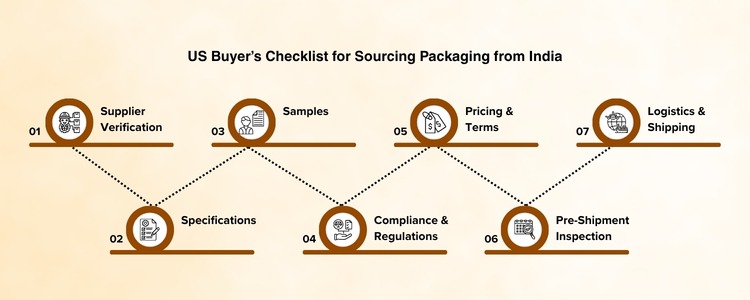
India offers US buyers a broad manufacturing base, but careful supplier evaluation is required for a successful sourcing operation. The process should begin with a detailed specification, followed by factory and business due diligence, sample approval, compliance verification, and a landed-cost calculation. Production capacity, lead times, packaging configuration and export documentation should all be agreed before an order is placed.
For companies planning to make regular packaging material export from india transactions, a test order can provide a good starting point. It allows the importer to assess actual product quality and supplier performance before committing to larger volumes. Ultimately, the supplier that is able to maintain the agreed specifications, deliver on schedule and provide accurate documentation and responsive communication is the most valuable.
1. Why do US importers source packaging from India?
India has a large manufacturing base and offers products across paper, flexible, corrugated, woven and customised categories. Buyers may also find competitive manufacturing costs and a wide choice of suppliers.
2. What packaging products can US buyers source from India?
Depending on the manufacturer, US importers can source paper bags, cartons, corrugated boxes, flexible pouches, films, woven sacks, printed packaging and other packaging formats.
3. How can I verify a Packaging Supplier In India?
Buyers can review factory facilities, production capacity, business credentials, certifications, export history, customer references and quality-control procedures. Factory audits and third-party inspections can provide additional assurance.
4. Should US importers order samples before bulk orders?
Yes. Samples allow buyers to assess quality and ensure that the supplier understands the required specifications. Technical packaging may also require laboratory testing.
5. What affects the landed cost of imported packaging?
Product price, tooling, printing, inland transportation, freight, insurance, customs duties, brokerage and domestic delivery can all contribute to the final landed cost.
6. Can Indian suppliers produce customised packaging for US companies?
Yes. Depending on the manufacturer’s capabilities, products can be customised in terms of dimensions, materials, printing, colours, closures and other specifications.

Diptanshu
Leading research and marketing at Inductus Global, Diptanshu drives the company’s vision to transcend traditional trading through thought leadership in import-export. He spearheads a research-driven approach that prioritizes quality over price arbitrage, positioning Inductus as a strategic sourcing partner rather than a transactional intermediary. His work spans market intelligence, supply chain innovation, and trade dynamics, while playing a key role in sales and business development.