


How Retailers Can Reduce Supply Chain Costs Without Killing Quality
In an era where retailers face increasing operational complexity along with price-sensitive consumers, the ability for retailers to find ways to operate more efficiently and at a lower cost without sacrificing the quality of their products is becoming an urgent need. As global market conditions change, consumers become more demanding in terms of quality, and competition continues to increase; therefore, retailers must find ways to manage their costs better while maintaining the value they provide to their customers.
This is where efficient supply chain management begins to become a competitive advantage for retailers rather than just a support function in the back room of operations. Retailers in the apparel, home goods, electronics, and many niche categories are beginning to realize that cost-cutting is not simply about trimming budgets; it is about redesigning operations, developing closer relationships with suppliers, enhancing visibility of data throughout the supply chain, and eliminating inefficiencies that erode margins over time. When retailers do this effectively, they can often improve the consistency of their products, increase their speed of delivery to customers, and improve the overall customer experience.
Why Cost Efficiency Matters More Than Ever
Over the past several years, the retail sector has seen dramatic changes, driven primarily by the adoption of e-commerce, inflationary pressure, and increased demand for quality goods. Consumers today want durable, competitively priced products delivered fast and with easy returns. They also expect the products they purchase to come from ethical sources.
This pressure is translating to low margins for retailers. While the traditional methods of purchasing in bulk or having a highly aggressive negotiation tactic may have worked, these methods will only serve retailers to an extent. To remain competitive, retailers must have a more proactive strategic plan that incorporates the concept of long-term quality assurance with better cost management.
Cost efficiency must be viewed by retailers as a structural requirement rather than just a tactic.
Building a Strong Foundation: Where Retailers Go Wrong
Invisible inefficiencies are eroding the margins of many retailers in a slow and inexorable manner:
- Poor procurement practices are still being followed
- Poor supplier performance visibility
- Outdated warehousing costs
- Fragmented logistics leading to delayed delivery
- Lack of oversight on quality.
It is not that the gaps exist; it is a lack of ability to proactively identify and fix them through a system designed to do so. To create a new approach to cost savings, you must have systemized processes, accurate data, and operational discipline.
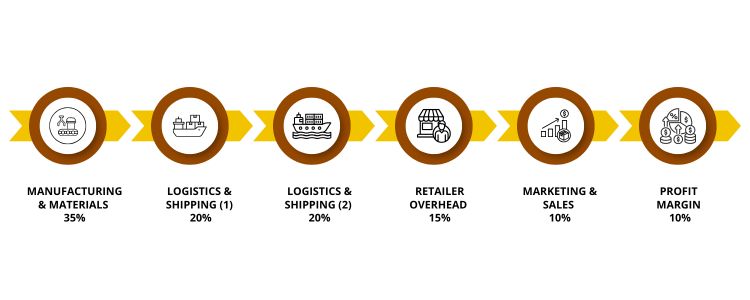
Step 1 : Strengthening Supplier Collaboration
Developing supplier relationships is one way to lower costs and improve the bottom line for retailers. By establishing lasting partnerships with suppliers through open communications and similar objectives, versus just transacting with them, retailers will see the greatest benefit from their suppliers.
Currently, there are retailers implementing a more collaborative way of doing business and working more closely with suppliers throughout the process to ensure timely production and higher quality products. The retailers are having suppliers engaged in the process much earlier during the planning, design, and forecasting phases of the buying decision. As a result, retailers are able to lower production delays and thus achieve greater financial savings through better negotiation with their suppliers for better terms and conditions, and also by establishing more consistent quality expectations and more accurately forecasting inventory levels.
In addition, many retailers work with an experienced “Product Sourcing Agent” that can bridge the gap between the manufacturers and the retailer, thereby creating a more seamless process for both parties and establishing better quality control.
Step 2 : Moving Toward Smarter Global Networks
As global markets continue to evolve, many retailers are no longer limited to working with a supplier in just one area of the country but rather have expanded their vendor base globally. By sourcing from many different countries and regions, retailers diminish their reliance on any one specific region while increasing their competitiveness and resiliency against supply chain disruptions.
Retailers using the Global Sourcing route have access to many different types of supplier organisations with varying levels of expertise. By working with a Global Sourcing company, retailers not only can reduce production costs while maintaining quality standards, but they are also creating greater cost flexibility in their supply chain. By fully evaluating and verifying their suppliers and ensuring compliance with the overall production process, retailers benefit from both price flexibility and product standardisation.
Step 3 : Upgrading Internal Processes
Before cost reduction is passed from the organisation to the supplier network, price reduction starts with improved processes/ways of working internally (within organisations). Retailers can improve their internal processes so they induce/facilitate the sourcing and quality outcomes associated with order fulfilment.
Examples of High Rate of Return from Process Improvements
- More effective demand levels forecasting/planning
- More accurate demand tracking leading to less overstocking
- Shorter approval processes for production runs
- Better visibility by cross-function team members in merchandising, procurement and inventory.
These process improvement actions may seem straightforward; however, they typically involve a change in the traditional structure of communication, workflow, and sharing of data between departments. Additionally, retailers who perform the above-listed improvements will typically realise immediate decreases in the cost of doing business without sacrificing product quality.
Step 4 : Reducing Waste Through Better Packaging Management
Effective management of packaging is a key factor in limiting expenses in the supply chain, though it is frequently overlooked. More expensive packaging causes a number of negative consequences, including increased freight costs, increased warehouse costs, and an increase in used materials that will ultimately be thrown away.
Poorly designed packaging results in product damage, which directly affects customer satisfaction. Effective packaging systems reduce the cost of using and procuring packaging materials while protecting the products during shipping. By redesigning the packaging for better durability and weight reduction, retailers are often able to achieve significant cost savings.
Step 5 : Smarter Production Planning
Many retail categories still rely heavily on large-scale manufacturing cycles. However, poorly planned runs cause overproduction, storage costs, and excess markdowns. More flexible mass production management systems allow retailers to adjust order quantities based on real-time demand signals, reducing unnecessary inventory buildup.
Retailers can also benefit from shared production lines, modular manufacturing models, or nearshore facilities that shorten lead times. These steps help reduce costs while maintaining reliable product standards.
Step 6 : Streamlining Logistics Without Affecting Quality
Large-scale manufacturing cycles are predominant in many retail sectors still, however when poorly planned, can lead to overproduction, excess storage expense, and an increased need for markdowns. Retailers could take advantage of systems that provide more flexibility in the mass production process by allowing retailers to modify their orders based on real-time demand signals which helps to eliminate unneeded inventory accumulation.
Additionally, retailers may benefit from using shared production lines, modular manufacturing models, or nearshore facilities to help minimise lead times. These strategies allow companies to reduce their overall costs while maintaining consistent levels of product quality.
The logistics of retail operations is one of the largest expense areas for retailers, and the impact of logistics on total business operation goes beyond simply shipping fees. An efficient, well coordinated distribution network will result in timely delivery, fewer returns of merchandise, and increased customer satisfaction.
By making investments into the effectiveness of logistics and shipping management, retailers are able to maximise their freight routes, decrease delays on the last-mile delivery, and lower the overall costs associated with storing inventory. By implementing some of the aforementioned measures, retailers are able to save large amounts of money on shipping costs. Instead of being reactive to–rather than proactive with regards to–the logistics of their business, retailers should look to build a logistics system that promotes and supports quality assurance.
Step 7 : Leveraging Technology Without Over-Engineering
Retailers do not need complex stacks of technology to cut their costs, but rather should adopt technologies selectively that help them to see their operations, accurately forecast their demand, and make timely decisions. Technologies that offer substantial value to retailers include:
- Dashboards showing real-time inventory levels
- Tools that allow for demand prediction
- Tools that allow for tracking supplier performance
- Workflows for automating quality control
- Order tracking tools for customers
The most important aspect is to select technology that matches the size and operational maturity of the retailer.
Quality Must Remain Non-Negotiable
The notion that the lower the retail cost, the lower the retail quality really isn’t quite so black and white. Retailers who take a long-term view of their suppliers, are disciplined with how they run their processes, and can forecast accurately, generally provide a higher quality at a lower price point than retailers who don’t do any of these things. The thing that actually diminishes a retailer’s quality is not lowering the costs of their products; rather, it is their lack of structure when it comes to making decisions. With the right tools, a retailer may be able to achieve enhanced efficiency, as well as greater quality in their products.
Conclusion
By adopting a disciplined, structured, and collaborative approach, retailers can achieve a reduction in their supply chain costs and still maintain their quality. Implementing better partnerships with suppliers, as well as better production planning, are just two examples of how retailers can improve the way they operate. In fact, the retailers that have the most success are those who view their supply chain as a long-term investment strategy rather than a cost centre.
1. Can retailers reduce costs without affecting quality?
Yes. Most cost savings come from better planning, supplier collaboration, and operational efficiency—not from lowering product standards.
2. Is global sourcing always cheaper?
Not always, but it offers diversification, competitive pricing, and access to specialised manufacturing, which can collectively reduce costs.
3. How can retailers prevent quality drops during cost reduction
By maintaining clear quality benchmarks, regular audits, and strong communication with suppliers.
4. Does packaging really impact supply chain expense?
Yes. Packaging influences freight charges, product safety, storage costs, and customer perception.
5. What is the fastest way to reduce supply chain costs?
Improving forecasting accuracy and streamlining logistics typically deliver the quickest, most measurable savings.
6. What industries benefit most from strong sourcing practices?
The manufacturing, retail, pharmaceutical, automotive, and consumer goods industries would be among those that rely most heavily on a company’s good sourcing practices