

Turmeric Export from India 2026: Quality Standards, Buyer Markets and Step-by-Step Export Process
Since time immemorial, India has been considered to be the worldwide center for turmeric production and contributes a significant proportion of the world’s demand for this spice. Turmeric exports from India sector will continue to grow and change over the next 5 years; as consumer preferences change, quality standards become stricter, and the international markets expand. Because turmeric is often called the “golden spice,” it has a unique place in the world of spices as it is used in many culinary applications, as well as traditional medicine, pharmaceuticals, and industrial products.
As a result, and due to increased global focus on health and wellness, the use of turmeric as an ingredient has changed dramatically over the past few years. Until recently, turmeric was primarily used as a spice; however, turmeric products are now being sold both domestically and internationally as functional foods. For both exporters and consumers, these changes create opportunities for continued growth, and for both parties, they will create higher standards of expectation for quality, traceability, and compliance.
India’s Role in the Global Turmeric Trade
With a major portion of turmeric production and exportation originating from India. Some of the states contributing largely through their cultivation include Telangana, Andhra Pradesh, Maharashtra, and Tamil Nadu. These states have a large share of both domestic and exported volumes.
India has an equal advantage in processing alongside producing turmeric, with products ranging from raw turmeric fingers through to finely processed powder. This variety of products gives Indian exporters an edge over other countries when it comes to selling in international markets.
Additionally, turmeric’s broader ecosystem within the Indian spice industry helps to enhance turmeric’s competitiveness in global markets since buyers frequently purchase multiple spices from one source to reduce shipping costs and achieve consistency across product lines.
Quality Standards Defining Export Competitiveness
In the turmeric export sector, quality has become a major part of success. With international customers concentrating on purity, safety, and uniformity, exporters must comply with international standards.
Exporters must ensure that export quality turmeric meets the following criteria:
- High curcumin levels, which gives turmeric its medicinal properties.
- A high degree of yellow colour and uniformity.
- A low amount of moisture to prevent the risk of spoilage.
- No adulteration or foreign matter.
Regulatory Compliance
Exporters are also required to comply with strict regulations concerning the presence of pesticide residues and contaminants in both the EU and the US. Therefore, exporters must adhere to Maximum Residue Levels (MRLs) and must comply with food safety requirements.
The most appropriate certification for exporters include:
- An ISO certification for a quality management system.
- A HACCP certificate for food safety.
- An organic certificate for niche markets.
Traceability and Transparency
Buyers expect to know where their product originated (traceability) and what conditions it has been in throughout all stages of the supply chain. This requirement has led exporters to implement electronic tracking systems, and keep accurate documentation of their products.
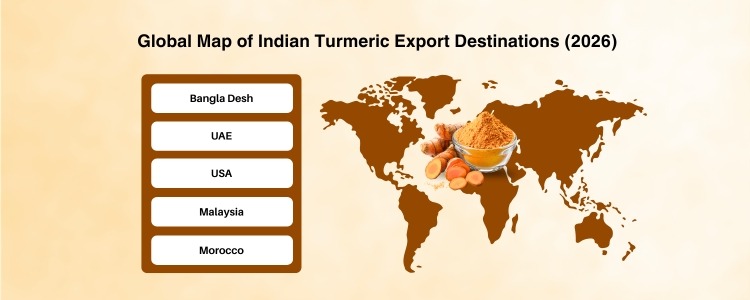
Key Buyer Markets for Indian Turmeric in 2026
Turmeric is increasingly popular in various parts of the world, with different types and ways to consume it.
Turmeric in the US: A High Price Market
The US is one of the top importers of turmeric because there is currently a lot of interest in the health and wellness market. Many people consume turmeric through supplements, beverages, and functional foods.
Turmeric in Europe: Quality Market
Countries in Europe will pay the highest price for turmeric; however, they have very strict regulations that require both the product to be safe and of high quality. Organic turmeric has become extremely popular in Europe.
Turmeric in the Middle East: Stable Market
The Middle East continues to be a stable market for turmeric. Traditional Middle Eastern cuisine features large quantities of turmeric, with both UAE and Saudi Arabia depending on imports.
Turmeric in Asia-Pacific: Growing Demand
There is an increasing demand for turmeric in Asia and the Pacific due to a growing food processing sector. Turmeric is often consumed as a part of ginger turmeric blends of spices, mirroring the evolution of culinary practices.
Growth of the Turmeric Export Industry
Over the years, there have been major changes to the turmeric exporting industry. Previously, most of the exports from the turmeric export industry were in bulk, but now many companies export value-added products along with their bulk products.
Importers of turmeric now concentrate on:
- Value Addition: Importers of turmeric are engaging in processing the chemical compound into powder, extract, and oil.
- Diversifying Product: Importers of turmeric have created new markets for their products by diversifying new products that can be utilized in the pharmaceutical and cosmetic industries.
- Branding – Growing their international brand presence.
- Improving Supply Chain Efficiency – Improving the efficiency of supply chain management through timely delivery and ensuring product consistency.
New market opportunities for the use of turmeric has developed through the creation of spice blends containing turmeric such as cumin and coriander spice blends with turmeric (ready-to-use, spice blends).
Step-by-Step Export Process
Exporters need to comprehend the entire export process if they are to be successful in penetrating the export market. The export process between the farm gate and the international marketplace consists of many distinct and well-defined steps.
- Sourcing and Procurement
Turmeric can be sourced from both farmers directly and agricultural markets. Prior to processing, exporters ensure that raw materials meet the minimum quality standard.
- Cleaning and Processing
Turmeric is cleaned prior to processing by removing any impurities, following this it is boiled , dried , and polished. The use of modern processing units ensures the hygienic processing of turmeric while also ensuring uniformity in the size and shape of the products.
- Grinding and Packaging
Depending upon the specifications of the marketplace, turmeric may either be processed into powdered form or shipped in its whole form. Proper packaging is essential in maintaining the quality of turmeric throughout the shipping process.
- Quality Testing
Laboratory testing will be performed on the product to determine the curcumin levels, moisture content, and compliance with the applicable international standards.
- Documentation
Exporters will prepare the necessary export documentation including invoices, packing lists, certificates of origin, and phytosanitary certificates. Accurate documentation assists in the timely completion of the clearance of exports from customs.
- Logistics and Shipment
The implementation of efficient logistics systems will support the maintenance of product quality and assist exporters in meeting their scheduled delivery date. Exporters frequently develop productive relationships with reliable freight forwarders to facilitate their logistics efforts.
It is imperative that businesses wishing to export turmeric from india execute each step of the export process in an accurate manner and in accordance with the relevant quality requirements for product specifications.
Challenges in Turmeric Export
Although industry growth will be strong, the industry will face numerous challenges:
- Very strict quality control regulations especially in developed nations
- Price movement from the yield of crops and the global demand
- Credibility is compromised due to concerns with food adulteration on international trade
- Competitively, many other countries are increasing their competitive advantage (export ability) over time.
Continuous improvement through quality control and improvement in supply chain management will be necessary to address these challenges.
Emerging Opportunities in 2026
India is a preferred supplier of turmeric. There will remain strong prospects for growth in the export of turmeric due to multiple reinforcing factors, including:
A rise in public awareness regarding health could account for an increase. Demand for turmeric’s positive properties that combat inflammation and have antioxidant effects will continue to develop hence driving continued demand over time.
The magnitude of organic and sustainable product sales has increased. The movement toward using organic turmeric allows for additional export opportunities for suppliers who invest in growing organic certification methods.
Value-added products (i.e. turmeric extract, turmeric capsules, and turmeric drink) rewrite the value relationship with raw exports and hence will provide exporters with higher profit margins.
Emerging economies in Africa and South America that are still underdeveloped, with little exposure to turmeric, will offer additional opportunities to all exporters willing to explore those regions.
Conclusion
With the global increase in demand for healthy, functional ingredients, the export of turmeric from India is ripe for continued growth. Companies have focused more than ever on maintaining their positions as market leaders through emphasis on quality (flavor, freshness), quality compliance (testing & safety of products), and innovation (new product development).
Thus, it is essential that Indian exporters implement the right strategies and partner with the respective buyers in order to increase their global visibility and to take advantage of the emerging global turmeric market in 2026, which will likely continue to shift from high-volume sales to high-value sales, emphasizing value-based purchasing – dependability of quality, reliable and consistent sources and pricing, and overall brand integrity.

Diptanshu
Leading research and marketing at Inductus Global, Diptanshu drives the company’s vision to transcend traditional trading through thought leadership in import-export. He spearheads a research-driven approach that prioritizes quality over price arbitrage, positioning Inductus as a strategic sourcing partner rather than a transactional intermediary. His work spans market intelligence, supply chain innovation, and trade dynamics, while playing a key role in sales and business development.