

Natural Stone vs. Engineered Stone: A Bahrain Buyer's Guide
Homeowners, developers, and builders throughout Bahrain are now faced with the important question of what surface material to choose. As design trends change and consumers continue to focus on durability, the debate between natural stone and man-made options continues to be a relevant issue. Evaluating the right surface to use in any project will require understanding both technical information about the materials available, how they will look when installed, and how much they cost.
Bahrain has seen adaptation of both traditional preferences and modern styles in both its construction & interior design industry. Both natural stones (like granite & marble) and engineered surfaces like quartz are commonly used in both residential and commercial buildings. The purpose of this document is to provide a detailed comparison of both options for use, and therefore assist buyers in making better choices.
Understanding Natural Stone and Engineered Stone
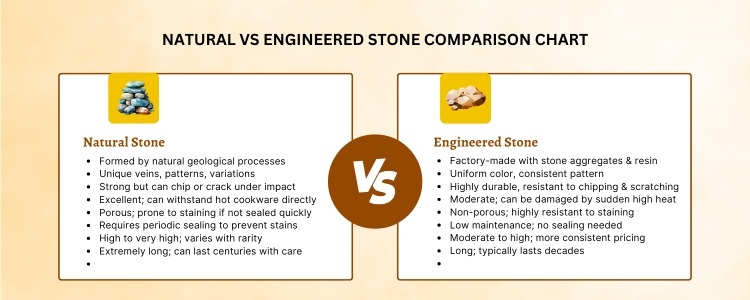
Natural Stone is obtained from the earth and is given a flat surface to create slabs or tiles. Each slab or tile is different from any other slab or tile in its colour, pattern and texture – some variations are much more apparent than others. The main types of natural stone include granite, marble and limestone.
Whereas engineered stone does not originate from the earth, it is made up of pieces of crushed stone mixed with resins and pigments (colours). This process allows for a consistent look to each piece of engineered stone and for the manufacturer to have control over the properties of the engineered stone.
When using either natural stone or engineered stone for applications such as kitchen countertops or bathroom vanity installations, each material can be advantageous based upon the intended application and design.
Durability and Performance in Bahrain’s Climate
Bahrain’s climate, characterised by high temperatures and humidity, plays a significant role in material selection.
Natural Stone Performance
Granite is widely regarded for its strength and resistance to heat and scratches. This makes it a preferred option for kitchens and outdoor applications. Marble, while visually appealing, is more porous and requires regular maintenance.
Engineered Stone Performance
Engineered stone surfaces, particularly quartz, offer high resistance to stains and require minimal maintenance. However, prolonged exposure to direct sunlight can affect their appearance over time.
For buyers seeking the best stone for kitchen countertops, durability under daily use and environmental conditions must be carefully assessed.
Aesthetic Appeal and Design Flexibility
Sculpturally Cast Natural Stone
Natural stone allows for unparalleled uniqueness in the sense that each slab has its own story, due to the natural vein and colour variations from the stone source. This is especially desirable in high-end residences and hospitality projects.
Designed Surface/Aesthetic Properties of the Engineered Stone
Due to a high degree of predictability in both colour and pattern, many manufactured surfaces are good options for modern minimalist designs. Engineered stone can replicate the aesthetics of natural stone but in a consistent manner.
When buyers are considering the purchase of engineered stone countertops, a frequently referenced benefit is that of consistency, particularly in the instance of large projects that require visual uniformity.
Cost Considerations and Budget Planning
Many buyers do consider the overall cost of a stone surface when determining whether or not to buy, especially when completing large construction projects.
Natural stone has varying prices based on stone type, origin, and rarity. Imported granite and marble are often more expensive, due to transportation and processing costs.
Engineered stones generally provide predictable price points as they are uniformly manufactured based upon a standard process. The cost of installation for engineered stone may also be lower, given uniformity of slab sizes.
Finance options must be evaluated by the buyer prior to making a purchase agreement to ensure all costs are taken into consideration (including ongoing maintenance cost over the life of the product).
Maintenance and Longevity
There is a large difference between how natural materials and engineered materials are maintained.
- Natural stone is maintained by applying seals periodically.
- Natural stone can be damaged quickly with stains if not maintained correctly.
- Natural stone, if properly cared for, can last for several decades.
Engineered stone is easy to keep clean since it is non-porous and does not require sealing or to be sealed.
- Engineered stone has natural stone properties, such as resisting stains and bacteria.
- Engineered stone can also be beneficial in high-traffic areas where natural stone requires extra maintenance for its beauty.
Sourcing and Supply Chain Dynamics
Bahrain has a sizeable reliance on natural and engineered stone through import, with India contributing significantly to this supply chain.
The trend toward importing natural stone from India for use in Bahrain has been driven by India’s vast reserves and their relatively low price points. Granite is another example; granite exports from India help to meet the continued demand for durable and affordable products in Bahrain.
By partnering with a trusted marble supplier in Bahrain, clients can be assured that they will receive quality materials, as well as streamlined logistics processes, thus minimizing possible delays during project execution.
Environmental and Sustainability Considerations
As a byproduct of increasing eco-consciousness, sustainability is now an integral aspect of material choice.
Natural Stone
Requires quarrying; typically, this has environmental consequences.
Material will usually have long lifespan and will, therefore, require less frequent replacement.
Engineered Stone
Contains recycled material in certain cases but may use energy-intensive processes in manufacture.
Buyers are increasingly evaluating environmental impact with equal importance to performance and cost.
Application Suitability: Where Each Material Works Best
The choice of using either natural or manufactured stone, depends upon the use to which each is going to be put.
Natural Stone
- Kitchen countertops (granite)
- Outdoor Façade (cladding)
- Luxury interior spaces
Manufactured Stone
- Bathroom countertop surfaces
- Indoor kitchen countertop surfaces
- Commercial areas that require same materials.
Knowing what each of these types are used for, will help the buyer choose the correct material for functionality.
Challenges Faced by Buyers in Bahrain
Most buyers encounter some type of difficulty when dealing with both natural and manufactured stones.
Typical Issues
- Difficulty in assessing the differences in quality.
- Variability of supplier reliability.
- Price variability due to imported materials.
- Limited knowledge of maintenance practices for product selection.
Resolving any of the above difficulties requires adequate research to ascertain the correct supplier and an accurate specification of the project.

Making the Right Choice
Ultimately the choice between natural and manufactured (engineered) stone is defined by the goals of the project.
- Use natural stone because it is different and typically lasts longer than manufactured products//
- Use manufactured (engineered) stone because it is easy to work with and provides consistency between jobs.
- Consider the environment in which the product is going to be installed and any maintenance required after installation.
- Consider the credibility of the supplier and shipping methods to the project location.
Using a balanced approach consisting of technical review and design criteria will lead to better results on your project than using either of the approaches alone.

Diptanshu
Leading research and marketing at Inductus Global, Diptanshu drives the company’s vision to transcend traditional trading through thought leadership in import-export. He spearheads a research-driven approach that prioritizes quality over price arbitrage, positioning Inductus as a strategic sourcing partner rather than a transactional intermediary. His work spans market intelligence, supply chain innovation, and trade dynamics, while playing a key role in sales and business development.