

Long Grain Rice Exporters from India: How Global Buyers Can Source with Confidence
India has a well-established position in the international rice trade, supplying different varieties to importers, food distributors, wholesalers and retailers across the world. Long-grain rice is particularly important in markets where buyers value grain appearance, cooking performance and consistency across large consignments. For international businesses, India offers a broad sourcing base, but selecting the right supplier requires careful commercial and technical evaluation.
A successful import transaction depends on more than securing an attractive price. Buyers must examine product specifications, assess supplier credibility, understand destination-country regulations and plan logistics well in advance. Inconsistent quality or incomplete documentation can affect delivery schedules, increase costs and weaken relationships with customers.
For businesses entering the Indian market or expanding existing procurement operations, a structured sourcing strategy can make the difference between a one-time purchase and a dependable supply arrangement.
Why India Is an Important Source of Long-Grain Rice
India’s rice industry benefits from established agricultural production, milling facilities, export infrastructure and access to major international shipping routes. Exporters supply different rice categories to markets with varying preferences for grain length, processing methods, cooking characteristics and price points.
Long-grain rice is used in household consumption, restaurants, catering, food distribution and institutional procurement. Depending on the variety, it may be sold through retail channels or purchased in bulk by importers supplying local wholesalers.
Buyers should recognise that long-grain rice is not a single, uniform product category. Grain variety, degree of milling, broken percentage, moisture content and other specifications can vary between offers. A clear understanding of local customer preferences is therefore essential before approaching suppliers.
1. Define Your Product Specifications Before Requesting Quotes
The first step is to establish exactly what your business intends to purchase. Vague requirements can result in quotations that appear comparable but describe products with different specifications.
Prepare a purchasing brief covering the following details:
- Rice variety: Identify the preferred variety and whether your market requires basmati or non-basmati rice.
- Grain characteristics: Specify acceptable grain length, appearance and uniformity.
- Broken percentage: State the maximum proportion of broken grains permitted.
- Moisture and purity: Agree on acceptable moisture levels, foreign matter limits and other quality parameters.
- Packaging: Determine whether you need retail-ready bags, private-label packaging or standard bulk sacks.
- Order volume: Provide the expected quantity and anticipated frequency of repeat purchases.
These details allow suppliers to prepare meaningful quotations and help buyers compare offers on a like-for-like basis. They also provide a written reference for quality inspections and contractual discussions.
2. Evaluate Supplier Experience and Business Credentials
Supplier verification deserves particular attention when working across borders. A professional website or a competitive quotation may indicate a legitimate business, but neither independently establishes export capability.
Begin by checking the company’s legal identity, business history, export experience and product range. Ask for relevant registration details and references from previous international customers where available. Buyers should also establish whether the supplier operates its own milling and processing facilities or works with third-party processors.
Experienced Long Grain Rice Exporters should be able to explain their sourcing arrangements, quality-control procedures, production capacity and expected lead times clearly.
Consider whether the supplier has experience shipping to your destination country. Familiarity with its documentation requirements, packaging expectations and inspection procedures can help prevent avoidable delays.
For significant orders, buyers may arrange a factory visit, request a video inspection or appoint an independent verification agency. These measures are particularly useful when the supplier is new to the relationship or the order represents a substantial financial commitment.
3. Request Samples and Verify Quality
A sample provides an initial assessment of the product, but buyers should avoid assuming that the entire shipment will automatically match it.
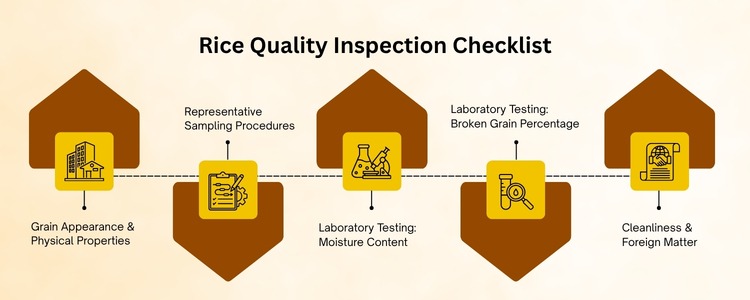
Request a representative sample and assess its appearance, grain uniformity, odour, cleanliness and suitability for the intended market. Cooking tests may also be appropriate where texture, aroma or grain separation influences customer preference.
For larger purchases, agree on measurable acceptance criteria before signing the contract. Depending on the product, these may include moisture content, broken grains, foreign matter and other relevant quality parameters.
Independent laboratory testing or pre-shipment inspection can provide additional assurance. The inspection method, sampling procedure and responsibility for inspection costs should be agreed in advance.
Importers should also establish how quality disputes will be handled. The contract should identify the approved specifications, applicable tolerances and remedies if the goods do not comply. Written procedures offer considerably more protection than informal assurances exchanged during negotiations.
4. Compare Quotations and Calculate the Landed Cost
The quoted price is only one part of the total purchasing decision. A lower offer may become more expensive once freight, insurance, customs charges and inland transportation are included.
Request itemised quotations and confirm the quantity, packaging, product grade, shipment schedule and delivery terms. Where applicable, compare offers under the same Incoterms, such as FOB or CIF, so that costs and responsibilities are clearly understood.
Your landed-cost calculation should account for:
- Product price and packaging.
- Inland transport and export handling.
- Ocean freight and insurance, where applicable.
- Customs duties, taxes and inspection charges.
- Port handling, storage and final delivery.
- Banking fees and currency conversion.
Buyers should also examine quotation validity, payment conditions and the supplier’s policy on price changes. Rice prices can be affected by crop conditions, freight rates, currency movements and trade-policy changes.
A detailed cost comparison gives procurement teams a more reliable basis for negotiating prices and calculating resale margins.
5. Confirm Import Regulations and Shipping Documents
Documentation requirements differ by destination, making early regulatory checks essential. Before placing an order, consult your customs broker or relevant authorities to establish which permits, certificates and product declarations are required.
Common export documents include the commercial invoice, packing list and bill of lading. Depending on the shipment and destination, buyers may also need a certificate of origin, phytosanitary documentation, inspection certificates or additional food-safety records.
Businesses sourcing through Non Basmati Rice Exporters should confirm that the selected variety meets local import rules and customer requirements. Product eligibility, labelling provisions and inspection standards should never be assumed to be identical across countries.
Check that the product description, quantity, weights, consignee details and shipment information are consistent across all documents. Even minor discrepancies can delay customs clearance or complicate payment processing.
Responsibility for obtaining each document should be clearly allocated between the exporter, importer and any appointed agents.
6. Choose Suitable Payment and Logistics Arrangements
Payment terms should reflect the size of the transaction, the relationship between the parties and the level of commercial risk. Options may include advance payment, documentary credit or other arrangements agreed through the parties’ banks.
New buyers should complete appropriate due diligence before transferring funds. Independently verify payment instructions and treat unexpected changes to bank details as a reason for additional checks.
Logistics planning requires equal attention. Confirm the loading port, destination port, shipment window, container requirements and responsibility for freight and insurance. Rice should be protected from moisture, contamination and unsuitable storage conditions during transit.
Allow time for vessel scheduling, port congestion and customs clearance. Importers supplying retailers or institutional customers should avoid promising delivery dates that leave no margin for disruption.
7. Build a Reliable Long-Term Supply Relationship
Once the shipment arrives, inspect the goods and retain records of the contract, approved sample, shipping documents and inspection findings. Report discrepancies promptly and follow the claims procedure specified in the agreement.
After completing the transaction, assess the supplier’s performance against clear criteria: product consistency, delivery reliability, documentation accuracy, communication and response to problems.
Businesses working with Non Basmati Rice Suppliers should review performance regularly rather than relying solely on the success of the first shipment. Repeat orders can support better production planning and more predictable procurement, but quality checks remain necessary.
Importers may also benefit from maintaining relationships with more than one qualified supplier. A diversified sourcing base can provide flexibility if production, freight availability or market conditions change.
India’s wider network of Agro Products Exporters also reflects the importance of established agricultural supply chains, although buyers should evaluate every supplier according to the specific product being purchased.

1. Why do international buyers source long-grain rice from India?
India offers a broad supplier base, established processing facilities, export infrastructure and different rice varieties suited to international markets.
2. What should buyers specify when requesting quotations?
Include the rice variety, grain specifications, broken percentage, moisture limits, packaging, quantity and required delivery terms.
3. How can an importer verify an Indian rice supplier?
Check business credentials, export experience, references, processing arrangements and quality-control procedures. Independent verification may be appropriate for large orders.
4. Which documents may be required for rice imports?
Common documents include the invoice, packing list and bill of lading. Additional certificates and permits depend on destination-country rules.
5. How can buyers reduce the risk of shipment delays?
Confirm regulatory requirements early, check documentation carefully, agree on shipment schedules and maintain communication with the exporter and customs broker.
6. What determines the total cost of importing rice?
Product price, packaging, freight, insurance, duties, taxes, inspection charges and inland delivery all influence the final landed cost.

Diptanshu
Leading research and marketing at Inductus Global, Diptanshu drives the company’s vision to transcend traditional trading through thought leadership in import-export. He spearheads a research-driven approach that prioritizes quality over price arbitrage, positioning Inductus as a strategic sourcing partner rather than a transactional intermediary. His work spans market intelligence, supply chain innovation, and trade dynamics, while playing a key role in sales and business development.