

End-to-End Procurement Process: How Sourcing Agencies Work
Introduction
The complexity of global trade has continued to grow over the last decade. Businesses are now managing networks between multiple countries rather than just limited domestic suppliers, facing issues such as multiple compliance regulations and unpredictable logistics paths. Because of this complexity, the entire procurement process from beginning to end is structured as a discipline rather than just an administrative task.
Organizations utilizing Source Agencies as a means of managing procurement complexity find themselves dealing with procurement as a cohesive and comprehensive process rather than individual activities. Sourcing Agencies function as both an intermediary and strategist while also helping to mitigate risk associated with procurement. They perform tasks such as identifying suppliers, negotiating contract terms, monitoring production, and ensuring that products get to the destination without issues.
Understanding the entire procurement cycle process of procurement is critical for organizations seeking an efficient and cost-effective operation.
What Does the End to End Procurement Process Actually Involve?
The end-to-end procurement Process is the full life cycle of acquiring items from the initial identification of need to final payment and evaluation of supplier.
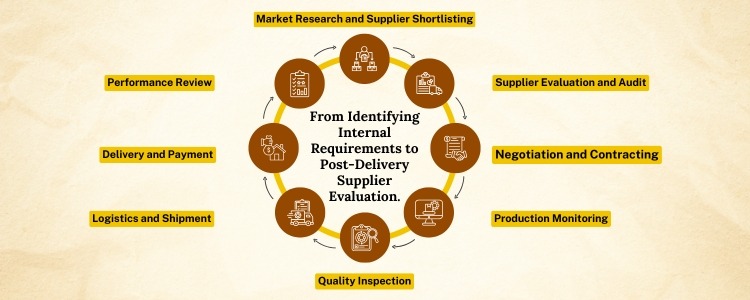
The procurement Process generally consists of the following process steps:
Requirement Analysis
Supplier identification
Supplier evaluation and shortlist
Price negotiation
Finalizing the contract
Production monitoring
Quality inspection
Logistics coordination & delivery
Payment
Performance review
Each step in the procurement Process impacts subsequent steps; for example, weakness in the supplier evaluation process could lead to production delays and, on the other hand, if the inspection process is incomplete or inadequate, it could result in significant returns.
How Do Sourcing Agencies Identify the Right Suppliers?
Selecting suppliers is one of the most important components of the procurement process. Sourcing agents typically start with conducting research on the market and mapping different vendors throughout the world according to specific types of manufacturing strengths.
For instance, an Indian sourcing agent might seek to source products from clusters which are established in the textile, pharmaceutical, or automotive component industries. Their goal is not just to find the lowest cost supplier, but rather the best quality supplier that can provide reliable service and meet compliance requirements.
Some of the factors suppliers are assessed on include their:
- Production capacities
- Financial positions
- Certification standards
- Previous export records
- Quality control systems
When sourcing a supplier’s viability, on-site audits, reference verification, or a background check will typically be included in the evaluation process. After conducting the evaluation, the outcome will be a list of potential suppliers who can meet both technical and pricing requirements.
Read this Articles :- End-to-End Sourcing Services and Process: A Complete Guide for Global Importers
Why is Negotiation a Strategic Stage in Procurement?
When we think of “negotiating,” most of us think of arguing about price. But in reality, it’s the process of outlining how the two parties are going to do business together.
When a product sourcing agent negotiates with a supplier, they will negotiate with them over the following issues. In addition to price, product sourcing agents will negotiate:
- Payment terms
- Delivery dates
- Penalty clauses
- Quality standards
- Intellectual Property protections
Having a well-written contract protects the buyer from things happening that are not anticipated. For example, if there are unclear clauses in regards to production delays, quality issues, and the shipment of goods, there could be confusion in the event that there are problems.
Having good negotiation skills will have direct benefits to businesses operating in competitive industries. Even a small difference in the terms of payment or unit cost can result in large savings over an extended period of time when dealing with large orders.
How is Production Monitoring Managed?
When entering into a contract, oversight starts immediately. This means that monitoring will help ensure that suppliers comply with the timelines and specifications that have been agreed upon.
Agencies will then put field representatives or independent inspectors to track the progress of the production. They will confirm that raw materials are of good quality, monitor the assembly lines, and validate packaging standards.
Periodic status reports are provided to keep buyers informed. If issues arise due to a supplier, the agency works quickly to mitigate any impact to the buyer to help keep the delays from escalating.
A well-organized Procurement agency understands that once a contract has been signed, it is equally as important to manage the supplier post award as it was to select the supplier. If production is not properly supervised, it will create inconsistencies in the production of goods which may jeopardize either the production quality of a product or the ability to meet delivery obligations of the goods to the buyer.
What Role Does Quality Control Play in the End to End Procurement Process?
In addition to quality being critical to maintain a brand’s reputation, there are typically three points in the procurement process where quality assurance inspection occurs:
- Pre-Production Inspection
- During Production Inspection
- Pre-shipment Inspection
Each of these inspections verifies that the products manufactured conform to the technical specifications established by the buyer and meet safety requirements.
Good documentation practices are essential to the customs arrival of goods. All shipments should be accompanied with test results, certificates and compliance documentation in order to minimize problems at customs.
By incorporating multiple checkpoints throughout the entire procurement process, agencies can minimize the risk of defective product shipments and costly product recalls.
Read this Articles :- End-to-End Supply Chain Management for International Buyers
How Do Agencies Handle Logistics and Documentation?
Logistics coordination transforms finished goods into delivered products. Agencies collaborate with freight forwarders, customs brokers, and insurance providers to ensure timely transport.
Key responsibilities include:
- Selecting appropriate shipping modes (air, sea, multimodal)
- Preparing export documentation
- Managing customs declarations
- Tracking shipment status
Integrated Procurement Solutions often include digital dashboards that provide real-time tracking updates.
Efficient logistics management reduces transit delays and optimizes inventory planning. For global buyers, timely delivery often determines customer satisfaction and revenue cycles.
How is Risk Mitigated Across the Procurement Cycle?
The global procurement market presents numerous inherent risks– currency volatility, changes in regulatory rules and politics, unexpected natural events etc.– that every procurement department must deal with.
Sourcing agencies try to address these risks through:
- Supplier base diversification
- Compliance auditing
- Milestone-based payment systems
- The use of buffer inventories
Some sourcing agencies even offer an “end to end” sourcing solution that combines supplier management with risk analysis and forecasting tools. Proactive risk management can help purchasers mitigate both operational disruptions and financial losses due to the risk of working with multiple suppliers.
How is Supplier Performance Evaluated Post-Delivery?
Once the products have shipped from the supplier, the procurement process is not finished. To make future sourcing decisions, purchasers must evaluate suppliers’ performance after shipment based on metrics such as:
- On-time deliveries
- Defects
- Communication response time
- Cost compliance
These evaluations provide purchasers with insights to help them make better sourcing decisions in the future. If a supplier consistently meets performance thresholds, the supplier may receive repeat orders from the purchaser. If a supplier does not meet agreed upon performance standards, they may find themselves phased out of the purchaser’s future orders.
By continually evaluating their suppliers, purchasers can ensure that the procurement process is evolving, as opposed to static.

1. What is the main purpose of the end to end procurement Process?
It ensures a structured, integrated approach to acquiring goods—from supplier identification to post-delivery evaluation.
2. Why do companies hire Sourcing Agencies?
To access supplier networks, reduce risk, manage compliance, and oversee production without maintaining large in-house procurement teams.
3. Is negotiation limited to pricing?
No. It includes payment terms, delivery timelines, contractual safeguards, and quality standards.
4. How do agencies ensure supplier reliability?
Through audits, certification verification, production monitoring, and performance scorecards.
5. What risks are common in global procurement?
Currency volatility, regulatory changes, logistics disruptions, and quality inconsistencies.
6. Can small businesses benefit from procurement agencies?
Yes. Agencies provide expertise and infrastructure that smaller firms may lack internally.

Diptanshu
Leading research and marketing at Inductus Global, Diptanshu drives the company’s vision to transcend traditional trading through thought leadership in import-export. He spearheads a research-driven approach that prioritizes quality over price arbitrage, positioning Inductus as a strategic sourcing partner rather than a transactional intermediary. His work spans market intelligence, supply chain innovation, and trade dynamics, while playing a key role in sales and business development.






One Reply to “End-to-End Procurement Process: How Sourcing Agencies Work”
Yellow Sweet Corn Exporter from India | Buyer Guide
29 Sep 2026[…] specification is the basis of any good procurement process. Instead of stating “wheat bran” only, international buyers should define the parameter […]