

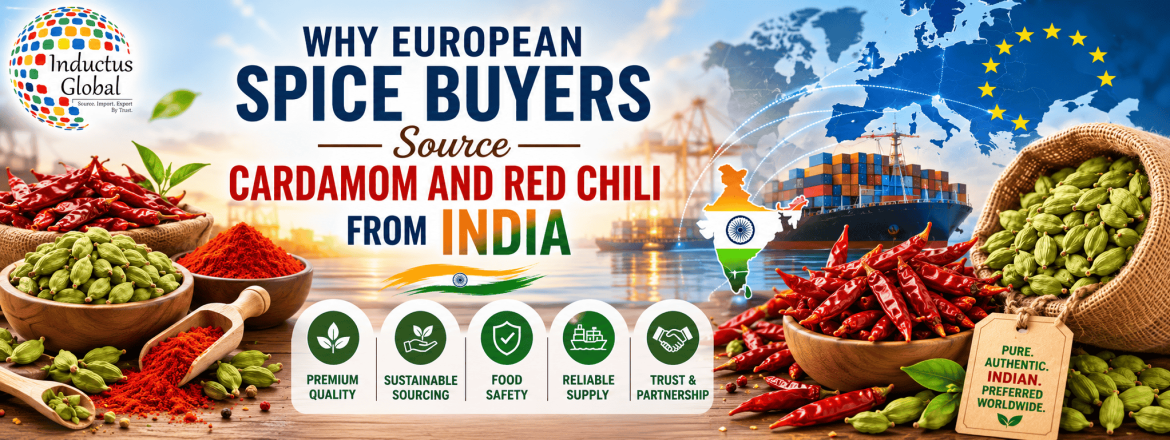
Why Europe Imports Cardamom & Red Chilli from India
Europe’s Choice: Indian Diverse Spice Market
What if the most cost-effective and authentic spice solutions weren’t hiding in warehouse districts across Amsterdam or Hamburg, but thriving in Kerala’s monsoon valleys? The European spice trade is changing in a big way. In India’s spice market, buyers are building stronger, more direct relationships with Green Cardamom Exporters and red chilli suppliers, bypassing layers of intermediaries.
Procurement has evolved beyond just cost-cutting. It is now more necessary to have authentic, transparent, and strong supply chains. By 2026, direct sourcing will be a strategic advantage. Today, European buyers want to work more closely with producers regarding their ability to guarantee origin, quality, and compliance. Three main drivers are at work: lower costs from fewer middlemen and enhanced visibility across the supply chain.
Three key drivers include:
- Cost efficiency through fewer intermediaries
- Greater supply chain transparency
- Improved resilience against disruptions
Why Choose Indian Green Cardamom Exporters?
There is a trend among European buyers to source Indian green cardamom, which assures quality, reliability, and transparency in the supply chain. The procurement team is saddled with price volatility, ever-increasing regulatory requirements, and growing consumer expectations, but a direct partnership with the Indian exporter will make it worthwhile.
India knows how to produce prime green cardamom, use modern processing, and quality control systems for uniform taste, fragrance, and traceability. Direct sourcing increases shipment visibility, enhances inventory planning, and decreases reliance on intermediaries. Also, many Indian exporters support sustainability certifications, fair-trade practices, and regulatory compliance, which helps European brands to mitigate sourcing risks and stay competitive in the marketplace.
Why Choose Indian Red Chilli Exporters?
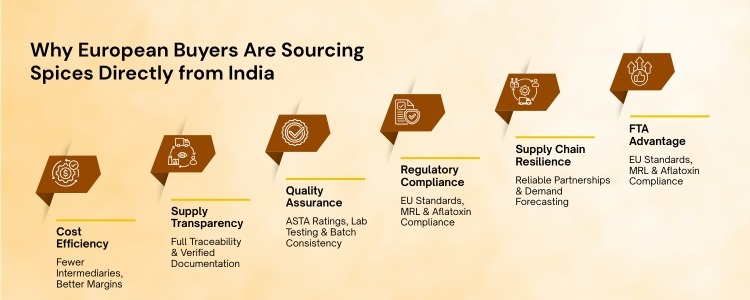
In Europe, red chilli is no longer a commodity in the industry but an extremely specified ingredient that has to perform to exacting standards of quality and performance. Today’s exporters to Europe must meet tough standards, including ASTA color ratings, capsaicinoid levels, microbial limits and full batch traceability.
This change is apparent from the rise in red chilli exports from India to Europe, where exporters are merging traditional cultivation knowledge with modern testing capabilities. Food manufacturers want uniform flavor. Cosmetic companies want uniform extracts. Pharmaceutical buyers want confirmed purity. Direct sourcing also allows for custom specifications, high documentation, and reliable quality assurance.
What European Buyers Seek from India’s Spice Market in 2026
- Source from Authentic Suppliers: Successful Sourcing spices From India begins with supplier verification. European procurement teams should follow a structured authentication framework. Source from Authentic Suppliers:
- Verify export registrations
- Review export council memberships
- Conduct third-party facility audits
- Assess production capabilities and certifications
- Seek Verifiable Documents: Documentation is not bureaucracy; it is risk insurance. Consider a European bakery whose cardamom shipment failed microbial testing during production. The resulting recalls, delays, and reputational damage far exceeded any sourcing savings. Competitors with verified sourcing protocols avoided the disruption entirely.
Essential Documentation Checklist
- Phytosanitary certificates
- Laboratory test reports
- Exporter registration numbers
- Certificate of origin
- Organic certifications
- Fair-trade certifications
- Quality assurance records
Reliable Green Cardamom Suppliers understand that every document protects buyers from financial, regulatory, and operational exposure. Compliance creates confidence, and confidence creates competitive advantage.
- Comply by Safety Norms: European food safety standards are amongst the strictest in the world, and spice importers are required to comply with EU Maximum Residue Limits (MRLs), aflatoxin monitoring standards, heavy metal testing thresholds, and traceability requirements. Non-compliance may lead to the rejection of shipments, loss of revenue, production delays, and damage to reputation.
To meet these expectations, top Indian exporters have invested in advanced laboratories, GMP-aligned facilities, and integrated compliance systems. The best suppliers are those that take a proactive approach, embedding compliance into their cultivation, processing, and export operations to ensure consistent safety and quality.
- Spice Check Pre-Post Delivery: Quality assurance is not a one-time check, but an ongoing process to assure the integrity of the product throughout the supply chain. Direct sourcing relationships allow buyers to implement quality controls at each level, including inspection touchpoints, pre-shipment laboratory testing, container inspections, port-side verification and post-delivery warehouse testing.
These measures will test for key things like moisture content, microbial levels, purity, color consistency, and residue compliance. The majority of exporters today follow quality systems and real-time monitoring practices that are compliant with FSSAI. This helps prevent problems, reduce risks, avoid costly recalls and build stronger, long-term business relationships.
- Long-term Reliable Supply Chain: Recent disruptions, from port congestion to geopolitical uncertainty to extreme weather events, have revealed vulnerabilities across global supply chains. Reliable Indian exporters will improve predictability through direct partnerships by:
- Planning of the seasonal supply
- Predicting demand
- Planning of inventories
- Visibility in logistics
Good sourcing strategies don’t rely on one supplier. Instead, buyers establish networks of trusted partners to help ensure continuity. Supply chain resilience is not a procurement goal, it is a competitive must-have.
- Quality over Compromise: While trying to concentrate on cost effectiveness, big companies often lose their grasp over Quality products. India’s best exporting hubs that actually offer Quality raw material often charge luxurious pieces which is optimum for the value provided. Rather than pricing, one should focus on the size of production, pesticide usage, cultivation practice, and lastly delivery management, from authentic taste to smooth delivery. Key differentiators are:
- Cultivation practices of heritage
- Investments in sustainable farming
- Rigorous selective batch
- Fair payment to the farmer
This creates a convergence of interests between European brands protecting their reputation and Indian exporters protecting their legacy. Ultimately, quality sourcing is about integrity, trust and long-term value creation.
Towards Smoother Logistics: Europe-India FTA 2026
“India and the European Union (EU) announced the conclusion of negotiations for a Free Trade Agreement (FTA), an important milestone in one of India’s most strategic economic partnerships. Designed as a modern, rules-based trade partnership, the FTA responds to contemporary global challenges while enabling deeper market integration between the world’s 4th and 2nd largest economies.”
The Europe-India FTA 2026 is giving a new impetus to direct sourcing of spices. Expected benefits include:
- Lower tariff barriers
- Quicker customs processing
- Harmonised compliance frameworks
- Enhanced recognition of certification
That’s a strategic opportunity for European buyers. Early adopters can secure preferred supplier relationships, improve margins and achieve supply-chain advantages before competition intensifies. The deal signals increasing confidence in open, direct trade relationships between the two regions that are beneficial for buyers, exporters and consumers.
Conclusion
Nobody wins with Indian red lentils vs green lentils. Both are excellent sources of plant-based nutrition for health, with their own benefits. When cooking, red lentils are ideal for quick creamy dishes, and green lentils for texture. Trade: Best choice based on end use, market demand, and source.
If you are a US importer, distributor, wholesaler, or food manufacturer seeking reliable Indian Red Lentils or Green Lentils sources, it’s time to find reliable sources. Get export quotes, shipping terms, product specifications, or sample consignments. As demand for healthy, sustainable pulses grows around the world, India is a reliable partner in feeding markets with reliable lentil exports.

Pratibha Soni
I write where strategy meets storytelling. As a passionate writer and literary enthusiast, I craft business-focused content that transforms trading insights into compelling narratives. Drawn to global business ecosystems, I enjoy turning research, innovation, and ideas into content that informs, connects, and inspires. With an analytical mind and a creative soul, I bring curiosity, collaboration, and a sharp eye for detail to every project. Adaptable and growth-driven, I believe the right words do more than communicate; they leave an impression.