

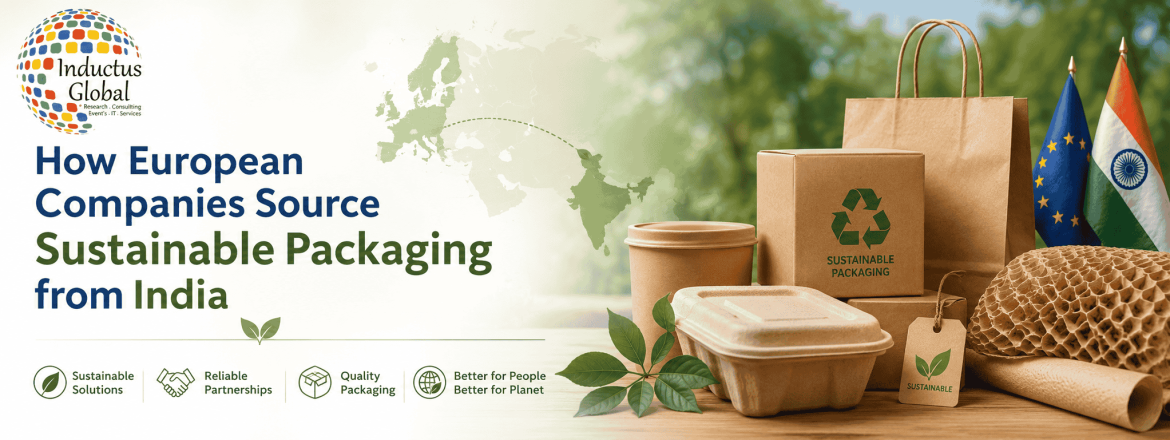
How European Companies Source Sustainable Packaging from India
Introduction
Walk into any European boardroom today and you’ll find a quiet revolution playing out in the supply chain, one that has little to do with Brussels and everything to do with Bangalore, Surat, and Chennai. The same companies that once chased the lowest unit cost are now chasing the lowest carbon footprint, and somewhere along that pivot, India stopped being a backup supplier and started becoming a strategic partner. The question worth asking isn’t whether this shift is real. It’s why a country built on cost advantage suddenly leads to sustainability.
Why is Sustainable Packaging a Global Priority in 2026?
Sustainability stopped being a brand value and became a balance-sheet line item somewhere around the time regulators decided to make it one. The EU’s Packaging and Packaging Waste Regulation (PPWR) is reshaping what counts as compliant material, pushing brands toward recyclability and away from vague green claims. Layer onto that a generation of European consumers who treat plastic-heavy packaging as a red flag rather than a convenience, and the commercial risk of inaction becomes obvious.
Add investors running ESG screens before they run profitability ones, and sustainability shifts from optional marketing flourish to operational necessity. Put plainly: the brands not adapting are the ones quietly losing shelf space and capital access. Which raises an uncomfortable question for every procurement head in Europe: if sustainable packaging at scale is now mandatory, who can actually deliver it?
India as a Leading Manufacturer & Exporter of Eco-Friendly Packaging
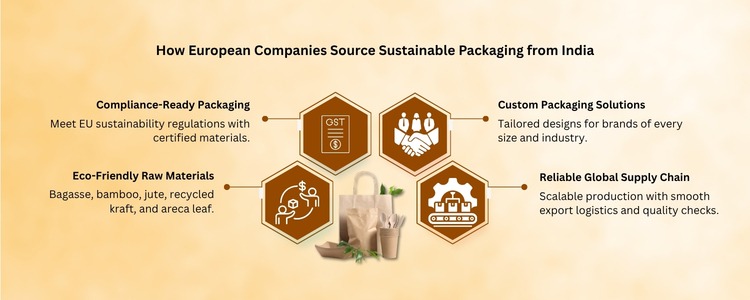
India’s answer to that question starts with raw material access most Western manufacturers simply don’t have at comparable scale or cost, bagasse, jute, areca leaf, recycled kraft, and bamboo, all sourced domestically rather than imported at a premium. That raw material advantage feeds into manufacturing clusters in Gujarat, Tamil Nadu, and Maharashtra, where decades of export infrastructure mean Indian producers aren’t improvising sustainable packaging material; they’re refining it.
Government policy has accelerated rather than lagged this shift: Extended Producer Responsibility norms and Make in India incentives are nudging manufacturers toward compliant, export-ready production rather than treating sustainability as an afterthought. The result is a cost-to-quality ratio Western manufacturing struggles to replicate without inflating unit prices. For a European buyer running the numbers, this isn’t charity sourcing; it’s a legitimate competitive advantage hiding in plain sight.
Why Major European Companies Source Sustainable Packaging from India
Here’s the assumption worth challenging: that “sustainable” and “cost-effective” can’t coexist. Indian sourcing quietly dismantles that idea. Sustainable materials for packaging produced in India often arrives cheaper than European alternatives without sacrificing the certifications buyers need to stay compliant. Beyond cost, there’s flexibility: Indian manufacturers are far more willing to co-develop custom SKUs for niche brand requirements than rigid mass producers elsewhere, who treat customization as a pricing penalty rather than a service.
That same supplier base scales both ways, serving eco-friendly packaging for small-business orders and multinational retail volumes without forcing buyers into separate sourcing strategies. And underpinning all of it is decades of India-EU trade familiarity, which removes much of the first-time-sourcing anxiety that derails newer trade corridors entirely.
Steps How European Companies Source Desirable Packaging from India
- Reliable Sourcing Partners
Reliability here isn’t about a single successful shipment, it’s about consistency across the fiftieth batch, not just the first. European buyers vet Indian manufacturers through site audits, sample production runs, references from existing EU clients, and increasingly through third-party verification platforms built specifically for cross-border sourcing diligence. The companies that get this stage right treat it as relationship-building, not box-checking, because packaging quality that holds steady is what actually protects brand trust downstream.
- Legal Compliance
This is the non-negotiable gatekeeper stage, and it filters out suppliers fast. European buyers require FSC certification for sourced wood and paper materials, BRCGS standards for packaging safety, REACH compliance for chemical content, and increasingly, direct alignment with PPWR material standards. Suppliers who can’t produce this documentation on demand, regardless of how attractive their pricing looks, get eliminated before negotiations even begin. Compliance isn’t a formality here, it’s the price of entry.
- Smooth Logistics
Even the most sustainable packaging is worthless if it’s stuck at customs. European companies navigate this by working closely with established freight forwarders who understand port efficiency at hubs like Nhava Sheva and Mundra, and by front-loading customs documentation rather than scrambling reactively. The bottlenecks that derail cross-border packaging deals are rarely about the product itself, they’re about logistics partners who weren’t built for this specific trade lane.
- Long-Term Supply Chain
The smartest buyers stop treating Indian sourcing as a series of one-off transactions and start building it as infrastructure. That means securing secondary suppliers for redundancy, locking in raw material pricing ahead of seasonal fluctuations, and creating joint forecasting models with manufacturing partners so production scales predictably rather than reactively. This is where sourcing stops being procurement and starts becoming genuine supply chain architecture.
- Pre-Post Delivery Verifications
Trust gets tested at the point of delivery, not before it. Pre-shipment inspections catch defects before they become expensive returns, third-party lab testing verifies biodegradability claims rather than taking them on faith, and structured post-delivery feedback loops feed directly back into the next production run. Over repeated cycles, this verification process is what transforms a transactional supplier relationship into a dependable long-term partnership.
Towards Resilience: Why Sustainable Packaging Matters?
Strip away the compliance language, and the real story is resilience. Sustainable packaging insulates European companies against regulation that’s only getting stricter, raw material scarcity that’s only getting worse, and consumer backlash that’s only getting louder. The question isn’t whether packaging becomes sustainable; it’s who gets there first and locks in the supply chain advantage. India-Europe sourcing partnerships aren’t a side note in that race. They’re becoming the blueprint for it.
Conclusion
What makes India compelling isn’t one single advantage; it’s the rare combination of raw material access, manufacturing scale, and compliance readiness arriving together, at a moment when European companies need all three simultaneously.
For procurement teams chasing sustainability mandates without sacrificing margin, that combination is difficult to find elsewhere. As India-EU trade in eco-friendly packaging deepens, it’s shaping up to be less a sourcing trend and more the default architecture of the next decade’s global commerce.

Pratibha Soni
I write where strategy meets storytelling. As a passionate writer and literary enthusiast, I craft business-focused content that transforms trading insights into compelling narratives. Drawn to global business ecosystems, I enjoy turning research, innovation, and ideas into content that informs, connects, and inspires. With an analytical mind and a creative soul, I bring curiosity, collaboration, and a sharp eye for detail to every project. Adaptable and growth-driven, I believe the right words do more than communicate; they leave an impression.