

How to Import Kabuli Chana (Chickpeas) from India to UAE: Complete Guide
India: From Agricultural Powerhouse to Global Pulse Supplier
Agricultural production, varied cuisines, and position as a major producer and consumer of pulses is part of what the world believes of India. But behind this well-known image is a story of years of efforts put in by India to build a system to handle agriculture processing, warehousing, logistics, testing, and export. The nation has been part of the World Trade Organization since its inception in 1995, and its agricultural export system has been becoming increasingly attuned to the requirements of global trade.
Kabuli Chana is positioned within the context of this larger pulse industry. For buyers from UAE, it does not mean just bringing chickpeas from India, but rather creating a sourcing solution that includes product availability, supplier management, quality checks, documentation, and highly improved Indo-UAE logistics.
Today’s orientation is towards making the supply chain more predictable for global buyers.
How India Becomes a Competitive Kabuli Chana Supply Hub
For decades, international buyers have sourced pulses through established commodity corridors based on price, availability, and proximity. The UAE, meanwhile, has developed into a major food-trading and re-export hub serving the wider Middle East, North Africa, and South Asian markets.
For years, international purchasers began to source pulses via established commodity corridors where they focused on price, availability and convenience. In fact, the UAE has become one of the most important food-trading and re-exporting places for firms in the Middle East, North Africa, and South Asia.
However, modern times have seen these patterns changing as purchasers began to put more value on traceability, consistency, reliability, food safety, and supply chain responsiveness.
The Indian supply system is a significant source. The Food and Agriculture Organization (FAO) reports that India is among the leading pulse producers in the world and therefore provides exporters with an extensive domestic agricultural system.
India has the necessary structure of mandis, processors, warehouses, ports, laboratories and freight companies to implement pulse supply chain processing.
Inductus Global is mostly concerned with the coordination of supply-side capabilities according to international buyers’ needs.
India is also supported by the growing trade relationship with the UAE since the India-UAE Comprehensive Economic Partnership Agreement (CEPA) took effect on May 1, 2022.
| Parameter | India | Canada | Australia | Mexico |
|---|---|---|---|---|
| Cost of Operations | Competitive sourcing base | Higher operating costs | Higher logistics costs | Competitive |
| Resource Quality | Large pulse ecosystem | Strong commercial farming | Strong agricultural systems | Regional strength |
| Product Variety | Broad pulse portfolio | Strong chickpea production | Strong chickpea production | Strong pulse trade |
| Operational Ease | Established export network | Mature export systems | Mature export systems | Regional advantage |
| Infrastructure Maturity | Major ports + logistics corridors | Developed | Developed | Developed |
| Trade Policy | CEPA with UAE | UAE trade access | UAE trade access | UAE trade access |
Role & Relevance of Pulse Sourcing Surrounding India as a Leading Destination for UAE Food Importers
Sourcing pulses at an international level is not just acquiring a crop. It involves ensuring the availability of the required product specifications, quality criteria, statutory certification, packaging, shipping schemes, and marketing expectations.
The importance of this distinction is that the Gulf region represents a local food market as well as a redistribution center for food products in the surrounding areas.
The India-UAE trade treaty, signed in 2022, has contributed towards developing a common commercial concept between these two countries.
The relation itself is of great significance, as indicated by the Indian Ministry of Commerce and Industry. The volume of trade between India and the UAE was about $100 billion in 2024-25.
Within the framework of these large-scale trade relations, agriculture is no exception, as it allows for building niche supply chains. Thus, white chickpeas (Kabuli chana) exporters in India have a specific task to
India as a Center of Agricultural Supply & Export Capability
Geography
India’s geography provides pulse exporters with access to various agricultural production areas and an advanced transport system that links inland markets to important maritime gateways. Ports such as Mundra, Nhava Sheva/Jawaharlal Nehru Port, and Kandla provide established routes for containerized and bulk agricultural cargo. The establishment of dedicated freight and logistics corridors has further enhanced India’s connectivity from inland to port.
Youth
India’s large working-age population leads to a skilled, growing set of professionals in the sphere of procurement, quality control, food processing, logistics, customs, finance, and international trade. Historically, skilled Indian professionals tended to look for work opportunities abroad, but with India exporting, developing, and establishing more logistics and manufacturing systems, this trend is changing.
Quality Experts
The agricultural universities, food-technology schools, laboratories, and management schools of the country offer specialized resources that are useful for commodity exporting. Institutes such as the Indian Agricultural Research Institute (IARI) and National Institute of Food Technology Entrepreneurship and Management (NIFTEM) help in agricultural research, food processing, quality, and technological competence, which can make the food-export environment more advanced.
Innovation First Strategy
India’s larger innovation strategy is also transforming agriculture. With the Startup India initiative, which was initiated in 2016, the country has created an ecosystem of startups through programs funded by the government, incubators, financing options, and institutions. In agriculture, this environment has led to interest in agritech, chain digitalization, traceability, logistics, and market linkage.
In this way, Kabuli Chana exporters are hoping for a more connected system rather than just buying the commodity at the farm gate.
How UAE Buyers Can Import Kabuli Chana from India
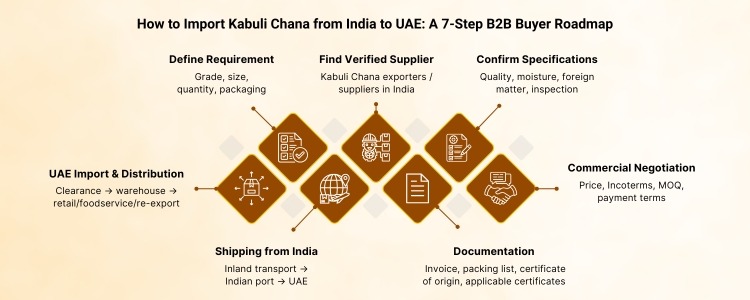
The practical process begins with identifying the specifications formally required. Buyers in the UAE will need to decide on factors such as the desired size or grade of Kabuli Chana, the desired quantities, packaging format, moisture values such as the amount of moisture present, acceptable amounts of foreign plant material, the quality level, and the name of the port of discharge or destination.
The next step is to find out the efficiency of the supplier. Buyers must look for Kabuli Chana exporters in India that have the capability to manage the process or sourcing, quality inspection, documentation, packaging, and shipment.
The quality documentation must meet the importers’ specifications and the laws of the UAE. Depending on the shipment and buyers’ specifications, the documentation can include commercial invoices, packing list, certificates of origin, phytosanitary documents if required, and all other necessary shipping or clarification paperwork.
Regarding packaging, it is also an important commercial aspect. Kabuli Chana can be packaged in retail-ready bags, woven bags, or otherwise, depending on the sales model of the buyer.
Finally, the logistics have to be organized from India to the UAE destination port.
| Buyer Requirement | Indian Kabuli Chana Exporters | Traditional Long-Distance Sources | UAE Importer Priority |
|---|---|---|---|
| Product Availability | Large domestic sourcing ecosystem | Production-cycle dependent | High |
| Supplier Flexibility | Multiple sourcing regions | Varies by country of origin | High |
| India–UAE Trade Framework | CEPA-supported trade relationship | Depends on country of origin | High |
| Logistics | Established maritime shipping routes | Route and origin dependent | High |
| Quality Coordination | Exporter/inspection dependent | Exporter/inspection dependent | Critical |
| Documentation | Structured export documentation process | Origin dependent | Critical |
| Overall Opportunity | Strong sourcing option for UAE buyers | Established alternatives | Evaluate supplier-by-supplier |
Conclusion
India is not trying to replace every established global chickpea origin overnight. Its differentiated pitch is more practical: combine a deep agricultural supply base with competitive sourcing, established export infrastructure, specialized professionals, and a strengthening India-UAE trade relationship.
For UAE buyers, importing Kabuli Chana from India can therefore be viewed not merely as a commodity purchase but as a supply-chain decision.
The trajectory is already supported by several concrete developments: the 2022 India-UAE CEPA, expanding bilateral trade, India’s extensive pulse-production ecosystem, and the continued development of agricultural logistics and processing capabilities.
For buyers evaluating Kabuli Chana suppliers, the commercial question is increasingly about consistency rather than origin alone. The right Indian exporter can bridge farm-level supply and UAE-market requirements through coordinated sourcing, quality management, documentation, and logistics.
Whether India ultimately expands its share of every major Kabuli Chana trade corridor remains to be seen. But the underlying directional momentum—from agricultural capacity to export infrastructure and India-UAE commercial integration—is difficult to ignore.

Diptanshu
Leading research and marketing at Inductus Global, Diptanshu drives the company’s vision to transcend traditional trading through thought leadership in import-export. He spearheads a research-driven approach that prioritizes quality over price arbitrage, positioning Inductus as a strategic sourcing partner rather than a transactional intermediary. His work spans market intelligence, supply chain innovation, and trade dynamics, while playing a key role in sales and business development.