

IR 64 Parboiled Rice Export from India to UAE: Complete Import Guide
IR 64 Parboiled Rice: The Grain Nobody Names, Everybody Eats
Ask most consumers what they’re eating, and “IR 64” will never come up — it has no heritage story, no GI tag, no aromatic signature the way Basmati does. It is, deliberately, an unglamorous grain: a high-yield semi-dwarf variety released by the International Rice Research Institute in 1985 and adopted widely across India’s rice belt for exactly one reason — it performs.
Behind that anonymity, IR 64 has spent four decades quietly becoming the backbone of India’s non-basmati rice trade. Parboiled — steamed and partially boiled in the husk before milling — it travels further and stores longer than raw milled rice, which is precisely why processing clusters in Andhra Pradesh, West Bengal, and Chhattisgarh built entire mill-town economies around it, feeding price-sensitive bulk markets across Africa, Southeast Asia, and the Gulf.
The current strategic push is about restoring trust as much as volume: after two years of shifting export restrictions, India’s rice trade is now working to convince UAE buyers that the supply disruptions of 2023–2024 are behind it, not a recurring risk to plan around.
How India's Parboiling Belt Becomes the New & Upgraded Sourcing Hotspot
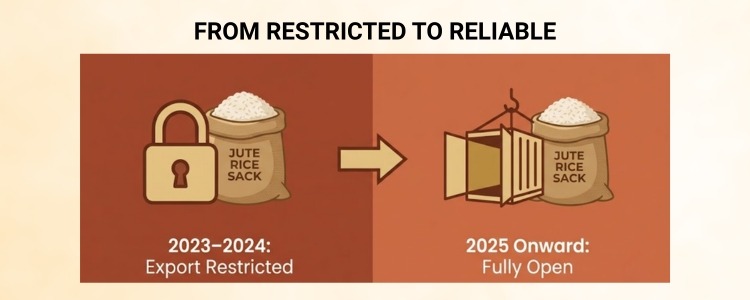
For much of 2023 and 2024, UAE and wider Gulf buyers had good reason to hedge. India banned non-basmati white rice exports outright in July 2023 and layered a 20% export duty onto parboiled rice the following month, both moves aimed at protecting domestic supply ahead of general elections. Pakistan and Thailand absorbed the resulting demand, with one Mumbai-based trader telling Reuters at the time that Indian parboiled rice had become “as expensive as supplies from Thailand and Pakistan” — erasing India’s usual price advantage overnight.
That friction has since reversed. India lifted the non-basmati white rice ban in September 2024, removed the minimum export price on basmati shortly after, and by March 2025 had eliminated the remaining export duties and the broken-rice ban entirely — according to USDA’s Foreign Agricultural Service Grain and Feed Annual report, this marked the removal of all rice export restrictions for the 2024/25 and 2025/26 marketing years. Trade publications tracking the category have estimated India’s non-basmati rice exports rebounded sharply as a result, though exact current-year figures should be pulled from the latest DGFT trade data before publishing.
India’s specific advantage in this reset isn’t just policy — it’s geography and stockpile. Andhra Pradesh’s parboiling clusters sit close to Krishnapatnam and Kakinada ports, giving them materially shorter shipping lanes to the UAE than Southeast Asian competitors. Internal Inductus Global shipment data shows a rising share of parboiled rice inquiries from UAE buyers specifically since the March 2025 policy reset — buyers who spent two years diversifying toward Pakistan now testing whether India’s supply reliability holds.
| Parameter | India | Pakistan | Thailand |
|---|---|---|---|
| Cost of Operations | Competitive; exports to the UAE are now duty-free | Competitive with relatively stable pricing | Higher freight costs to the Gulf |
| Export Policy Stability | Volatile during 2022–24; stabilized after March 2025 | Consistently open throughout the period | Consistently open |
| Grain Quality & Consistency | Strong, supported by established parboiling infrastructure | Strong, particularly for IRRI-6 varieties | Strong, with a distinct grain profile |
| Shipping Distance to UAE | Short; major access through Andhra Pradesh ports | Short; Karachi provides direct Gulf access | Longer route through the Gulf of Thailand |
| Infrastructure Maturity | Rapidly maturing following the policy reset | Mature but comparatively smaller scale | Mature and well-established |
| Government Incentives & Policy | Duty-free since March 2025; APEDA support available | Stable policies with a smaller export-incentive push | Limited incentive schemes |
| Best For | Long-term bulk buyers prioritizing reliability, supply continuity, and competitive pricing | Buyers seeking a reliable alternative supply source | Buyers prioritizing shipping consistency and a different grain profile |
| Overall Trend | Strong option for long-term bulk supply now that export curbs have been lifted | Reliable fallback supplier with comparatively smaller scale | Suitable for buyers prioritizing shipping consistency over price |
India as Leading Destination for Non-Basmati Rice Exports
Bulk parboiled rice trade is a different discipline from Basmati or specialty rice sourcing — it runs on price-per-tonne, consistent moisture and broken-grain percentages, and predictable shipping schedules rather than provenance or aroma. A single disrupted harvest or policy shift can move global benchmark prices, which is exactly what happened when India’s 2022–2024 restrictions pushed Asian rice prices to their highest levels in over a decade.
India’s rice trade bodies and DGFT continue to update export policy conditions even after the 2025 reset — most recently an April 2026 notification adjusting inspection certificate requirements for exports to European destinations, a reminder that this category still moves on regulatory detail buyers need to track closely rather than assume is static. (Check the latest DGFT notification for any UAE-specific requirements before citing a specific compliance detail in the published version.)
At a national level, India remains the world’s largest rice exporter by volume, with non-basmati varieties — IR 64 chief among them — making up the large majority of that trade by tonnage. Within that broader position, Andhra Pradesh and West Bengal’s parboiling clusters carry a specific mandate: prove to Gulf buyers that India’s post-2025 export policy is stable enough to plan a full year’s procurement around, not just a single opportunistic order.
India's Parboiling Belt as Center of Scale & Reliability
Geographic Factors — Andhra Pradesh’s Krishna and Godavari delta mills sit within short trucking distance of Krishnapatnam and Kakinada ports, both of which run regular container services to Jebel Ali and other UAE gateways — a shorter, more direct shipping lane than competing origins in Southeast Asia.
Talented Youth — Rice mill towns across Andhra Pradesh and Chhattisgarh have historically seen younger workers migrate toward urban manufacturing and services; a reverse trend is now visible as parboiling and export-documentation roles modernize and offer more stable, better-paid work than a generation ago.
Qualified Professionals — The Indian Institute of Rice Research (IIRR) in Hyderabad, formerly the Directorate of Rice Research, continues to develop and certify high-yield varieties and processing standards specific to India’s parboiling industry — a level of variety-specific research infrastructure that smaller competing origins don’t match.
Innovation First Strategy — Government initiatives such as the PM Formalisation of Micro Food Processing Enterprises (PMFME) scheme, launched in 2020, have funneled investment into upgrading small and mid-sized parboiling mills — modern dryers, better moisture control, more consistent grading — precisely the improvements that make bulk export shipments more predictable for overseas buyers.
Conclusion
India isn’t trying to out-price Pakistan on IR 64 parboiled rice, nor out-ship Thailand on shorter Gulf logistics from Southeast Asia. The actual pitch is narrower: after two volatile years, India is asking Gulf buyers to trust that the current open, duty-free export policy is the new normal, not another temporary window before the next restriction.
This is not marketing gloss — it is a trajectory. The proof points are concrete: every rice export restriction, including the broken-rice ban, was lifted by March 2025, per USDA-FAS reporting; India’s domestic rice stockpiles have run several times above the government’s annual procurement requirement, reducing the odds of another supply-driven restriction; Andhra Pradesh’s port infrastructure keeps shipping lanes to the UAE shorter than most competing origins; and institutional backing from IIRR and schemes like PMFME continue to push processing quality upward.
Whether India holds this policy stability through the next election cycle — the same pressure that triggered the 2023–2024 restrictions in the first place — remains to be seen. But for UAE buyers weighing where to place their next bulk parboiled rice order, India’s case for reliability is stronger now than it has been in several years.

Diptanshu
Leading research and marketing at Inductus Global, Diptanshu drives the company’s vision to transcend traditional trading through thought leadership in import-export. He spearheads a research-driven approach that prioritizes quality over price arbitrage, positioning Inductus as a strategic sourcing partner rather than a transactional intermediary. His work spans market intelligence, supply chain innovation, and trade dynamics, while playing a key role in sales and business development.