

Cattle Feed Exporter from India: Sourcing Guide for Global Buyers
The world livestock industry is highly dependent on a reliable supply of high-quality, safe and affordable animal feed. This factor plays an essential role for dairy farmers, cattle breeders and related businesses. It creates demand for animal feed manufacturing and exporting companies in countries that possess the necessary resources.
India is a market of interest for many livestock producers. The country has a strong agricultural sector, a considerable number of cattle and well-developed feed manufacturing capabilities. A buyer, however, needs to carefully review several details before purchasing animal feed in India. This guide provides information on the key aspects of this business transaction.
Why Source Feed in India?
Being a developing country, India possesses a wide range of resources that can be used for livestock feed production. Most often, the product contains a combination of cereals, oilseeds, bran, protein, minerals, vitamins and other ingredients.
India’s agricultural and processing industries are also suited to producing and storing feed materials. Different types and varieties of feed can be produced depending on the animal species, its age and purpose. These advantages make the country an interesting market for international buyers.
Understand the Product: Cattle Feed
The term “feed” includes a variety of livestock foodstuffs. Before placing an order, it is vital to clarify the following details:
- Type of feed (for what category of animals – cattle, sheep, poultry, etc.)
- Ingredients
- Content of nutrients
- Protein, fibre, fat
- Minerals, vitamins
- Moisture
- Feed form: pellets, mash or another
- Shelf life
- Packaging size
- Storage conditions
It is also essential to indicate whether the buyer is looking for a complete feed, a concentrate or a supplement, and a particular ingredient.
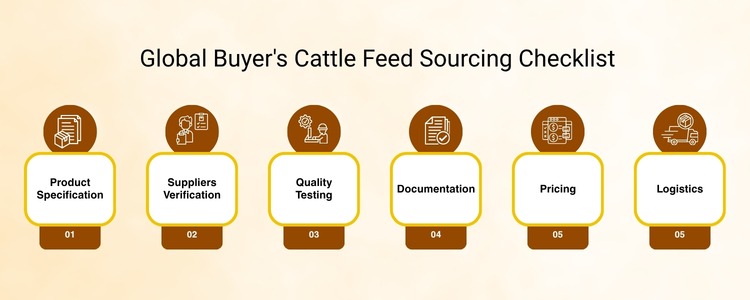
Assess the Manufacturer and Supplier
This step is one of the most important in the entire transaction as choosing a reliable partner will ensure future business. It is reasonable to ask for the necessary documents and arrange an inspection of the manufacturing facility.
A potential supplier must be able to answer all the questions and provide the necessary supporting documents. It is also vital to clarify how the raw materials are sourced and tested.
The factors to consider when choosing a feed supplier may include:
- Manufacturer’s capabilities
- Quality of the product
- Type and scope of laboratory analyses
- Traceability
- Packaging
- Shipment documentation
- The company’s experience
If possible, it is also advisable to arrange an independent inspection of the facility. In addition, buyers should obtain a sample of the product to ensure the quality of raw materials and manufacturing.
Verify Feed Quality and Safety
Feed safety is another crucial aspect of this transaction. Poor quality and improper formulations can limit the productivity of the farm and jeopardize the animals’ health. Therefore, it is necessary to ensure that the product meets all the requirements and specifications.
Depending on the type of feed, an exporter may provide documentation confirming compliance with specific standards. If the buyer has particular requirements, it is also possible to request analytical results from independent laboratory tests.
The choice of testing methods will depend on the type of feed and the requirements in the country of importation. The parties should also discuss this aspect to ensure that the product meets all the criteria.
Traceability is also a significant factor when selecting an animal feed supplier. This feature allows tracing the product to a particular batch and quickly identifying the cause of poor quality if it arises.
Check Destination-Country Regulations
An Indian manufacturer cannot be aware of all the regulations in the importing countries. Feed laws differ from country to country and may relate to ingredients, documentation, labels, additives, contaminants, packaging and other aspects.
Therefore, it is vital for the buyer to obtain this information from the relevant authorities in his country. To ensure a reliable transaction, it is advisable to consult experts in customs and regulatory affairs.
For example, before purchasing feed in India, the buyer should study the regulations in the United States (or another country of importation) concerning feed imports. The same applies to the Middle East, Africa, Southeast Asia and other regions.
It is always advisable for the parties to discuss compliance issues at the stage of determining the commercial terms of the transaction.
Review Export Documents
Proper documentation facilitates customs clearance and reduces the risk of delays or seizure of goods. The documents may vary depending on the transaction structure and the country of importation. Typically, an invoice, packing list, transport documents, certificate of origin and various certificates and analyses are required.
In any case, the parties should clarify who is responsible for preparing each of the documents and what details should be included. Consistency of information is of particular importance in this case.
Compare Feed Prices: Choose Reliable Animal Feed Suppliers in India
When searching for a supplier, a buyer should consider not only the price per tonne of the product but also the total cost of the purchase. Before finalizing a deal, it is advisable to calculate the cost of transporting goods, insurance, port dues and other expenses.
Parties can also agree on the currency in which the transaction will be executed and the payment method. When requesting a quotation, it is advisable to indicate the Incoterms to obtain a realistic estimate of the total cost.
Select Feed Packaging and Shipping Schedule
Feed packaging is not standardized. Packaging must be appropriate for the type of product, mode of transport and storage conditions. The choice of bags or bulk depends on the volume of the transaction and the parties’ preferences.
It is important to ensure that the packaging is suitable for the climate in the zone of importation. The seller must indicate the storage and transportation conditions for each type of feed.
The parties should also agree on the timeline for the delivery of goods. Transportation costs and schedules vary for different routes and modes of transport. It is vital to plan the volume of shipments and the time of year when the feed will be transported.
Selecting a Long-Term Feed Supplier from India: The Bottom Line for Global Buyers
For the livestock industry, a stable supply of high-quality animal feed is essential for uninterrupted production. Therefore, it may be worth selecting a reliable supplier in India with whom the company will work not only once but for many years.
This approach reduces costs and the search for partners, as well as the risk of shortages or poor quality that can damage the entire batch of goods.
When determining the commercial terms of the transaction, it is advisable to choose a long-term cooperative strategy with a focus on the needs of both sides. In this case, the buyer must ensure the necessary conditions for the product and the seller – stable income.
In any case, the contract should fully reflect the expectations of both parties and include the appropriate guarantees.
India’s Feed Export Opportunities
The global livestock industry is highly integrated today, and buyers are interested in securing long-term, reliable and cost-effective sources of animal feed. India, with its resources and capabilities in feed production, is of interest to many buyers.
For exporters, the main advantage lies in the ability to meet the specific requirements of the client and provide high quality of product and compliance with all documentation. For the buyer, the most crucial aspect is the reliability of the supplier, which will secure a stable source of high-quality feed for years.
Conclusion
Buying animal feed in India can be an optimal solution for international buyers. However, the transaction requires due diligence on the part of the importer. The main aspects to consider are the product’s characteristics, the financial capabilities of the supplier, the quality and safety of the goods, the documentation and compliance with the legislation of the country of importation, the cost of transportation and other expenses.
A well-developed strategy and attention to detail will ensure a stable and profitable partnership in the long term. Indian manufacturers and exporters have great potential to meet the growing demand for animal feed from foreign markets.

Diptanshu
Leading research and marketing at Inductus Global, Diptanshu drives the company’s vision to transcend traditional trading through thought leadership in import-export. He spearheads a research-driven approach that prioritizes quality over price arbitrage, positioning Inductus as a strategic sourcing partner rather than a transactional intermediary. His work spans market intelligence, supply chain innovation, and trade dynamics, while playing a key role in sales and business development.