

How to Import Basmati Rice from India: A Complete Guide for USA & UK Buyers
Owing to its long grain, unique aroma, and remarkable cooking quality, Basmati rice has carved a favorable position in the global food market. As exports continue to rise, India leads the pack as the top exporter of Basmati rice in the world, supplying its premium quality rice to retailers, wholesalers, food service companies, and store brands across different continents.
The sourcing of rice from India proves to be an affordable option for buyers in the United States and the United Kingdom, as they can avail themselves of reasonably priced rice offering steady quality and considerable variety of rice grades. However, a rice import does not begin and end with the supplier choice but involves an understanding of various aspects of export, food safety regulations, necessary paperwork, and logistics of import.
This guide discusses the essentials of importing Basmati rice and exporting it successfully among the different considerations during Basmati rice export from India for international buyers.
Why is Basmati Rice Export From India Preferred by Global Buyers?
India is one of the largest exporters of Basmati rice, owing to its suitable climatic conditions, centuries-old cultivation techniques, and excellent export ecosystem. There are many reasons why Basmati rice from India enjoys a good reputation. First, India is the producer of pure traditional Basmati rice, which is characterized by its long grains, strong aroma, and good texture after cooking.
Second, Indian exporters have invested heavily in modern milling, grading, and packaging technology that conforms to international standards. Third, India has a well-developed export infrastructure that allows providers to meet the needs of clients in different parts of the world, including North America, Europe, and the Middle East. As a result, when seeking reliable and quality supply, bulk buyers are more likely to purchase Basmati rice from India.
How to Import Basmati Rice Successfully?
The process of getting rice imported includes structured procurement regarding compliance, logistics planning and quality assurance.
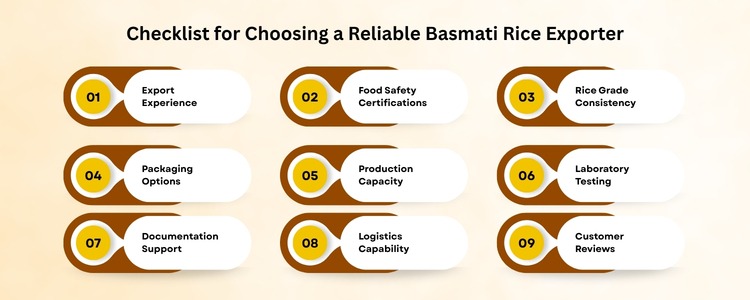
Step 1: Identify Dependable Exporters
Supplier selection is the first and foremost step in executing an import strategy.
Before placing an order, the buyers must look into:
- Export experience
- Processing capability
- Quality certification
- Packaging capability
- Customer reference
Reliable exporters are usually better at understanding the regulatory issues, international logistics management, and country compliance as compared to others.
Step 2: Assess Quality
Quality assessment has to be performed before committing to bulk purchase.
It is best to obtain:
- Product samples
- Grain length information
- Moisture content reports
- Purity certificates
- Laboratory analysis if necessary
So Basmati rice must be of the consistent grain size and low broken grain ratio with characteristic aroma.
Quality assessment ensures product reputation as well as customer satisfaction.
Step 3: Make Sure You Are Familiar With the Regulations
Each country has its own requirements when it comes to food safety and customs.
Businesses need to check:
- Import licensing requirements
- Food safety requirements
- Labeling regulations
- Packaging compliance
- Customs documentation
In the case of Basmati Rice Importers In USA, compliance with food safety requirements as well as customs procedure is a must in order to avoid shipment delays.
Similarly, Basmati Rice Importers In Uk should ensure imported products meet UK food regulations, labelling requirements, and customs documentation standards.
What Documents Are Required for Importing Basmati Rice?
Proper documentation is vital for having an easy customs clearance.
Some of the standard export documents are:
- Commercial Invoice,
- Packing List,
- Bill of Lading,
- Certificate of Origin,
- Phytosanitary Certificate,
- Quality Certificate,
- Insurance Documents (if applicable).
Importers should also check for extra requirements in that specific country.
Complete and precise documentation helps reduce delays in customs procedures and improve the supply chain efficiency.
How Should Buyers Choose the Right Rice Grade?
Basmati rice comes in different grades, distinguished from grain length, aging, and purpose.
Factors to look at include:
Consumer Market
Supermarkets and specialty stores often prefer premium-quality aged basmati rice.
Food Industry
In a restaurant setting, performance is somewhat of a consideration, but affordability plays a more essential role.
Private Branding
In this case, there is particular interest in custom packaging, etc.
How Does Shipping and Logistics Work?
Sea freight using containers is usually how international rice exports are transported.
Importers need to talk about:
- Incoterms
- Getting shipping dates
- Ways of packaging
- Type of insurance
- Time for delivering
Usually, packaging options are:
- Retail pouches
- Layered sacks
- Big export bags
Shrewd logistic management is key for achieving highest quality transportation.
What Challenges Should Importers Prepare For?
Even though rice imports are well known, buyers can still face operational problems.
Price Movements
Agricultural commodities are subject to price changes due to weather patterns, yields obtained and level of demand around the world.
Paperwork Problems
Incorrect documents and paperwork are quite common among reasons for customs delays.
Quality Fluctuations
The quality of products may vary between suppliers if grading standards don’t match.
Regular audits and inspections of suppliers may help reduce such risks.
How Can Buyers Build Long-Term Supplier Relationships?
Having a successful procurement experience does not stop at one transaction.
Long-lasting partnerships bring various benefits:
– Stable pricing
– Preferential production timeframes
– Increased communication
– Better quality constancy
– Better supply reliability
Many foreign buyers also pay attention to a comprehensive Basmati rice sourcing guide for importers when selecting new suppliers, making sure that quality, compliance, and logistics evaluation is carried out ahead of time.
Building strategic supplier relations creates an opportunity to implement less costly operational processes benefiting both the importer and the exporter.
What Trends Will Influence Basmati Rice Imports in 2026?
The dynamics of global food markets continue to change in response to changing consumer needs.
Main trends include:
Increased Interest in Premium Rice
Consumers appreciate sourcing authenticity, quality, and taste more and more.
Development of Digital Procurement
Companies increasingly utilize digital tools for procurement purpose to assess suppliers effectively.
Improved Transparency
Food safety regulations are leading to greater transparency of supply chain from farm to store.
Growing European Demand
Besides traditional markets in North America and UK, German importers of basmati rice are also stimulating demand from Europe for basmati rice.
Exporters who can adapt accordingly will benefit most from the changes.
Conclusion
India is the frontrunner in the Basmati rice market, thanks to the excellence of its product quality as well as its highly developed processing infrastructure and vast export experience.
Nevertheless, strategic planning is indispensable for successful importing. Buyers should recognize supplier reliability, check product quality, grasp regulation standards, and organize logistics effectively.
Finding out what needs to be done to import Basmati rice and teaming up with seasoned exporters engaged in Basmati Rice Export from India will allow companies to create reliable sources of supply enabling continuous business expansion.

Diptanshu
Leading research and marketing at Inductus Global, Diptanshu drives the company’s vision to transcend traditional trading through thought leadership in import-export. He spearheads a research-driven approach that prioritizes quality over price arbitrage, positioning Inductus as a strategic sourcing partner rather than a transactional intermediary. His work spans market intelligence, supply chain innovation, and trade dynamics, while playing a key role in sales and business development.






One Reply to “How to Import Basmati Rice from India: A Complete Guide for USA & UK Buyers”
Top Spice Exporters from India | Trusted Global Suppliers
24 Aug 2026[…] A direct-mill wholesale partnership is fundamentally different from the multi-tier broker distribution that has historically defined bulk rice trade. Rather than rice changing hands across several intermediaries before reaching a wholesale buyer — each layer adding cost and diluting traceability back to the harvest — a direct partnership ties every shipment to a specific mill, aging batch, and documented compliance record, including the phytosanitary certificates, FSSAI licensing, and APEDA registration that buyers now expect as standard when importing basmati rice from India. […]