

Trusted Indian Spices Suppliers for USA, UK & UAE Buyers
Indian Spices: From Kitchen Shelf to Cargo Manifest
Indian spices carry a tourist-brochure image — chilli-red bazaars, saffron sacks, the “Spice Bowl of the World” nickname that’s followed the country since the age of sail. It’s a true image, but a partial one. Behind it, India has spent nearly four decades quietly building an industrial-grade export apparatus: the Spices Board of India, set up in 1987 under the Ministry of Commerce and Industry, now oversees a network of more than 6,600 registered exporters, of which roughly 600 are manufacturers with their own processing lines.
That’s not folklore infrastructure. It’s a regulated pipeline that handles 75 of the 109 spice varieties recognised by the International Organization for Standardization and ships to over 180 countries. The current push is narrower and more specific: converting that scale into documented, auditable trust — because in 2026, the buyers who matter most are asking for lab reports before they ask about price.
Emerging Alternative to Brand-Only Sourcing: How Verified Exporters Step Up
For years, the default filter for overseas buyers was simple: stick to recognisable, packaged Indian brands and treat the label as a quality guarantee. That assumption broke in April 2024, when Hong Kong’s Centre for Food Safety suspended sales of several MDH and Everest spice blends after detecting ethylene oxide, a Group 1 carcinogen. Singapore ordered its own recall within days.
The US FDA opened an information-gathering review, and the UK’s Food Standards Agency went further than any regulator — it applied extra control measures to all spice consignments arriving from India, not just the two flagged brands. Separately, the European Food Safety Authority had already logged ethylene oxide in 527 India-linked food consignments between September 2020 and April 2024, most of them nuts, sesame, and spices.
The lesson for procurement teams was blunt: brand recognition is not the same as compliance. That gap is where a different category of supplier has stepped in — mid-sized, CRES-registered exporters built around documentation rather than shelf presence, offering Certificates of Analysis, pesticide-residue data, and moisture reports as standard, not on request.
The American Spice Trade Association formally engaged the Spices Board on ethylene oxide protocols in May 2024, and India’s own food regulator, FSSAI, responded by ordering nationwide testing across all spice-mix manufacturers, not just the two implicated brands. Inductus Global’s own export documentation flow reflects the same shift: since mid-2024, pre-shipment COA and residue-test requests from UK- and US-bound buyers have gone from an occasional ask to a standing line item on every purchase order.
The ambition sitting behind this shift is stated in dollars. Commerce and Industry Minister Piyush Goyal, addressing the World Spice Congress in Navi Mumbai in September 2023, set a target of USD 10 billion in annual spice exports by 2030 — more than double the roughly USD 4 billion baseline at the time. The World Spice Organisation has since reaffirmed that figure, tying it explicitly to higher value-addition and better-documented supply chains rather than raw volume growth alone.
Where buyers now weigh India against other origins:
| Parameter | India 🇮🇳 | Vietnam 🇻🇳 | China 🇨🇳 | Sri Lanka 🇱🇰 |
|---|---|---|---|---|
| Cost of Operations | Competitive at scale | Lower labour costs | Rising labour costs | Higher for niche products |
| Raw Material Depth | Broad domestic supply; strong spice variety | Pepper-led supply base | Broad supply with significant import dependence | Cinnamon-led supply |
| Compliance & Traceability | CRES registration, quality controls and SPICED-scheme support | Developing residue and certification systems | Advanced systems, but standards can vary by supplier | Emerging traceability practices |
| Processing & Grading | Advanced sorting, grading and steam sterilisation available | Basic to moderate grading and processing | Advanced, centralised processing capabilities | More manual-intensive processing |
| Port & Export Access | Kochi, Mundra, JNPT and other major export gateways | Ho Chi Minh City and regional ports | Shanghai, Ningbo and other major ports | Colombo Port |
| Government Incentives | SPICED scheme and trade-agreement support | Limited spice-specific incentives | Strong state-backed industrial support | Limited sector-specific incentives |
| Best Known For | Diverse spices, turmeric, cumin, chilli, cardamom and pepper | Black pepper and cinnamon | Processed spices and large-scale manufacturing | Ceylon cinnamon and specialty spices |
| Best Fit for Buyers | Buyers seeking diversified sourcing and scalable supply | Buyers focused on pepper and cost efficiency | Large-volume buyers needing industrial-scale processing | Buyers seeking premium specialty cinnamon |
Traceable Sourcing's Role in India's Compliance-Grade Spice Exports
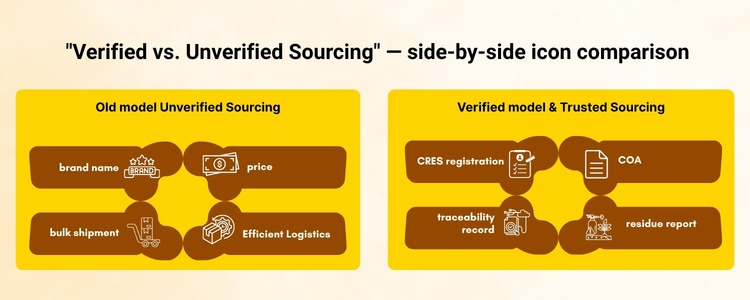
Traceable sourcing isn’t the old trading-house model of buying in bulk and shipping on price alone. It’s a documentation chain — from farm-gate procurement through Spices Board-registered testing labs to a Certificate of Registration as Exporter of Spices (CRES) — that follows a consignment all the way to the buyer’s dock.
The distinction was the centrepiece of the National Spice Conference 2024 in Ahmedabad, where World Spice Organisation chairman Ramkumar Menon told delegates that reaching the USD 10 billion export target would require India to lift its share of the global seasoning market beyond its current 0.7%, against China’s 12% and the US’s 11% — a gap that pure volume growth won’t close.
The scale of what’s already moving is real: Spices Board data puts FY 2024-25 exports at an all-time high of USD 4.72 billion across 17.99 lakh tonnes, before a modest 6% pullback to USD 4.43 billion in FY 2025-26 — a normal cyclical correction, not a demand problem, since buyer enquiries into verified suppliers kept climbing through the same period.
India’s specific task inside that national push is narrower than “sell more spice”: it’s converting production dominance into an equal share of documented, compliance-grade trust, particularly in the three markets tightening scrutiny fastest — the US, the UK, and the UAE.
India as the Base for Verified Spice Sourcing
Geographic Factors Kochi, headquarters of the Spices Board since 1987, sits at the historic centre of the global spice trade and remains the logistics anchor for exports moving through Kochi and Mundra ports today. Jebel Ali in Dubai receives a steady flow of bulk indian spice for regional re-export, helped by the India-UAE Comprehensive Economic Partnership Agreement, under which roughly 90% of India’s exports to the UAE now clear at zero or reduced duty.
New-Generation Exporters Spice sourcing in India used to mean thousands of fragmented smallholders selling through informal middlemen with no shared quality standard. That’s reversing. Farmer Producer Organisations and SME exporters are increasingly folded into a single traceable chain under the government’s SPICED scheme, replacing scattered, undocumented supply with organised, auditable procurement.
Qualified Professionals This isn’t generic food-testing capacity. The ICAR–Indian Institute of Spices Research in Kozhikode and the Spices Board’s own network of Quality Evaluation Labs across Cochin, Guntur, and Mumbai specialise specifically in spice chemistry, essential-oil content, and residue analysis — the exact technical skill set that generic agri-testing labs don’t carry.
Innovation First Strategy The SPICED scheme (Sustainability in Spice Sector through Progressive, Innovative, and Collaborative Interventions for Export Development), backed by a Rs. 422.30 crore outlay through the 15th Finance Commission cycle to FY 2025-26, funds Mission Clean and Safe Spices and Mission Value Addition, and directly supports FPOs, SMEs, and SC/ST exporters in meeting international residue and traceability standards.
Conclusion
India isn’t trying to out-cheap Vietnam’s labour costs or out-scale China’s processing volumes. Its actual pitch is narrower and more durable: documented, traceable, compliance-first supply at a scale few origins can match. The kitchen-shelf image and the cargo-manifest reality aren’t marketing gloss set against each other — they’re a trajectory, with the second steadily overtaking the first.
Proof points so far:
- FY 2024-25 exports hit an all-time high of USD 4.72 billion across 17.99 lakh tonnes, per Spices Board data
- The SPICED scheme has committed Rs. 422.30 crore specifically to clean, traceable, value-added export capacity
- The UK’s blanket compliance checks on Indian spice imports, in effect since May 2024, have pushed the entire exporter base toward better documentation, not just the flagged brands
- The India-UAE CEPA now clears roughly 90% of Indian exports to the UAE at zero or reduced duty
Whether the USD 10 billion 2030 target lands on schedule remains to be seen. But the direction of travel — toward verified, paper-backed sourcing as the actual selection criterion for USA, UK, and UAE buyers — is no longer in question.

Diptanshu
Leading research and marketing at Inductus Global, Diptanshu drives the company’s vision to transcend traditional trading through thought leadership in import-export. He spearheads a research-driven approach that prioritizes quality over price arbitrage, positioning Inductus as a strategic sourcing partner rather than a transactional intermediary. His work spans market intelligence, supply chain innovation, and trade dynamics, while playing a key role in sales and business development.