

What Types of Rice Does India Export? Major Varieties and Global Markets
Types of Indian Exports
India is a key global player in the rice export arena. It exports a number of rice types, including aromatic rice, non-basmati rice, and various rice products to many countries such as those in the Middle East, Africa, Europe, North America, and Asia.
Understanding the available types of rice is a key consideration for companies wishing to import Indian rice. Grain size, aroma, feel, production process, and how the rice cooks can all impact how suitable a specific type is. Packaging, quality, and transport are also affected by these factors, and consumer expectations will then be influenced accordingly.
India exports a number of rice types and not just one. Each has its own market appeal. Below are some of the key rice types and the markets to which they are exported.
1. Basmati Rice – India’s Highly Exportable Aromatic Rice
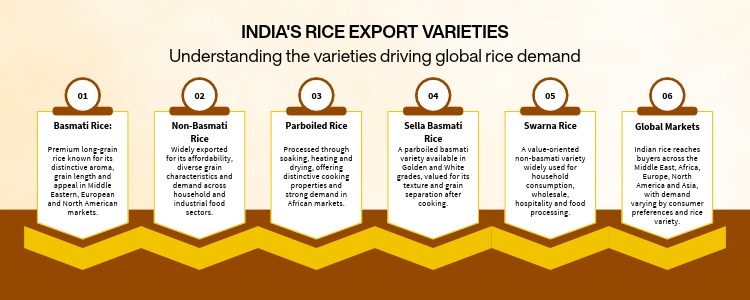
Rice exports from India frequently include basmati. It is appreciated for its aroma and long grain and is especially favoured in countries where rice is cooked into foods such as biryani and pilaf.
Whilst there are differing grades of basmati rice, grain size, aroma and age can all affect the rice’s feel and smell. Price can also be influenced by these factors. High interest in basmati rice is seen in many countries throughout the Middle East, Europe, North America and elsewhere, where South Asian foods are commonly consumed.
Common basmati rice types are:
1121 Basmati Rice
1509 Basmati Rice
Traditional Basmati Rice
Pusa Basmati Rice
Companies importing basmati rice should investigate the grain size, aroma, level of breakages, moisture and age of rice supplied. Due to basmati’s premium nature, maintaining high product uniformity is often an important consideration. Consumers typically expect a consistent cooking result each time they buy basmati rice.
2. Non-Basmati Rice – Key global export
Natural 1121 Basmati Rice (Organic Long Grain) – 25Kg, White, 100% Pure, Fresh. 12 Month Shelf life. Healthy To Eat in Chennai at Best Price
Parmal Raw Non Basmati Rice, Colour: White at Best Price in Haridwar (ID: 6610522)
Sugandha Golden Sella Rice, Type: Long Grain at Best Price in Sonipat (ID: 7290416)
Non-basmati rice is widely exported and utilised in numerous sectors, including for personal, industrial, wholesale and institutional purposes. Companies often seek non-basmati rice for good value for money, along with steady supply, and for a type which matches local eating trends.
Grain size, feel, aroma and cooking properties will differ between non-basmati rice types. Some are favoured for personal consumption, whereas others are for industry.
Demand for Non – Basmati Rice Suppliers is encouraged by the desire for good value, extensive food supply chains, and the importance people place on good value and supply. Sub-Saharan African, Asian and also sections of the Middle East are key markets for varying non-basmati rice types.
Importers should investigate grain details, production processes, moisture, purity and packaging for larger orders. Furthermore, as local cooking styles can influence demand, consumer tastes are often a key decision-making element in ascertaining which non-basmati rice type to import.
3. Parboiled Rice – Widely Exported
1509 Golden Sella Manufacturer & Exporter in India: Indian Parboiled Rice for sale in Chandrapur, Maharashtra – Agro Industries, Buy Rice – PR 11 Sella Golden | India
Parboiled rice is produced by initially submerging and heating rice, followed by drying. This alters the rice and can aid the preservation of some of its nutritional content. It is also favoured in countries where consumers favour stiffer rice and particular cooking results.
India exports parboiled rice to a number of countries worldwide. Countries in Africa and elsewhere, where rice is a key food source, frequently show keen interest in this rice type.
Various grain types and grades of parboiled rice exist and can depend on the production process and starting rice. Consequently, importers can receive rice of differing sizes and colours and to differing extents of parboiling.
Importers should investigate the parboiling process, moisture, colour and breakage of rice and storage circumstances for parboiled rice suppliers. As the parboiling process can alter rice feel and cooking outcomes, clearly defined product details are often important.
4. Sella Basmati Rice – Further Processed Basmati Type
1509 Golden Sella Manufacturer & Exporter in India. India Seller of XXXL 1121 SELLA GOLDEN BASMATI RICE. PR11 Golden Sella Basmati Rice, Cooking Use, Type: Long Grain for Best Price in Chennai
Sella rice is a type of parboiled rice and is often linked with basmati. It is produced by submerging and heating rice and then milling it. This process leads to distinctive colouration and cooking properties.
Both golden and White Sella rice types are commonly available. Golden sella rice is typically a more intense gold colour and White Sella rice is paler. Depending on consumer taste, these rice types can be used for personal, catering, hospitality and retail purposes.
Sella Basmati rice is favoured by some for its stiff texture and cooking properties. Again, this is especially so if rice needs to maintain a degree of separability post-cooking.Companies importing from Sella Basmati Rice Suppliers should analyse grain size, parboiling process, breakage rate, aroma and age. Uniformity is again important for hospitality groups, plus for wholesalers and retailers, to ensure consistent cooking results are achieved.
Swarna Rice – Good Value Non - Basmati Rice
Indian Swarna Raw Rice | Gulfood 2026, Agrifoods Pvt Ltd, Pilibhit, UP, India, Rich in Carbohydrates, Medium Grain, Natural Taste White Dried Swarna Rice for Best Price in Kolhapur
Swarna is a non-basmati rice type which is connected with eastern and some southern Indian regions. It is extensively consumed by people for personal purposes and is often taken into consideration by companies seeking good value and good supply.
Its appeal is derived from both its personal consumption suitability and good value for money. Swarna rice can be directed towards a number of sectors including wholesalers, food industry, hospitality and retail, depending on the target market.
Importers importing from Swarna Rice Exporters should analyse grain uniformity, moisture, purity, and whether the rice is appropriate for local eating styles. As is the case for many agricultural goods, export potential and a product’s availability can be impacted by factors such as growing conditions and governmental policy.
6. Where Else is Indian Rice Imported?
Iran disturbance impacts Indian basmati rice exports – export suspended and export settlements deferred – Business News | The Financial Express
Depending on rice type, price, governmental policy, consumer tastes and supply chains, India exports rice to a number of countries.
Middle East – Basmati rice has strong cultural and gastronomic significance in many countries within this region, especially for traditional rice foods.
Africa – A range of non-basmati and parboiled rice types are imported into countries where rice is a key personal foodstuff.
Europe – Besides aromatic rice, specialist rice and rice items for ethnic retail and hospitality are also in demand.
North America – Supermarkets, wholesalers, hospitality and individuals with differing eating styles all import rice.
Asia – Non-basmati rice and rice items are imported into this area. These are usually adapted for local personal and industrial application.
Importers should investigate target market consumer interests, tariffs, food legislation, packaging inclinations and competitive environments. Even if a rice type is successful within one market, pricing and/or market positioning may need adaptation for another market.
What to Investigate
Whilst analysing appropriate rice type(s) is an important factor, importers must also investigate a supplier’s reliability and contractual terms.
Obtain samples and data relating to products
- Investigate a supplier’s background and assess its export expertise.
- Define product quality, packaging and order size.
- Ensure that a company is currently authorised to export and ascertain import legislation for the target country.
- Analyse total landed costs (including transport, duty and handling charges).
- Outline transport, payment and inspection details.
This allows importers to generally minimise disagreements. Pilot orders can also be a prudent step, particularly for new markets and/or new suppliers.
1. What types of Indian rice are exported?
Indian rice exports include basmati, non-basmati, parboiled, Sella Basmati and various other rice types.
2. How does Sella Basmati rice differ from basmati rice?
As Sella Basmati rice is parboiled and milled, its texture, colour and cooking properties are affected by this process.
3. Why is parboiled rice popular?
It is favoured for its cooking properties, production process and for its appropriateness for consumption in numerous rice-importing countries.
4. How can importers decide on suitable rice?
Factors to analyse include local consumer tastes, rice grain attributes, pricing and purpose, alongside target market conditions.
5. What is regarded as premium Indian rice?
Generally, basmati rice is seen as premium due to its aroma, grain size, and cooking properties.
6. Why is it important to analyse export legislation?
Government policy, export and import legislation can all shift. Such alterations may in turn affect supply, export and import timing and customs clearance.

Diptanshu
Leading research and marketing at Inductus Global, Diptanshu drives the company’s vision to transcend traditional trading through thought leadership in import-export. He spearheads a research-driven approach that prioritizes quality over price arbitrage, positioning Inductus as a strategic sourcing partner rather than a transactional intermediary. His work spans market intelligence, supply chain innovation, and trade dynamics, while playing a key role in sales and business development.